Worksheet Solutions: The Sentence

 Q.1. MCQs Choose the correct option (1 mark each, 5 marks total)
(i) Which of the following is a complete sentence?
(a) The cat on the tree.
(b) The cat climbed the tree.
(c) Climbed the tree.
(d) Cat and tree.
Correct Answer is option (b)
(ii) Identify the type of sentence: "What time is it?"
(a) Declarative sentence
(b) Interrogative sentence
(c) Imperative sentence
(d) Exclamatory sentence
Correct Answer is option (b)
(iii) Identify the type of sentence: "How beautiful the rainbow is!"
(a) Declarative sentence
(b) Interrogative sentence
(c) Imperative sentence
(d) Exclamatory sentence
Correct Answer is option (d)
(iv) A sentence that gives a command or makes a request is called:
(a) Declarative sentence
(b) Interrogative sentence
(c) Imperative sentence
(d) Exclamatory sentence
Correct Answer is option (c)
(v) Identify the type of sentence: "The sun rises in the east."
(a) Affirmative sentence
(b) Interrogative sentence
(c) Imperative sentence
(d) Exclamatory sentence
Correct Answer is option (a)
Q.2. Short Questions Answer the following questions within the word limit: (2 marks each, 10 marks total)
(i) What are the two basic components of a sentence?
The two basic components of a sentence are the subject and the predicate.
(ii) Explain the difference between a phrase and a sentence.
A phrase is a group of words that does not have a subject and a predicate, while a sentence is a group of words that has a subject and a predicate and expresses a complete thought.
(iii) How would you change the affirmative sentence "He is as good as I am" to a negative sentence?
The correct way to change the affirmative sentence "He is as good as I am" to a negative one is by saying "I am not better than he is," which still implies that both are equally good.
(iv) Give an example of an imperative sentence and explain its purpose.
"Please pass the salt." The purpose of this imperative sentence is to make a polite request.
(v) Define a declarative sentence and give an example.
A declarative sentence is a sentence that makes a statement or expresses an opinion. Example: "The sky is blue."
Q.3. Put a suitable Predicate to complete the following sentences:
(i) The moon ______
appears at night.
(ii) The sun ______
rises in the east.
(iii) The crow ______
flies in the sky.
(iv) Dogs _____
bark at the strangers.
(v) The rose ______
has a sweet smell.
(vi) Stars ______
look beautiful in the night.
(vii) Delhi ______
is the capital of India.
(viii) Cows ______
give us milk.
(ix) The door ______
was closed in the night.
(x) The peon _____
has to work very hard.
Q.4. Separate the Subject and the Predicate in the following sentences:
(i) The boy stood on the last bench.
Subject: The boy
Predicate: stood on the last bench
(ii) The singing of the birds makes me happy.
Subject: The singing of the birds
Predicate: makes me happy
(iii) A good boy passed the examination.
Subject: A good boy
Predicate: passed the examination
(iv) It is very hot.
Subject: It
Predicate: is very hot
(v) The cow gives us milk.
Subject: The cow
Predicate: gives us milk
(vi) The earth revolves round the sun.
Subject: The earth
Predicate: revolves round the sun
(vii) Edison invented the phonograph.
Subject: Edison
Predicate: invented the phonograph
(viii) Delhi is the capital of India.
Subject: Delhi
Predicate: is the capital of India
(ix) We cannot make the ocean dry.
Subject: We
Predicate: cannot make the ocean dry
(x) No man can serve two masters.
Subject: No man
Predicate: can serve two masters
Q.5. Complete the following sentences by inserting a suitable subject:
(i) ______ bark at night.
Dogs
(ii) ______ sets in the west.
The sun
(iii) ______ gives us milk.
The cow
(iv) ______ is cloudy today.
It
(v) ______ fly in the air.
Birds
(vi) ______ sleep on the roof at night.
They
(vii) ______ am in a hurry.
I
(viii) ______ opens at 10 o'clock in the morning.
This shop
(ix) ______ are playing football.
Boys
(x) ______ greeted me with a sweet smile.
He
Q.6. Match the type of sentence with the correct example: (1 mark each, 5 marks total)
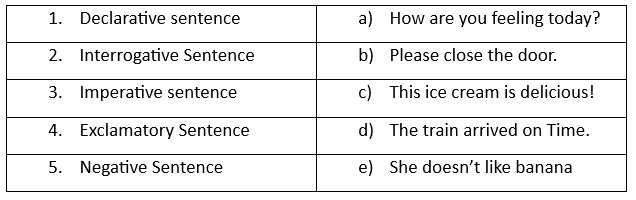
1. d
2. a
3. b
4. c
5. e
Q.7. Fill in the blanks with the appropriate type of sentence: (1 mark each, 5 marks total)
(i) "Where did you put my book?" - _________ sentence
Interrogative
(ii) "It's raining heavily outside." - _________ sentence
Declarative
(iii) "Be quiet!" - _________ sentence
Imperative
(iv) "I can't believe we didn't win the game!" - __________ sentence
Negative
(V) "She is going to the market." - __________ sentence
Affirmative
Q.8. State whether the following statements are True or False: (1 mark each, 5 marks total)
(i) An interrogative sentence always ends with an exclamation mark.
False
(ii) A declarative sentence makes a statement or expresses an opinion.
True
(iii) An exclamatory sentence gives a command or makes a request.
False
(iv) A sentence must have a subject and a predicate to be complete.
True
(v) A phrase can stand alone and express a complete thought.
False
FAQs on Worksheet Solutions: The Sentence
| 1. What are the main parts of a sentence that I need to identify in Class 6? |  |
| 2. How do I tell the difference between a phrase and a clause in sentence construction? | |
| 3. What makes a sentence complete versus a sentence fragment, and how do I avoid fragments? | |
| 4. Can you explain the difference between simple, compound, and complex sentences in easy terms? | |
| 5. Why do I keep making mistakes with sentence construction, and what should I check when solving worksheet problems? | |