Active and Passive Voice - 1 Class 6 Worksheet English Grammar

Instructions
- Attempt all questions.
- Word limit for Short Questions: 30-40 words.
- Marking scheme: MCQs- 1 mark each, Short Questions- 2 marks each, Fill in the blanks- 1 mark each, Match the column- 1 mark each, True False- 1 mark each.
Section - A
Q.1. Choose the correct option to complete the sentences: (5 marks)
(i) In the sentence "The cat chased the mouse", the verb is in _______ voice.
(a) Active
(b) Passive
Correct Answer is Option (a)
(ii) In the sentence "The letter was written by Sarah", the verb is in _______ voice.
a) Active
b) Passive
Correct Answer is Option (b)
(iii) Which of the following sentences is in passive voice?
(a) The dog chased the cat.
(b) The cat was chased by the dog.
Correct Answer is Option (b)
(iv) To change an active voice sentence to passive voice, the object becomes the _______.
a) Subject
b) Verb
Correct Answer is Option (a)
(v) In the passive voice, the action is performed _______ the subject.
(a) By
(b) On
Correct Answer is Option (a)
Section - B
Q.2. Short Questions (10 marks)
(i) What is the difference between active and passive voice?
In active voice, the subject performs the action of the verb, while in passive voice, the subject is acted upon by the verb.
(ii) Rewrite the following sentence in the passive voice: "Sheila is painting the house."
The house is being painted by Sheila.
(iii) Rewrite the following sentence in the active voice: "The cake was baked by John."
John baked the cake.
(iv) Explain how to change a sentence from active voice to passive voice.
To change a sentence from active voice to passive voice, make the object of the active voice sentence the subject of the passive voice sentence, and use the appropriate form of the verb "to be" followed by the past participle of the main verb.
(v) Explain how to change a sentence from passive voice to active voice.
To change a sentence from passive voice to active voice, make the subject of the passive voice sentence the object of the active voice sentence, and use the main verb in its appropriate tense.
Section - C
Q.3. Complete the sentences with the correct form of the verb in brackets: (5 marks)
(i) The book _______ (write) by the famous author.
The book was written by the famous author.
(ii) The window _______ (break) by the children.
The window was broken by the children.
(iii) The dog _______ (feed) by its owner.
The dog was fed by its owner.
(iv) The car _______ (wash) by John.
The car was washed by John.
(v) The cake _______ (eat) by the children.
The cake was eaten by the children.
Section - D
Q.4. Match the sentences in column A with their corresponding passive voice sentences in column B: (5 marks)
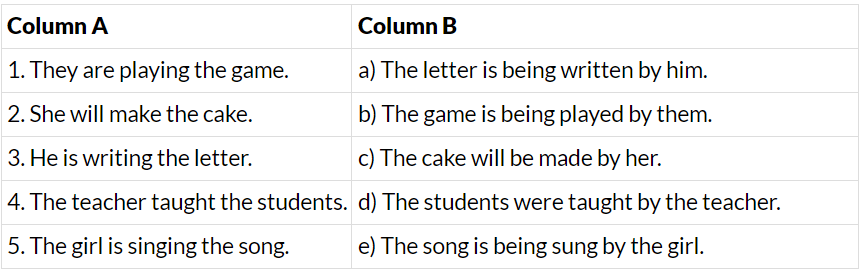
1 - b) The game is being played by them.
2 - c) The cake will be made by her.
3 - a) The letter is being written by him.
4 - d) The students were taught by the teacher.
5 - e) The song is being sung by the girl.
Section - E
Q.5. State whether the following statements are True or False:
(i) In active voice, the subject performs the action.
True
(ii) In passive voice, the object performs the action.
False
(iii) The passive voice is used when the focus is on the action being done.
True
(iv) The active voice is used when the focus is on the doer of the action.
True
(v) Passive voice sentences always have a "by" phrase.
False
|
49 videos|333 docs|46 tests
|




Free
,Viva Questions
,ppt
,Previous Year Questions with Solutions
,Objective type Questions
,MCQs
,Active and Passive Voice - 1 Class 6 Worksheet English Grammar
,practice quizzes
,Active and Passive Voice - 1 Class 6 Worksheet English Grammar
,Sample Paper
,Extra Questions
,shortcuts and tricks
,mock tests for examination
,Semester Notes
,past year papers
,Summary
,Active and Passive Voice - 1 Class 6 Worksheet English Grammar
,Exam
,study material
,video lectures
,Important questions
;



Worksheet Solutions: Active & Passive Voice - 1 Free PDF Download
Importance of Worksheet Solutions: Active & Passive Voice - 1
Worksheet Solutions: Active & Passive Voice - 1 Notes
Worksheet Solutions: Active & Passive Voice - 1 Class 6 Questions
Study Worksheet Solutions: Active & Passive Voice - 1 on the App
|
© EduRev
|
Education Revolution
|


|




