Tenses Class 6 Worksheet English Grammar

Section - A
Q.1. Choose the correct option for each of the following questions: Total 5 marks
(i) Which of the following tenses is used for actions that are happening now?
(a) Present Continuous
(b) Past Continuous
(c) Future Continuous
(d) Present Perfect
Correct Answer is Option (a)
(ii) Which tense is used for actions that happened at a specific time in the past?
(a) Present Perfect
(b) Past Simple
(c) Future Simple
(d) Past Continuous
Correct Answer is Option (b)
(iii) Which tense is used to talk about actions that will happen in the future?
(a) Past Simple
(b) Present Continuous
(c) Future Simple
(d) Present Perfect
Correct Answer is Option (c)
(iv) Which tense is used for actions that started in the past and continue to the present?
(a) Present Perfect
(b) Past Continuous
(c) Present Continuous
(d) Past Perfect
Correct Answer is Option (a)
(v) Which tense is used for actions that were in progress in the past when another action occurred?
(a) Past Continuous
(b) Present Perfect
(c) Future Simple
(d) Past Perfect
Correct Answer is Option (a)
Section - B
Q.2. Answer the following questions in 30-40 words: (Total 10 marks)
(i) What is the difference between the Present Simple and Present Continuous tenses? Give an example of each.
Present Simple tense is used for habitual actions, general truths, and facts. Present Continuous tense is used for actions happening now or around now. Example: Present Simple - She drinks coffee. Present Continuous - She is drinking coffee.
(ii) Explain the difference between the Past Simple and Past Perfect tenses with an example.
Past Simple tense is used for actions that happened at a specific time in the past. Past Perfect tense is used for actions that were completed before another action in the past. Example: Past Simple - She went to the store. Past Perfect - She had gone to the store before it started raining.
(iii) How do you form the Future Simple tense? Give an example.
We form the Future Simple tense by using "will" or "shall" + the base form of the verb. Example: I will visit my grandparents next week.
(iv) When do we use the Present Perfect tense? Give an example.
We use the Present Perfect tense for actions that started in the past and continue to the present or have a connection to the present. Example: She has lived in New York for ten years.
(v) What is the difference between the Past Continuous and Past Perfect Continuous tenses? Give an example of each.
Past Continuous tense is used for actions that were in progress in the past when another action occurred. Past Perfect Continuous tense is used for actions that were in progress before another action occurred in the past. Example: Past Continuous - She was studying when he called. Past Perfect Continuous - She had been studying for two hours before he called.
Section - C
Q.3. Complete the sentences by filling in the blanks with the appropriate tense: Total 5 marks
(i) She _______ (study) for the exam right now.
is studying
(ii) They _______ (go) to the beach last weekend.
went
(iii) I _______ (finish) my homework by tomorrow.
will finish
(iv) We _______ (live) in this house for five years.
have lived
(v) It _______ (rain) when I left the house.
was raining
Section - D
Q.4. Match the sentences in Column A with the correct tense in Column B: Total 5 marks
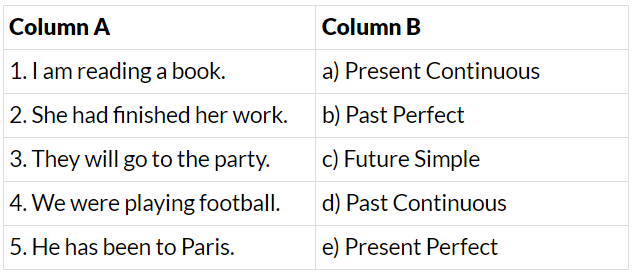
1. a
2. b
3. c
4. d
5. e
Section - E
Q.5. State whether the following statements are true or false: (Total 5 marks)
(i) The Present Simple tense is used for habitual actions.
True
(ii) The Past Perfect tense is used for actions that started in the past and continue to the present.
False
(iii) The Future Continuous tense is used for actions that will be in progress at a specific time in the future.
True
(iv) The Present Perfect tense is used for actions that happened at a specific time in the past.
False
(v) The Past Continuous tense is used for actions that were in progress in the past when another action occurred.
True
Section - F
Q.6. Fill in the correct form of the verb given.
(i) When we finally _________ at the camp it _________ heavily. (ARRIVE, RAIN)
When we finally arrived at the camp it was raining heavily.
(ii) I can't reach my manager. He _________ in North America at the moment. (TRAVEL)
I can't reach my manager. He is travelling in North America at the moment.
(iii) I _________ your uncle for ages. I don't know where he _________ right now. (NOT SEE, BE)
I haven't seen your uncle for ages. I don't know where he is right now.
(iv) I _________ this school for the last two years. Before that I _________ to Jackson High School for a year. (ATTEND, GO)
I have been attending this school for the last two years. Before that I went to Jackson High School for a year.
(v) I _________ at the door for ages. Where _________? (KNOCK,YOU BE)
I have been knocking at the door for ages. Where have you been?
(vi) I'd like to introduce my new girlfriend. She _________ from Australia. (COME)
I'd like to introduce my new girlfriend. She comes from Australia.
(vii) It was a wonderful morning and the sun _________ brightly when I_________ up. (SHINE, GET)
It was a wonderful morning and the sun was shining brightly when I got up.
(viii) The president _________ to Virginia for a campaign speech next Sunday.(COME)
The president is coming to Virginia for a campaign speech next Sunday.
(ix) He _________ his first championship in 2012. Since then he _________ everything and _________ only once. (WIN, WIN, LOSE)
He won his first championship in 2012. Since then he has won everything and has lost only once.
(x) Dad _________ a walk with the dog every afternoon. (TAKE)
Dad takes a walk with the dog every afternoon.
(xi) I _________ to the meeting yesterday because I _________ about it. (NOT GO, NOT INFORM)
I didn't go to the meeting yesterday because I had not been informed about it.
(xii) The family usually _________ breakfast together during the week, but on weekends everyone _________ breakfast on their own.
The family usually have breakfast together during the week, but on weekends everyone has breakfast on their own.
(xiii) What _________ when the headmaster _________ the room yesterday afternoon?
What were you doing when the headmaster entered the room yesterday afternoon? (YOU
(xiv) He _________ noise for a whole hour before the neighbours finally _________ the police.
He had been making noise for a whole hour before the neighbours finally called the police.
(xv) She _________ well yesterday, probably because she _________ too much. (NOT FEEL, EAT)
She didn't feel well yesterday, probably because she had eaten too much.
(xvi) They _________ this church in the 19th century and since then it _________ renovated.
They built this church in the 19th century and since then it has never been renovated.
|
49 videos|349 docs|46 tests
|




study material
,Objective type Questions
,Important questions
,shortcuts and tricks
,ppt
,Free
,Tenses Class 6 Worksheet English Grammar
,Viva Questions
,Summary
,video lectures
,Extra Questions
,MCQs
,Tenses Class 6 Worksheet English Grammar
,Semester Notes
,Sample Paper
,mock tests for examination
,Tenses Class 6 Worksheet English Grammar
,Previous Year Questions with Solutions
,practice quizzes
,Exam
,past year papers
;




Worksheet Solutions: Tenses Free PDF Download
Importance of Worksheet Solutions: Tenses
Worksheet Solutions: Tenses Notes
Worksheet Solutions: Tenses Class 6 Questions
Study Worksheet Solutions: Tenses on the App
|
© EduRev
|
Education Revolution
|


|




