Mensuration Class 6 Worksheet Maths Chapter 9
| Table of contents |

|
| Fill in the Blanks |
|
| True or False |
|
| Crossword |
|
| Answer the following Questions |
|

Fill in the Blanks
Q1: The length of the boundary of a plane figure is called_____
Q2: Perimeter of rectangle = ____?
Q3: Perimeter of square = ___?
Q4: Area of rectangle =(a)_______×(b)______square units.
Q5: Area of square =(a)_______×(b)______square units.
True or False
Q6: The area of a triangle can be found using the formula Area 
Q7: In an equilateral triangle, the perimeter is calculated by multiplying the side length by 4.
Q8: To determine the amount of material needed to cover a square-shaped frame, Rohan needs to calculate the area of the frame.
Crossword
Q9: Complete the crossword:
Across →
(1) Perimeter (in cm) of an equilateral triangle of side 220 cm.
(3) Perimeter (in cm) of a regular hexagon of side 84 cm.
(5) 4 m 25 cm = ________ cm.
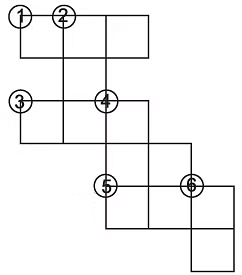
Down ↓
(2) Perimeter (in cm) of a regular pentagon of side 120 cm.
(4) Number of unit squares (sq. cm.) enclosed in a square of side 22 cm.
(6) Distance covered along a triangular park (in 1 round) measuring 12 m, 20 m, and 23 m. (distance in m)
Answer the following Questions
Q10: Which of the following figures has a greater perimeter?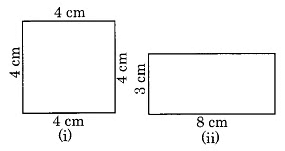
Q11: Find the total distance covered by an athlete in taking 2 rounds of a rectangular park of length 150 m and breadth 80 m.
Q12: A tailor wants to put lace around a square tablecloth with a side of 20 cm. He bought 1 m of lace from the market. Find the length of lace left with him after completing the task.
Q13: The length of a rectangular park is 50 m, and its area is 650 m2. Find its breadth.
Q14: Find the number of square tiles required to cover the floor of a room whose length is 4 m and width is 3 m if each square tile is of side 0.2 m.
Q15: Two equal sides of an isosceles triangle measure 10 cm each. Find the length of its third side if its perimeter is 32 cm.
Q16: A piece of string is 60 cm long. What will be the length of each side if the string is used to form :
(a) a square
(b) an equilateral triangle
(c) a regular pentagon
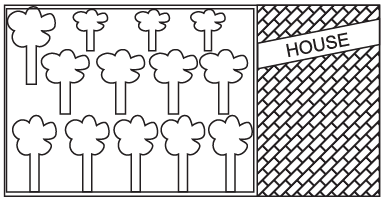
Q17: A farmer's rectangular garden is adjacent to his house (as shown in the figure).
The rectangular garden is 200 m long and 150 m wide. Find the cost of fencing three sides of this garden at the rate of 12 per meter.
Q18: Find the perimeter of each of the following figures : (The measures are given in cm)
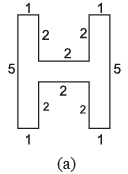
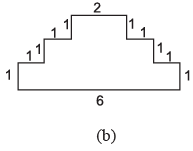
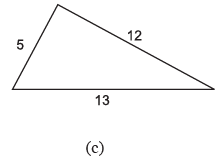
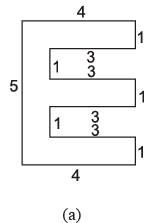
Q19: Find the area of each of the following figures : (The measures area given in cm)
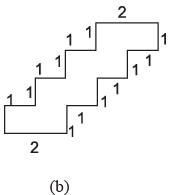
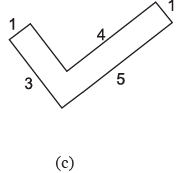
Q20: Fencing the compound of a house costs ₹5452. If the rate is ₹94 per meter, find the perimeter of the compound. If the breadth is 10 m, find its length.
You can access the solutions to this worksheet here.
FAQs on Mensuration Class 6 Worksheet Maths Chapter 9
| 1. What is mensuration and why is it important in mathematics? |  |
| 2. How do you calculate the area of a rectangle? | |
| 3. What is the formula for the volume of a cylinder? | |
| 4. How can I find the surface area of a sphere? | |
| 5. What is the difference between area and perimeter? | |




shortcuts and tricks
,Semester Notes
,Summary
,practice quizzes
,Previous Year Questions with Solutions
,Mensuration Class 6 Worksheet Maths Chapter 9
,Mensuration Class 6 Worksheet Maths Chapter 9
,past year papers
,Objective type Questions
,Sample Paper
,Extra Questions
,video lectures
,ppt
,Important questions
,Mensuration Class 6 Worksheet Maths Chapter 9
,MCQs
,study material
,Free
,Viva Questions
,mock tests for examination
,Exam
;




Worksheet: Mensuration Free PDF Download
Importance of Worksheet: Mensuration
Worksheet: Mensuration Notes
Worksheet: Mensuration Class 6 Questions
Study Worksheet: Mensuration on the App
|
© EduRev
|
Education Revolution
|


|




