Decision Making & Problem Solving | CSAT Preparation - UPSC PDF Download


CSAT Angle: The UPSC Civil Services Aptitude Test (CSAT) Paper 2 includes decision-making and problem-solving questions to assess candidates’ aptitude for administrative roles. From 2022 to 2025, CSAT Paper 2 has featured approximately 4–6 questions focused on decision-making and problem-solving.
Introduction
- Decision making is the skill of choosing the best course of action among various options to solve a specific problem. It involves considering different viewpoints and maintaining objectivity.
- The process of decision making assesses your critical thinking abilities through discussion and debate, and it is an ongoing process and linked to social interactions.

What is Decision Making?
Decision making is the cognitive process of carefully choosing a rational option among several alternatives, taking into consideration the advantages and disadvantages of each. It serves as a comprehensive test of an individual's ability to respond to a given situation. To make effective decisions, one must be capable of anticipating the outcomes of each available choice and then selecting the one that is most suitable for the given circumstances. Put simply, decision making can be defined as the firm process of mentally resolving or addressing a problematic situation.
Types of Decisions
Decisions can be classified into three types:
- 'Whether' Decision: This type of decision involves choosing between only two options, either "Yes or No." These decisions are made by carefully considering the reasons, advantages, and disadvantages associated with the situation. For example, deciding whether to purchase a piece of land or whether to appear for the IAS Exam this year.
- 'Which' Decision: This refers to selecting one option from multiple alternatives. The choice is typically made by evaluating how well each alternative aligns with a predefined set of criteria. For example, when choosing a subject for the Civil Services Main Examination from a list of options, the decision revolves around selecting 'which' subject to pursue.
- 'Contingent' Decision: This type of decision is made but postponed until certain conditions are met. These decisions are typically based on 'if' statements, where you choose to take a particular action only if specific criteria are satisfied. For instance, you may decide to appear in the Civil Services Prelims this year, but only if you manage to complete your syllabus by that time. Similarly, you may consider purchasing a book, but only if you have sufficient funds available.
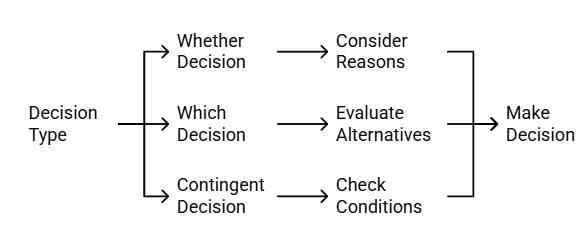
Decision making can be categorised into following three groups:
- Rational decision-making involves following logical and systematic models that focus on generating numerous potential options and then determining the best one. Often, the pros and cons of each option are assessed and ranked based on their significance.
- Intuitive decision-making, on the other hand, does not rely on reason or logic. Instead, it involves relying on inner knowledge, intuition, or a sense of what feels right. The decision-making process may lack a clear explanation or justification.
- Combination decision-making occurs when decisions are influenced by a combination of natural (rational) and intuitive processes. This can happen intentionally when a person consciously combines elements of both approaches, or it can happen unintentionally, where the decision-making process naturally incorporates elements of both rationality and intuition.
Case Study: Sohan's Decision-Making Process
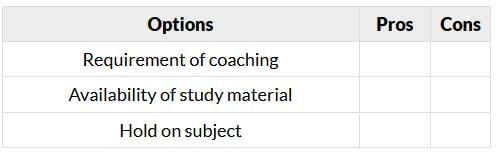
Sohan aspires to become an IAS officer. To pursue this goal, he began researching the process of entering the Civil Services. Upon reviewing the syllabus, he discovered that selecting an optional subject for the Civil Services Main Examination is a crucial step.
Now, Sohan is faced with the challenge of choosing the right optional subject. He considers the following options:
(a) Choosing a subject he studied during graduation
(b) Opting for a popular subject like Public Administration or Sociology
(c) Selecting a subject based on the easy availability of study material
(d) Choosing a subject offered by well-known coaching institutions
(e) Picking a subject with a relatively smaller syllabus
(f) Selecting a subject that overlaps with the General Studies syllabusTo make a rational and well-informed decision, Sohan decides to evaluate each option based on several personal criteria such as financial capacity, place of residence, educational background, etc. For each option, he assigns weightage to the following factors on a scale of 1 to 10:
After weighing the pros and cons of each alternative, Sohan calculates the net weightage. He then compares all the options and eliminates the ones with lower scores. The option with the highest overall weightage becomes his final choice.
This is an example of a rational decision-making process.
Steps of Decision Making Process
 Decision Making Process
The decision making process involves the following steps:
- Step 1: Identify the Problem: Carefully review the provided case study to gain a clear understanding of the problem that requires resolution. Consider all aspects of the problem, even those not explicitly mentioned in the case study. Your knowledge and judgment will help identify various dimensions of the problem.
- Step 2: Identify Multiple Alternatives: Recognize that not every problem can be solved using a single approach; it may require different courses of action. Considering the complexity of the world today, analyzing numerous variables is essential. Therefore, ensure to explore and consider every possible alternative that comes to mind.
- Step 3: Analyze Each Alternative: Establish criteria to evaluate the alternatives. Once the criteria are set, assess the pros and cons of each alternative systematically. Analyze the implications of each option based on your selection criteria and determine which alternative effectively solves the problem identified in step 1.
- Step 4: Remove Unsuitable Alternatives: After analyzing each alternative, eliminate those options that do not meet your criteria or have negative consequences. This process helps narrow down the choices to two or three alternatives.
- Step 5: Make the Decision: Rank the remaining alternatives in order of preference based on the desired outcome. Strive for a rational approach that balances humanitarian and logical aspects when prioritizing the various alternatives. Finally, choose the best option and make the final decision.
Decision Making Skills
Decision-making skills are essential for administrators, especially those in high-ranking positions within the administrative structure. As they advance up the hierarchy, their responsibilities and the complexity of their decisions increase.
To make effective decision making, the three basic skills required are as under:
1. Technical skills
- Technical skills refer to an administrator's knowledge and expertise in the specific processes or techniques required for the work carried out by their team. These skills involve the effective use of resources in a particular field.
- For instance, a surgeon must possess surgical expertise, an accountant should know how to manage accounts, a programmer needs coding skills, and a teacher should be knowledgeable about teaching methods.
2. Interpersonal skills
- Interpersonal skills involve the ability to persuade others and make decisions that consider ethical considerations and the well-being of the community.
- Qualities such as honesty, integrity, courage, and patience are essential for effective decision-making in this regard.
3. Conceptual skills
- Conceptual skills encompass the ability to take a broad and forward-thinking perspective. This includes understanding the interconnectedness of people, businesses, industries, communities, and the broader political, social, and economic factors.
- These skills help individuals grasp their environment, the organization, and their own role within it, enabling them to make sound decisions for the organization, society, themselves, and their team. Conceptual skills typically develop over time through experience.
Case Study: Environmental Responsibility at ChemCorp
Ms. Priya Sharma is a senior manager at ChemCorp, a leading chemical manufacturing company. She receives an urgent report that the effluent treatment plant (ETP) is malfunctioning, causing a significant amount of untreated wastewater to mix with the local municipal drainage system. This poses a risk of environmental contamination and public health hazards. Ms. Sharma must decide on the best course of action to address the situation promptly.Options
Ms. Sharma can choose one of the following options:
(a) Ignore the issue, as it does not directly affect the plant's operations.
(b) Escalate the matter to the CEO and step back from decision-making.
(c) Temporarily halt plant operations to repair the effluent treatment plant.
(d) Notify the municipal authorities and request them to handle the treatment of the discharged wastewater.
Correct Decision
The most appropriate decision is (c). Temporarily halting plant operations to repair the effluent treatment plant is essential to prevent further environmental damage and protect public health. Ignoring the issue (option a) risks contaminating water sources and spreading diseases, which could lead to legal and reputational consequences. Stepping back from responsibility (option b) is not suitable, as Ms. Sharma is expected to take proactive measures as a senior manager. Requesting the municipality to treat the wastewater (option d) shifts responsibility and may not address the issue effectively or promptly. By choosing option (c), Ms. Sharma demonstrates conceptual and leadership skills, prioritizing environmental responsibility and public safety
Qualities of a Good Decision Maker
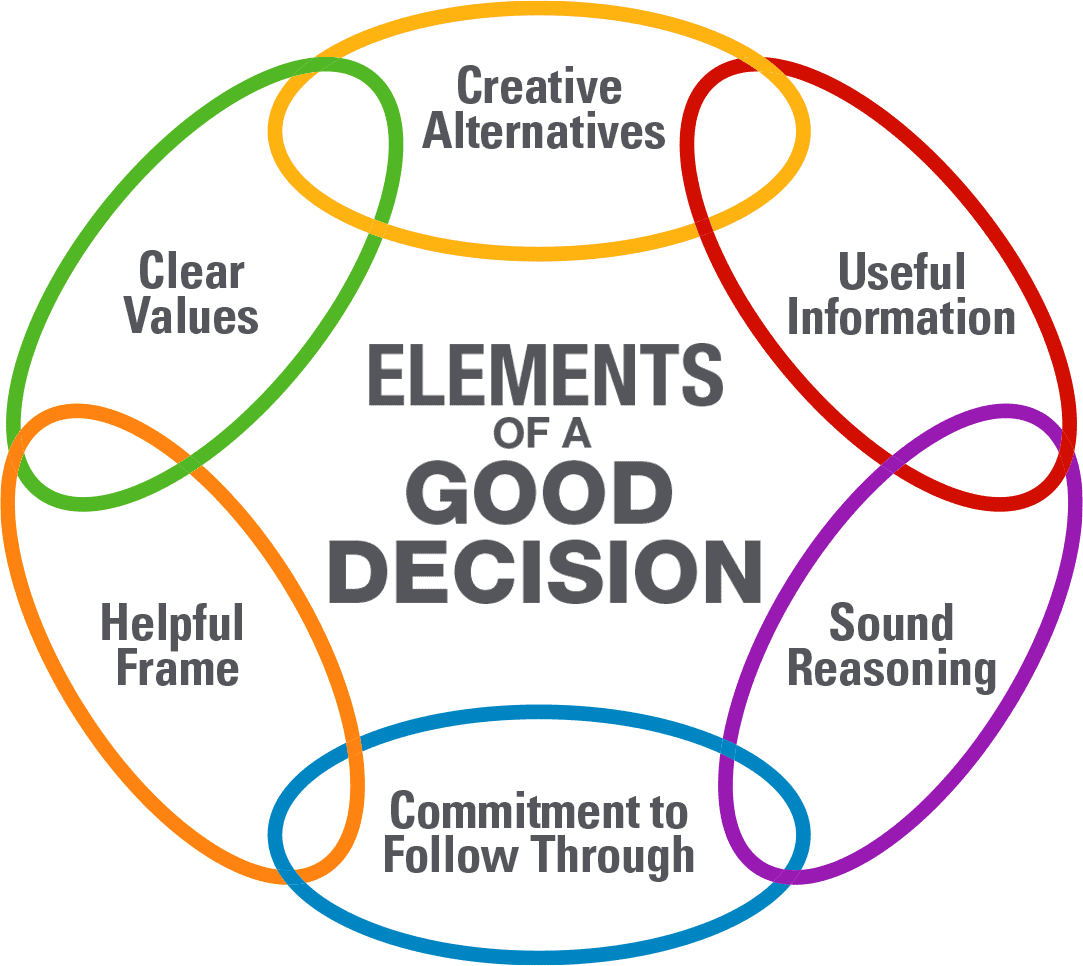
- Ethical and impartial: It is crucial for a decision maker, especially when acting alone, to possess strong moral values and approach decisions without any biases or prejudices. This is particularly important in decision-making styles such as command and convenience.
- Clarity in thinking: Individuals involved in decision making should have strong analytical, logical, and reasoning abilities. These skills are vital when dealing with complex alternatives and when qualitative outcomes are required. Lack of clarity in thinking, especially in strategic decision making, can lead to significant long-term costs for an organization.
- Optimal utilization of data: Finding the right balance in information is key to effective decision making. Decision makers should be able to sift through available information, identify its relevance to the decision at hand, and proceed accordingly.
- Practicality: Decision makers should strive to make decisions that are practical and have a positive impact on the organization. Approaching decision making from an ivory tower perspective is unwarranted and does not contribute to the progress of the organization.
- Vision: Good decision makers should possess a strong sense of vision, allowing them to anticipate the future impact of their decisions on the organization and society as a whole. Decisions that solely prioritize the organization's bottom line at the expense of the community and society demonstrate a narrow mindset and lack of vision.
- Sustainability: Decision making should take into account the balance between organizational impact and societal well-being. Decisions that benefit the organization but harm society are examples of unsustainable decision making. Making assumptions that the public, customers, or suppliers are ignorant also reflects unsustainable decision making.
- Timeliness: Timely decision making is crucial and one of the most important factors for a good decision maker. All decisions are constrained by time, which adds to the difficulty of decision making. A competent decision maker should allocate sufficient time to arrive at well-informed decisions.
- Prioritization: A skilled decision maker understands the importance of prioritizing decisions based on strategic, tactical, and operational aspects. Strategic decisions should receive the highest allocation of time, resources, and energy, given their significance.
Personality Variations in Decision Making
Research has indicated that individuals have distinct orientations towards decision making, resulting in meaningful differences among them. Some individuals prioritize achieving success at any cost, while others are more concerned about the impact of their decisions on others. Some individuals lean towards a logical and analytical approach, while others rely more on intuition.
Based on these different approaches, decision making can be categorized into four styles:
- Directive style: This style is preferred by individuals who seek clear and straightforward solutions. They rely on existing rules and use their status or position to achieve desired outcomes.
- Analytical style: Individuals with extensive knowledge adopt this style. They carefully analyze decisions using as much information as possible, often engaging in brainstorming processes.
- Conceptual style: Individuals who are more socially-oriented and have a humanistic approach follow this style. They have a strong future orientation, initiating new ideas and focusing on the broader impact of decisions.
- Behavioral style: This style is embraced by individuals who deeply care about the organizations they work for and the personal development of their colleagues.
Case Study (UPSC CSAT PYQ): As a Civil Services Aspirant, it is important to be adaptable and utilize different decision-making styles based on the situation. Flexibility is a key requirement in decision making, as it allows you to shift between styles. While each aspirant may have their own unique personality and interpersonal skills influencing their decision-making approach, being open to adapting and transitioning between styles is crucial.
As the head of your office, you have the authority to allot reserved houses to office staff based on a set of publicly disclosed rules. Your personal secretary, who is very close to you, requests priority in house allotment due to his father's serious illness. However, the office secretariat, after reviewing the request per the established rules, rejects it and recommends adhering to the standard procedure. You wish to avoid upsetting your personal secretary. In such circumstances, what should you do?
Options
(a) Invite the secretary to your office and personally explain why the allotment cannot be made.
(b) Allot the house to the secretary to secure his loyalty.
(c) Agree with the office secretariat's recommendation to demonstrate impartiality and avoid favoritism.
(d) Hold onto the file without issuing any orders.Correct Decision
The best course of action is (a). Inviting the secretary to your office and explaining why the allotment cannot be made upholds the established rules while addressing the secretary's concerns in a respectful and transparent manner. This approach maintains fairness, adheres to the law, and minimizes the risk of annoying the secretary, achieving both objectives of the scenario.
The Key Attributes of Decision Making
A decision is always made within a specific decision environment, which comprises the available information, options, values, and preferences at that particular time. Ideally, this environment would include all relevant and accurate data along with every possible choice. However, due to limitations in time and effort, the amount of information and options considered is restricted.
- Time constraints necessitate that decisions be made within a certain timeframe.
- Effort constraints refer to the limits on resources such as manpower, finances, and priorities.
Making decisions within this constrained environment introduces a level of uncertainty, and the purpose of decision analysis is to reduce this uncertainty. Typically, it is not feasible to have complete information for making a decision with absolute certainty, which means that decisions often involve some degree of risk.
Delaying a decision as long as reasonably possible offers several benefits:
- First, the decision environment expands, providing more information.
- Second, there is additional time for thoughtful and thorough analysis.
- Third, new alternatives may arise or be created. Lastly, the decision maker's preferences may evolve with further reflection, wisdom, and maturity, leading to a different decision.
However, delaying a decision also carries risks.
- First, the decision maker may become overwhelmed with excessive information, leading to either a suboptimal decision or decision paralysis.
- Second, in a competitive environment, a faster competitor may make the decision and gain an advantage. For instance, another company may bring a similar product to market sooner because they didn't delay the decision, or an opposing army might seize a strategic pass while the other army was "letting the decision environment grow."
Approaches to Decision Making
There are two primary approaches to decision making within an organization: the authoritarian method and the group method.
- Authoritarian: In this approach, a manager or executive figure takes on the responsibility of making a decision based on their gathered knowledge. After making the decision, the manager must then communicate and explain it to the group, seeking their acceptance and buy-in.
- Group: In the group approach, the decision-making process involves active participation from the group members. They share their ideas, engage in analysis and discussion, and collectively agree upon a decision to be implemented. Research indicates that the group often holds values, feelings, and reactions that may differ from what the manager assumes. The group itself possesses the deepest understanding of its own tastes and preferences.
In summary, decision making within an organization can either be driven by an authoritative figure or involve active participation and consensus-building within the group. Each approach has its own strengths and considerations.
Decision Making Strategies
As we are aware, there are often multiple solutions available for a given problem, and it is the task of the decision maker to select one of them. The complexity of the decision-making task can vary based on the importance of the decision, and the number and quality of alternatives can be adjusted considering factors such as time, resources, and importance.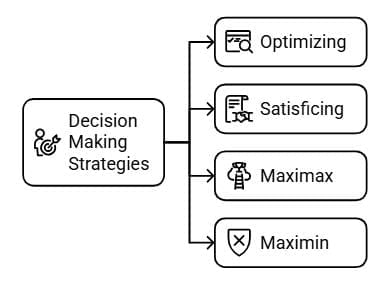
There are several strategies employed for decision making, including the following:
- Optimizing: This strategy involves seeking the best possible solution by exploring numerous alternatives and selecting the very best one. The extent to which optimization can be pursued depends on factors such as the problem's importance, available time, cost implications, resource availability, knowledge, and personal psychology or values. However, complete information and consideration of all alternatives are seldom feasible for major decisions, necessitating limitations on alternatives.
- Satisficing: In this strategy, the decision maker chooses the first satisfactory alternative instead of the absolute best. For example, if one is very hungry, they might opt for the first decent-looking restaurant in the next town rather than spending time to identify the best restaurant (as in the optimizing strategy). The term "satisficing" combines "satisfactory" and "sufficient." This strategy is commonly used for small decisions like parking, beverage choices, pen selection, or picking a tie.
- Maximax: This strategy involves evaluating and selecting alternatives based on their maximum potential payoff. It is often associated with optimistic thinking, as it focuses on favorable outcomes and high potentials. The maximax strategy is suitable when risk-taking is more acceptable.
- Maximin: In contrast to maximax, maximin strategy (associated with pessimistic thinking) considers the worst possible outcome for each decision and selects the option with the least potential loss. Maximin orientation is useful when the consequences of a failed decision are particularly harmful or undesirable. It emphasizes the salvage value or the guaranteed return of a decision, reflecting the notion that "a bird in the hand is worth two in the bush."
Quiz shows like KBC take advantage of the uncertainty people experience when deciding between maximax and maximin strategies. For instance, contestants are presented with the choice to either take their winnings and leave or risk losing it all for a chance at a larger prize. Quitting the game represents a maximin decision, while continuing to play reflects a maximax decision-making strategy.
Problem Solving
- Problem-solving is a cognitive process that involves complex intellectual functions. Effective problem-solving skills encompass the ability to develop creative and innovative solutions, practical problem-solving approaches, independence and initiative in problem identification and resolution, as well as the capacity to make choices.
- To understand problem-solving, it is essential to first recognize and identify a problem. A problem can be defined as a challenging state that hinders the achievement of desired goals, objectives, or purposes. Problems are encountered by individuals in their daily lives, ranging from simple issues that require minimal brainstorming to highly complex and severe challenges.
- Efficient and timely problem-solving is a valuable aspect of an impressive personality. It involves thorough planning, effective execution, and the ability to make sound judgments. It has been observed that the lack of problem-solving skills can lead to the failure of relationships and businesses. Therefore, developing strong problem-solving abilities is crucial for success in various aspects of life.
Types of Problems
Based on the features and nature, problems are classified into four types which are as follows:
- Question-Based Problems: Problems that involve a question requiring an answer can be categorized as question-based problems. These problems provide clear data and facts that aid in making a correct decision. However, they often entail questions such as "who," "why," and "how," which require deeper insight to minimize confusion and arrive at the right decision.
- Situation-Based Problems: This type of problem presents a situation where you find yourself in a dilemma, torn between two options or conflicting factors.
- Convincing-Based Problems: These problems involve a situation where you need to persuade or convince others. You possess certain information that others, whom you need to persuade, may lack.
- Solving-Based Problems: As the name implies, these problems require finding a solution. The solution can be short-term or long-term in nature. If the solution is short-term, there may be a possibility of the problem recurring. On the other hand, if there is no long-term solution, efforts can be made to minimize the problem.
Risk Management Strategies in Decision Making and Problem-Solving
In order of precedence, the strategies are:
- Disregard highly unlikely possibilities: When assessing risks and making decisions, it is important to ignore scenarios that are very unlikely or unrealistic. For instance, when deciding whether to go to the store, risks like dying on the way or being shot by robbers should not typically be factored into the risk evaluation because they are highly improbable. While life inherently involves risk, it is essential to consider the likelihood of such events.
- Avoid catastrophic outcomes: If there is a small but significant chance of a catastrophic event, standard expected value calculations may not apply. Risk management principles emphasize the avoidance of real catastrophic risks at a reasonable cost. However, determining what constitutes a real risk and a reasonable cost can be challenging due to uncertainties.
- Recognize trade-offs: Every action in life carries some level of risk. Even when we do not actively take on risks, they are often imposed on us by the nature of life and society. For example, eating involves the risk of food poisoning or choking, but it is a necessity for survival. Socializing carries the risk of disease, driving or flying carries the risk of accidents, but these activities are integral parts of life. While certain risks, such as smoking or consuming unhealthy foods, can be avoided, it is important not to deny the inherent risks of living and not excessively worry about the consequences of modern life.
- Maximize expected values: Generally, the expected value of each alternative indicates its relative desirability, favoring the option with the highest probability of the greatest benefit. However, it is crucial to acknowledge that these calculations rely on subjective probabilities and rewards. There is no legal requirement to choose any specific alternative. If the alternative with the highest expected value is considered unsatisfactory, it is necessary to reassess the assigned probabilities and rewards for all alternatives.
The income level in the area are low and 25% of the population is Below Poverty Line (BPL). When a decision has to be taken on pricing you would
Implications in Civil Services
- Critical Role in Democracy: Civil servants bear significant responsibility for serving a democratic society and addressing public needs.
- Anticipating Problems: Though unable to be present everywhere, civil servants must visualize and understand societal issues effectively.
- Formal and Discretionary Powers: Bureaucracy grants powers that must align with the state’s philosophy and be used for public welfare.
- Social Leadership: In a democracy, civil servants are expected to act as social leaders and agents of the government.
- Driving Change: They serve as a medium for implementing desirable societal changes through state authority.
- Setting an Example: Civil servants must model behavior that enhances their credibility and fosters public trust.
- Effective Decision-Making: Crucial for balancing state objectives with public aspirations, navigating complex issues, and ensuring impactful outcomes.
- Challenging Yet Vital Role: Civil servants must prepare for a demanding role that significantly influences society and fulfills public expectations.
UPSC CSAT PYQs for Decision-Making
1. Electricity Meter Installation Delay
Scenario: You applied for an electricity meter for your house, but after two months, it has not been installed. Upon enquiry, you find no issue with the application form; the clerk admits it was an oversight. How will you respond?
Options:
(a) Report to the head.
(b) File a written complaint.
(c) Ignore it, knowing how government offices work.
(d) Engage a tout to expedite the installation.
 View Answer
Correct Decision: (a) Reporting to the head is the most appropriate response. It addresses the oversight directly and professionally. If the head’s response is unsatisfactory, filing a written complaint (option b) can be considered as a follow-up action.
Analysis:
- Option (a): Directly addresses the issue through proper channels, ensuring accountability without escalating unnecessarily.
- Option (b): A written complaint is a valid step but may be premature without first engaging the head.
- Option (c): Ignoring the issue is passive and fails to resolve the problem.
- Option (d): Engaging a tout is unethical and undermines proper procedures.
2. Subordinate Officer’s Changed Behavior
Scenario: As a Police Commissioner, you notice a subordinate officer, previously well-mannered, now appears shabby and exhibits ill-mannered behavior, as reported by colleagues. You suspect an underlying issue and are concerned about his relationships with colleagues. How will you approach him?
Options:
(a) Meet him separately, discuss at length, and try to identify the cause of his problem.
(b) Call him to your chamber and warn him about his shabby appearance.
(c) Show sympathy and suggest he seek a transfer.
(d) Send him on leave to recover.
View Answer Correct Decision: (a) Meeting the officer separately to understand the cause of his behavior is the most appropriate approach, showing empathy and leadership.
Analysis:
- Option (a): Demonstrates a proactive, empathetic approach to address the root cause while maintaining professionalism.
- Option (b): Warning him is a negative approach that may worsen the situation without understanding the cause.
- Option (c): Suggesting a transfer is irresponsible and avoids addressing the issue.
- Option (d): Sending him on leave shows negligence and lacks coordination, failing to resolve the underlying problem.
3. Subordinate Attacked During Duty
Scenario: As a Senior Police Officer, your unarmed subordinate and a driver, sent on duty in a jeep, stop to assist a broken-down vehicle. They are attacked and looted by criminals. The subordinate is charged with negligence. What will you do?
Options:
(a) Suspend him for lack of common sense.
(b) Frame charges for stopping the jeep mid-way.
(c) Not hold him responsible for this accidental happening.
(d) Accuse him of not being precautious.
View Answer Correct Decision: (c) Not holding the subordinate responsible is appropriate, as the incident was an accident, not a deliberate mistake or negligence.
Analysis:
- Option (a): Suspension lacks empathy and is based on incomplete information.
- Option (b): Framing charges for stopping the jeep is unfair, as assisting was a reasonable action.
- Option (c): Acknowledges the incident as an unfortunate accident, showing fairness and empathy.
- Option (d): Accusing him of lack of precaution is unjust without evidence of deliberate negligence.
4. Gift from an Industrialist
Scenario: As a District Collector, you approve a subsidy for an industrialist as part of your duties. At a social gathering, the industrialist gifts you a costly diamond jewelry set. Shocked, what will you do?
Options:
(a) Sell the jewelry for cash.
(b) Ask your wife to deposit it in a bank locker.
(c) Keep it in a house locker.
(d) Return it to the industrialist.
View Answer Correct Decision: (d) Returning the jewelry to the industrialist is the only honest and ethical choice, maintaining integrity.
Analysis:
- Option (a): Selling the jewelry implies accepting a bribe, which is unethical and illegal.
- Option (b): Depositing it in a bank locker suggests intent to keep it, compromising honesty.
- Option (c): Keeping it in a house locker also indicates dishonesty.
- Option (d): Returning the gift upholds integrity and adherence to ethical standards.
5. Unfair Time Allocation in Presentation
Scenario: You are competing with a batchmate for a prestigious award based on a 10-minute oral presentation. The committee asks you to finish on time, but your friend is allowed extra time. What will you do?
Options:
(a) Lodge a complaint with the chairperson against the discrimination.
(b) Refuse to listen to the committee’s justification.
(c) Withdraw your name.
(d) Protest and leave the place.
View Answer Correct Decision: (a) Lodging a complaint with the chairperson is the best course of action to address the unfairness constructively.
Analysis:
- Option (a): Lodging a complaint is a professional way to seek fairness through proper channels.
- Option (b): Refusing justification is immature and denies the committee a chance to explain.
- Option (c): Withdrawing is an escapist approach, avoiding resolution.
- Option (d): Protesting and leaving is unprofessional and unlikely to yield results.
|
205 videos|264 docs|136 tests
|
FAQs on Decision Making & Problem Solving - CSAT Preparation - UPSC
| 1. What is the importance of decision-making skills in problem-solving? |  |
| 2. How can risk management strategies be applied in decision-making and problem-solving processes? | |
| 3. What are some common decision-making strategies that can be utilized in problem-solving situations? | |
| 4. How can individuals improve their decision-making skills and problem-solving abilities? | |
| 5. How do multiple-choice questions on decision-making and problem-solving help in assessing an individual's skills in these areas? | |




Previous Year Questions with Solutions
,Decision Making & Problem Solving | CSAT Preparation - UPSC
,past year papers
,Semester Notes
,video lectures
,ppt
,Free
,MCQs
,mock tests for examination
,study material
,Summary
,Sample Paper
,Decision Making & Problem Solving | CSAT Preparation - UPSC
,Extra Questions
,shortcuts and tricks
,practice quizzes
,Exam
,Objective type Questions
,Viva Questions
,Important questions
,Decision Making & Problem Solving | CSAT Preparation - UPSC
;



Decision Making & Problem Solving Free PDF Download
Importance of Decision Making & Problem Solving
Decision Making & Problem Solving Notes
Decision Making & Problem Solving UPSC Questions
Study Decision Making & Problem Solving on the App
|
© EduRev
|
Education Revolution
|


|




