NEET Exam  >  NEET Notes  >  Biology Class 11  >  Mnemonics: Structural Organisation in Animals

Mnemonics: Structural Organisation in Animals | Biology Class 11 - NEET PDF Download

Mnemonics are memory aids that help you recall complex biological information quickly during exams. This guide provides targeted mnemonics for Structural Organisation in Animals, covering Animal Tissues, Frog anatomy, and Cockroach anatomy. These memory tools will help you remember tissue types, their locations, functions, and anatomical features that are frequently tested. Master these mnemonics to recall facts instantly during your exam.

1. Animal Tissues - Classification Mnemonics

1. Animal Tissues - Classification Mnemonics

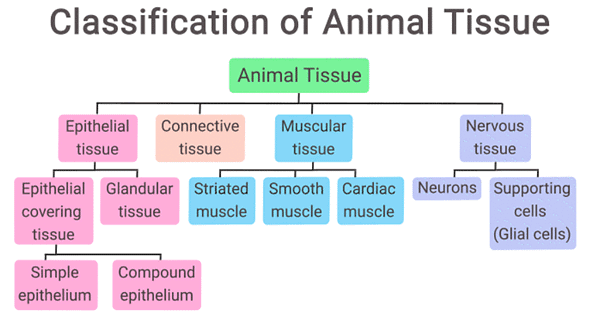
1.1 Four Types of Animal Tissues

Mnemonic: "Each Cow Needs Milk"

  • E = Epithelial tissue (covering and lining tissue)
  • C = Connective tissue (binding and supporting tissue)
  • N = Nervous tissue (coordination tissue)
  • M = Muscular tissue (movement tissue)

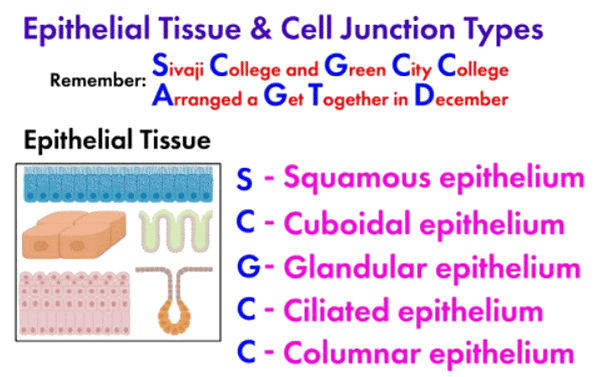
1.2 Types of Epithelial Tissue

Mnemonic: "Simple Snakes Can't Climb"

  • S = Squamous epithelium (flat, plate-like cells)
  • S = Stratified epithelium (multilayered)
  • C = Cuboidal epithelium (cube-shaped cells)
  • C = Columnar epithelium (tall, pillar-like cells)
  • C = Ciliated epithelium (with hair-like projections)

1.3 Simple Epithelium Locations

Mnemonic for Simple Squamous: "Air Bags Love Blood"

  • Air = Alveoli of lungs
  • Bags = Bowman's capsule
  • Love = Lining of blood vessels (endothelium)
  • Blood = Blood vessels

Mnemonic for Simple Cuboidal: "Kids Get Tubular Toys"

  • K = Kidney tubules
  • G = Glands (ducts)
  • T = Thyroid follicles
  • T = Tubular parts of nephron

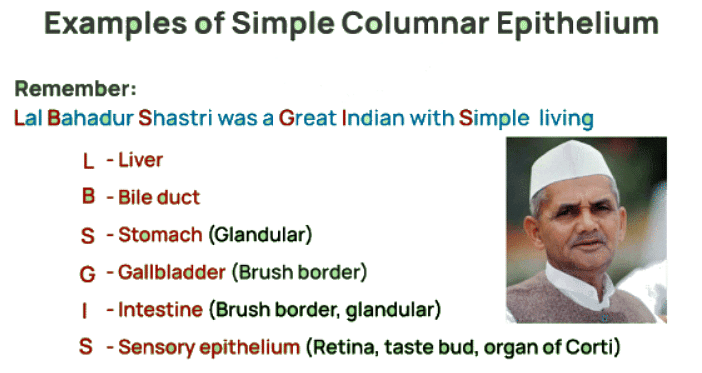
Mnemonic for Simple Columnar: "Intestines Store Good"

  • I = Inner lining of intestine
  • S = Stomach lining
  • G = Gastric glands

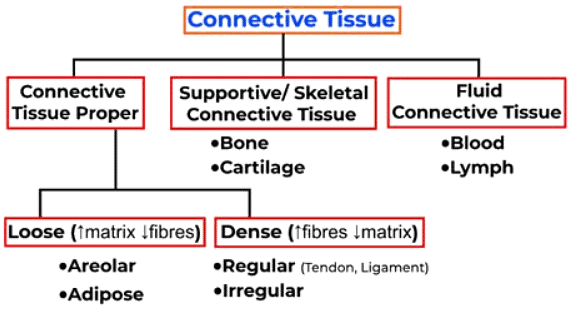
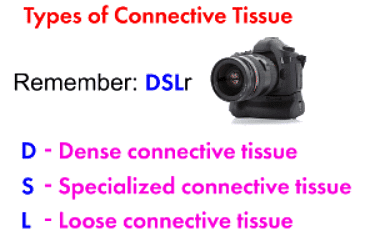
1.4 Connective Tissue Types

1.4 Connective Tissue Types

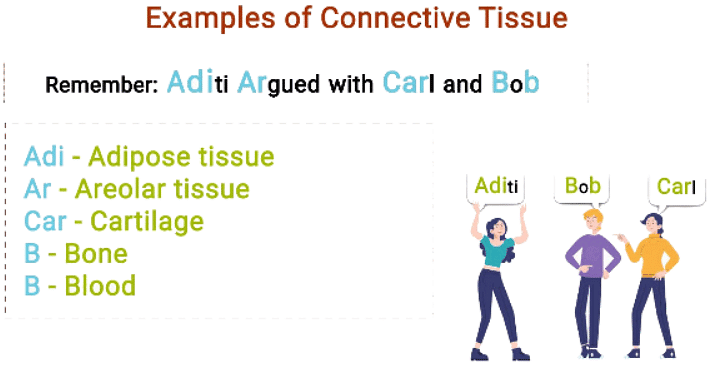
Mnemonic: "All Friends Are Cool"

  • A = Areolar connective tissue
  • F = Fibrous connective tissue (Dense Regular/Irregular)
  • A = Adipose tissue
  • C = Cartilage, Bone, Blood (Specialized connective tissues)

1.5 Three Types of Cartilage

Mnemonic: "HEF" (Like "Chef" without C)

  • H = Hyaline cartilage (most common, glassy appearance)
  • E = Elastic cartilage (yellow, flexible)
  • F = Fibrous cartilage (white fibrous tissue)

Locations Mnemonic: "Nose Eats Ears Violently"

  • Nose = Hyaline at nose tip
  • Eats = Elastic in epiglottis
  • Ears = Elastic in external ears (pinna)
  • Violently = Fibrous in vertebral discs (intervertebral discs)

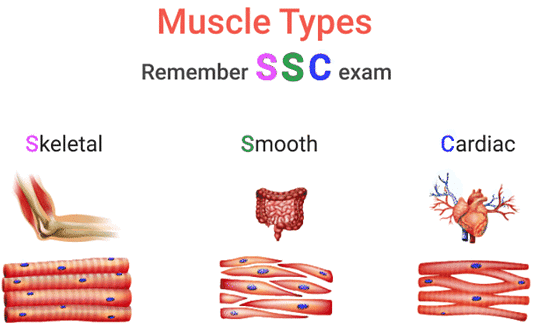
1.6 Three Types of Muscular Tissue

Mnemonic: "SSC Exam"

1.6 Three Types of Muscular Tissue

  • S = Striated muscle = Skeletal muscle (voluntary)
  • S = Smooth muscle (involuntary, non-striated)
  • C = Cardiac muscle (involuntary but striated)

Control Type Mnemonic: "Voluntary Voting Is Important"

  • V = Voluntary = Skeletal/Striated muscle
  • I = Involuntary = Smooth muscle and Cardiac muscle

1.7 Components of Nervous Tissue

Mnemonic: "Neurons Need Glial Guards"

  • Neurons = Nerve cells (functional units)
  • Glial = Neuroglia (supporting cells)

Neuron Parts Mnemonic: "Dogs Chase Axons"

  • D = Dendrites (receiving end)
  • C = Cell body (Cyton/Soma)
  • A = Axon (transmitting fiber)

2. Frog (Rana tigrina) - Anatomy Mnemonics

2.1 Frog External Features

Mnemonic for Skin Characteristics: "Moist Skin Gets Slimy"

  • M = Moist skin
  • S = Slippery due to mucus
  • G = Glandular skin
  • S = Smooth texture

Tympanum Mnemonic: "Ears Behind Eyes"

  • Tympanum (ear drum) = located behind each eye
  • Function: Receives sound vibrations

2.2 Frog Digestive System Organs

2.2 Frog Digestive System Organs

Mnemonic: "My Big Stomach Is Large, Colon Reacts Angrily"

  • M = Mouth
  • B = Buccal cavity
  • S = Stomach
  • I = Intestine (small)
  • L = Large intestine
  • C = Cloaca
  • R = Rectum
  • A = Anus (cloacal aperture)

2.3 Frog Respiratory Organs

Mnemonic: "Some Lungs Breathe Moist"

  • S = Skin (cutaneous respiration)
  • L = Lungs (pulmonary respiration)
  • B = Buccal cavity (bucco-pharyngeal respiration)
  • M = Moist skin essential

2.4 Frog Circulatory System

Mnemonic for Heart Chambers: "2 Atria, 1 Ventricle" = "2A1V"

  • 3-chambered heart: 2 atria (left + right) and 1 ventricle
  • Sinus venosus: Thin-walled sac on dorsal side
  • Conus arteriosus: On ventral side

Blood Type Mnemonic: "In Cold Water, Mixed Blood Flows"

  • Cold = Cold-blooded (poikilothermic)
  • Mixed Blood = Ventricle contains mixed blood (oxygenated + deoxygenated)

2.5 Frog Excretory System

Mnemonic: "Kids Use Urine Bladders Carefully"

  • K = Kidneys (mesonephric, paired)
  • U = Ureters
  • U = Urinary bladder
  • B = Bladder opens into cloaca
  • C = Cloaca (common chamber)

Excretory Product Mnemonic: "Frogs Are Ureotelic"

  • Ureotelic: Main excretory product is urea
  • In water: Tadpoles are ammonotelic (excrete ammonia)

2.6 Frog Nervous System Components

Mnemonic: "Brain Spins Neurons" = "BSN"

  • B = Brain
  • S = Spinal cord
  • N = Nerves (10 pairs cranial, 10 pairs spinal)

Brain Parts Mnemonic: "Old Cerebral Optic Medulla Cells"

  • O = Olfactory lobes (smell)
  • C = Cerebral hemispheres
  • O = Optic lobes (vision)
  • M = Medulla oblongata
  • C = Cerebellum (very small in frog)

2.7 Frog Sense Organs

Mnemonic: "Every Night Owls Taste"

  • E = Eyes (large, bulged)
  • N = Nose (external nares)
  • O = Olfactory organs (smell)
  • T = Tympanum (hearing)

3. Cockroach (Periplaneta americana) - Anatomy Mnemonics

3.1 Cockroach External Features

Body Divisions Mnemonic: "HTA"

  • H = Head
  • T = Thorax
  • A = Abdomen

Thorax Segments Mnemonic: "Please Make Meals"

  • P = Prothorax
  • M = Mesothorax
  • M = Metathorax

3.2 Cockroach Appendages

Mnemonic: "1 Antenna, 3 Legs, 2 Wings Per Side" = "1-3-2"

  • Antennae: 1 pair (sensory, long, jointed)
  • Legs: 3 pairs (one pair per thoracic segment)
  • Wings: 2 pairs (forewings = tegmina, hindwings = membranous)

Wing Mnemonic: "Males Fly, Females Try"

  • Males: Wings extend beyond abdomen tip
  • Females: Wings shorter, covering 2/3 of abdomen
  • Both sexes have forewings (tegmina) that are tough and opaque

3.3 Cockroach Digestive System

3.3 Cockroach Digestive System

Mnemonic: "Many Farmers Grow Maize, Hens Immediately Reconsider"

  • M = Mouth
  • F = Foregut (Pharynx, Oesophagus, Crop, Gizzard)
  • G = Gizzard (grinding organ with teeth)
  • M = Midgut (Mesenteron/Stomach)
  • H = Hepatic caeca (6-8 blind tubules at junction)
  • I = Ileum (part of hindgut)
  • R = Rectum and Anus

Hepatic Caeca Mnemonic: "6-8 Hepatic Helpers"

  • 6-8 hepatic caeca at the junction of foregut and midgut
  • Function: Secrete digestive enzymes

3.4 Cockroach Respiratory System

Mnemonic: "Ten Spiracles Supply Trachea"

  • 10 pairs of spiracles: 2 thoracic + 8 abdominal
  • Spiracles = small openings on lateral sides
  • Trachea = network of tubes carrying air
  • Tracheoles = finest branches reaching tissues

Spiracle Distribution: "2T + 8A = 10"

  • 2 Thoracic pairs (on mesothorax and metathorax)
  • 8 Abdominal pairs

3.5 Cockroach Circulatory System

Mnemonic: "Open Heart, Blood Lakes"

  • Open circulatory system: Blood (hemolymph) flows in open spaces (haemocoel)
  • Heart: Elongated, 13-chambered, located middorsally
  • Blood: Colorless, does NOT carry oxygen (respiration via trachea)

Heart Chambers Mnemonic: "13 Chambers in Cockroach Heart"

  • 13 funnel-shaped chambers with ostia (openings)

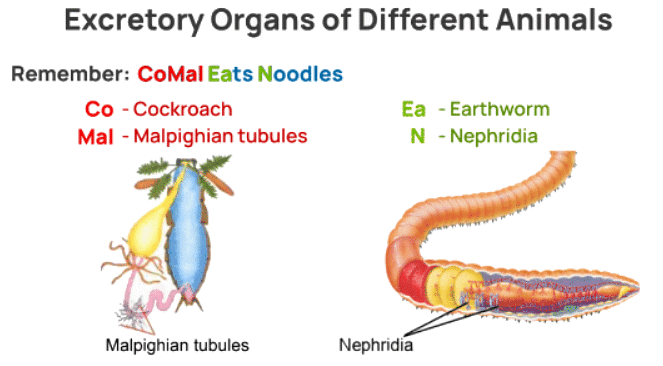
3.6 Cockroach Excretory System

Mnemonic: "100 Malpighian Tubules Make Uric Acid"

  • Malpighian tubules: 100-150 yellow, thread-like structures
  • Located at junction of midgut and hindgut
  • Uricotelic: Excrete uric acid (nitrogenous waste)

Fat Body Mnemonic: "Fat Stores Uric Crystals"

  • Fat body: Stores nutrients and uric acid
  • Scattered in haemocoel

3.7 Cockroach Nervous System

Mnemonic: "Brain Connects 3 Ganglia, Ventral Nerves Deliver"

  • Brain = Supra-oesophageal ganglion (in head)
  • 3 ganglia in thorax: 1 in each segment
  • 6 ganglia in abdomen
  • Ventral nerve cord: Connects all ganglia

Ganglion Distribution: "1 Brain, 3 Thorax, 6 Abdomen" = "1-3-6"

3.8 Cockroach Sense Organs

Mnemonic: "Compound Eyes, Antennae Can Analyze Smells"

  • Compound eyes: Large, 2000 ommatidia per eye (visual mosaic)
  • Antennae: Long, jointed, sensory (touch, taste, smell)
  • Anal cerci: Paired, sensory filaments at posterior end

3.9 Cockroach Reproductive System

3.9 Cockroach Reproductive System

Male Reproductive Mnemonic: "Ten Testis, Vas, Vesicula, Penis"

  • Testes: 4-6 pairs (10-12 total) in abdomen
  • Vas deferens: Carries sperm
  • Seminal vesicles: Store sperm
  • Male gonopore: Ventral to anus

Female Reproductive Mnemonic: "2 Ovaries, Oviducts, Ootheca"

  • Ovaries: 2 (8 ovarioles each)
  • Oviducts: Lateral oviducts join to form common oviduct
  • Ootheca: Dark reddish egg case (contains 14-16 eggs)
  • Spermatheca: Stores sperm received from male

4. Comparative Quick-Recall Tables

4.1 Epithelial Tissue Types - Location Table

4.1 Epithelial Tissue Types - Location Table

4.2 Muscle Types Comparison

4.2 Muscle Types Comparison

4.3 Frog vs Cockroach - Comparative Systems

4.3 Frog vs Cockroach - Comparative Systems

5. High-Yield Exam Traps & Alerts

5.1 Common Student Mistakes

  • Trap: Confusing simple squamous with stratified squamous. Simple = single layer (alveoli, blood vessels). Stratified = multiple layers (skin).
  • Trap: Cardiac muscle is striated BUT involuntary. Students often think all striated muscles are voluntary.
  • Trap: Frog heart has 3 chambers (2 atria + 1 ventricle), NOT 4. Mixed blood flows in ventricle.
  • Trap: Cockroach blood does NOT transport oxygen. Oxygen is transported by tracheal system directly to tissues.
  • Trap: Cockroach has 10 pairs of spiracles (2 thoracic + 8 abdominal), NOT 10 total.
  • Trap: Tegmina are the tough forewings of cockroach, NOT hindwings. Hindwings are membranous.
  • Trap: Frog excretory product is urea (ureotelic), but tadpoles excrete ammonia (ammonotelic).
  • Trap: Hepatic caeca in cockroach are digestive glands (6-8 in number), NOT excretory organs.
  • Trap: Cockroach heart has 13 chambers, NOT 13 valves or 13 vessels.

5.2 Frequently Confused Terms

  • Areolar vs Adipose: Areolar = loose connective tissue (under skin, between organs). Adipose = fat storage tissue (beneath skin, around kidneys).
  • Hyaline vs Elastic Cartilage: Hyaline = glassy, at nose tip, tracheal rings, ends of long bones. Elastic = yellow, flexible, in ear pinna and epiglottis.
  • Tympanum vs Tympanic membrane: Both are same = ear drum in frog, located behind eyes.
  • Sinus venosus vs Conus arteriosus: Sinus venosus = thin-walled sac on dorsal side of frog heart (receives blood). Conus arteriosus = on ventral side (distributes blood).
  • Mesonephric vs Metanephric kidneys: Frog has mesonephric kidneys (functional in adults). Metanephric kidneys are found in mammals.
  • Ureotelic vs Uricotelic vs Ammonotelic: Ureotelic = excrete urea (frog, mammals). Uricotelic = excrete uric acid (cockroach, birds, reptiles). Ammonotelic = excrete ammonia (tadpoles, aquatic animals).

5.3 Number-Based Quick Facts (Exam Favorites)

  • 4 types of animal tissues
  • 3 types of cartilage (Hyaline, Elastic, Fibrous)
  • 3 types of muscular tissue (Skeletal, Smooth, Cardiac)
  • 3 chambers in frog heart (2 atria + 1 ventricle)
  • 10 pairs cranial nerves + 10 pairs spinal nerves in frog
  • 3 body divisions in cockroach (Head, Thorax, Abdomen)
  • 3 thoracic segments (Prothorax, Mesothorax, Metathorax)
  • 10 pairs of spiracles in cockroach (2 thoracic + 8 abdominal)
  • 13 chambers in cockroach heart
  • 100-150 Malpighian tubules in cockroach
  • 6-8 hepatic caeca in cockroach
  • 2000 ommatidia per compound eye in cockroach
  • 14-16 eggs per ootheca in cockroach

Mastering these mnemonics will significantly reduce your recall time during exams. Practice these memory aids regularly, especially the number-based facts and comparative tables. Focus on understanding the differences between similar structures and trap areas where questions are designed to test precise knowledge. Revise the location-specific mnemonics for tissues, as these are high-frequency exam questions. Connect the mnemonics to diagrams for better visual retention.

The document Mnemonics: Structural Organisation in Animals is a part of the NEET Course Biology Class 11.
All you need of NEET at this link: NEET

FAQs on Mnemonics: Structural Organisation in Animals

1. What are the main tissue types in animal structure that I need to memorise for NEET?
Ans. Animals have four primary tissue types: epithelial (covering and protection), connective (support and structure), muscular (movement), and nervous (communication and control). Epithelial tissue lines body surfaces; connective tissue includes bone and cartilage; muscular tissue enables contraction; nervous tissue transmits signals. Understanding these fundamental tissue categories forms the foundation for comprehending complex organ systems in structural organisation of animals.
2. How do I remember the layers of skin and their functions?
Ans. Human skin comprises three main layers: epidermis (outermost, protective), dermis (middle, contains blood vessels and nerves), and hypodermis (innermost, fat storage and insulation). The epidermis sheds dead cells continuously; the dermis provides strength and sensation; the hypodermis anchors skin to underlying structures. Using memory aids and visual diagrams helps students recall these integumentary system layers during exam preparation on structural organisation.
3. What's the difference between simple and complex tissues in animal anatomy?
Ans. Simple tissues contain one cell type and perform a single function; complex tissues contain multiple cell types working together for diverse functions. In animal structural organisation, simple epithelial tissues line surfaces, while complex tissues like bone combine osteocytes, blood vessels, and matrix. This distinction helps students understand how tissue complexity correlates with functional specialisation in different body regions and organ systems.
4. Which mnemonic helps remember the order of skeletal system components from smallest to largest?
Ans. The skeletal hierarchy progresses from cells to organs: osteocytes (bone cells) → osteons (structural units) → bones (organs) → skeleton (system). Memory devices using acronyms or visual hierarchies simplify this progression during NEET preparation. Referring to mind maps and flashcards on structural organisation clarifies how individual bone cells aggregate into complete skeletal structures supporting the entire animal body.
5. How can I quickly memorise the functions of different organ systems in animals?
Ans. Organ systems function through integration: digestive (nutrition), circulatory (transport), respiratory (gas exchange), nervous (coordination), endocrine (regulation), reproductive (continuity), and excretory (waste removal). Creating mnemonics or using visual study aids helps retain these systemic functions. Students preparing for NEET benefit from studying how each system's tissues and organs work together within the broader framework of animal structural organisation and physiological coordination.
Explore Courses for NEET exam
Get EduRev Notes directly in your Google search
Related Searches
Extra Questions, Mnemonics: Structural Organisation in Animals, ppt, Free, practice quizzes, Important questions, Mnemonics: Structural Organisation in Animals, Viva Questions, Exam, Mnemonics: Structural Organisation in Animals, pdf , Sample Paper, Objective type Questions, Summary, study material, MCQs, shortcuts and tricks, mock tests for examination, Semester Notes, past year papers, Previous Year Questions with Solutions, video lectures;