NEET Exam > NEET Notes > Biology Class 11 > Mnemonics: Excretory Products & their Elimination
Mnemonics: Excretory Products & their Elimination | Biology Class 11 - NEET PDF Download


Let's learn the complex parts and processes of kidney by interlinking it with our daily words and never ever forgetting it again.
Types of Excretion Processes
Mnemonic: "All Urea Ultimately Evolves"
- All - Ammonotelism: Excretion of ammonia (e.g., bony fish, amphibians).
- Urea - Ureotelism: Excretion of urea (e.g., mammals, amphibians).
- Ultimately - Uricotelism: Excretion of uric acid (e.g., birds, reptiles).
- Evolves - Evolutionary Adaptation: Terrestrial animals produce less toxic forms like urea or uric acid for water conservation.
Types of Excretory Organs and Examples
Mnemonic: "Please Never Make Green Plants"
- Please - Protonephridia (e.g., Planaria): For osmoregulation in flatworms.
- Never- Nephridia (e.g., Earthworm): Remove nitrogenous wastes and maintain fluid balance.
- Make - Malpighian Tubules (e.g., Cockroach): For osmoregulation and nitrogen waste elimination in insects.
- Green - Green Glands (e.g., Prawns): Excretion in crustaceans.
- Plants- Plants: Use transpiration, guttation, and excretion through leaves for waste elimination.
Parts of the Kidney
Mnemonic: "Can Medics Handle Calm Patients?"
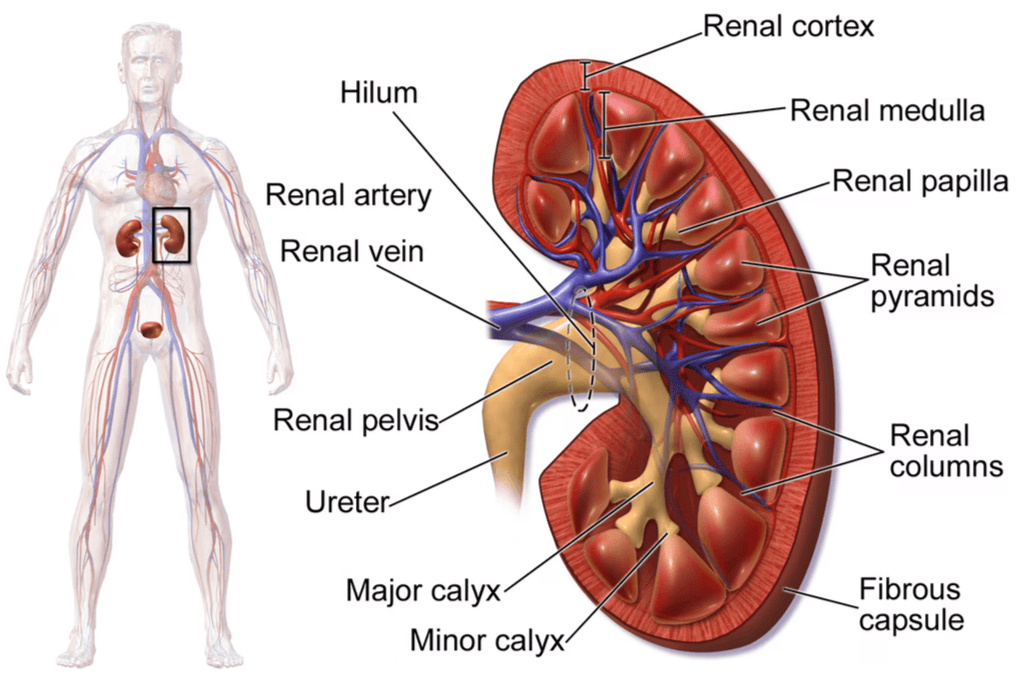
- Can - Cortex: Outer layer containing glomeruli and convoluted tubules.
- Medics - Medulla: Inner region with pyramids and loop of Henle.
- Handle - Hilum: Entry/exit for ureters, blood vessels, and nerves.
- Calm - Calyces: Funnel-shaped projections leading to the renal pelvis.
- Patients - Pelvis: Collects urine and passes it to the ureter.
Steps of Urine Formation
Mnemonic: "Good Rabbits Swim"
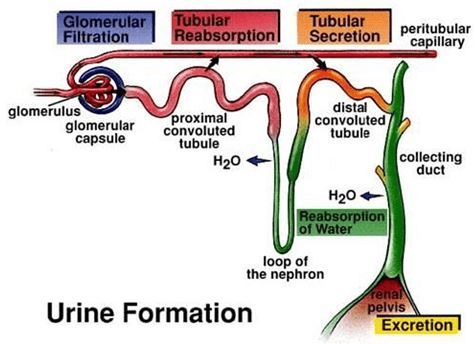
- Good - Glomerular Filtration: Ultrafiltration of blood in the glomerulus.
- Rabbits - Reabsorption: Active/passive absorption of nutrients, water, and ions in the tubules.
- Swim - Secretion: Elimination of H+, K+, and ammonia into the filtrate for pH and ionic balance.
Counter Current Mechanism
Mnemonic: "Henle's Loop Regulates Salts"
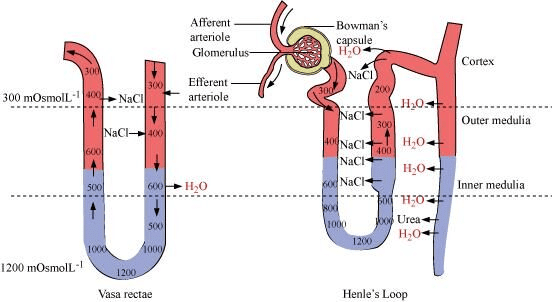
- Henle's Loop - Henle's Loop: Creates a gradient via descending (water permeable) and ascending limbs (impermeable to water, salt transport).
- Loop - Loop of Vasa Recta: Parallel capillaries help in exchange and retention of salts (NaCl and urea).
- Regulates - Regulation: Ensures concentrated urine with osmolarity up to 1200 mOsmol/L.
- Salts - Salts and Urea: Contribute to the osmotic gradient in the medulla.
Role of Other Organs in Excretion
Mnemonic: "Love Liver, Skin, and Sweat"
- Love - Lungs: Remove CO₂ and water vapor.
- Liver- Liver: Excretes bile pigments (bilirubin and biliverdin), drugs, and cholesterol.
- Skin - Skin: Eliminates salts, urea, and lactic acid via sweat.
- Sweat - Sebaceous Glands: Remove sterols and hydrocarbons through sebum.
Disorders of the Excretory System
Mnemonic: "U Really Shouldn't Get Kidney Glitches"
- U - Uremia: Accumulation of urea in blood due to kidney failure.
- Really - Renal Calculi: Kidney stones formed by crystallized salts.
- Shouldn't - Stone Formation: Includes oxalate stones causing pain and obstruction.
- Get - Glomerulonephritis: Inflammation of glomeruli, impairing filtration.
- Kidney - Kidney Failure: Treated by dialysis or kidney transplantation.
- Glitches - Glycosuria and Ketonuria: Presence of glucose and ketone bodies in urine, indicative of diabetes.
The document Mnemonics: Excretory Products & their Elimination | Biology Class 11 - NEET is a part of the NEET Course Biology Class 11.
All you need of NEET at this link: NEET
|
150 videos|399 docs|136 tests
|
FAQs on Mnemonics: Excretory Products & their Elimination - Biology Class 11 - NEET
| 1. What are the main types of excretion processes in organisms? |  |
Ans. The main types of excretion processes in organisms include:
1. <b>Diffusion</b> - the movement of waste products from an area of higher concentration to lower concentration across cell membranes (e.g., gases like CO2).
2. <b>Exocytosis</b> - the process where cells expel waste materials in vesicles that fuse with the cell membrane.
3. <b>Active Transport</b> - the movement of ions or molecules against their concentration gradient, often using energy (e.g., reabsorption of ions in kidneys).
4. <b>Filtration</b> - the process of separating waste from blood, primarily occurring in the kidneys.
| 2. What are the different types of excretory organs and their examples? | |
Ans. Different types of excretory organs include:
1. <b>Kidneys</b> - responsible for filtering blood and producing urine (e.g., human kidneys).
2. <b>Liver</b> - detoxifies and metabolizes substances, producing urea (e.g., human liver).
3. <b>Skin</b> - excretes sweat which contains water, salts, and urea (e.g., human skin).
4. <b>Lungs</b> - expel carbon dioxide and water vapor during respiration (e.g., human lungs).
| 3. What are the main parts of the kidney and their functions? | |
Ans. The main parts of the kidney include:
1. <b>Cortex</b> - the outer region where blood filtration occurs.
2. <b>Medulla</b> - the inner region containing renal pyramids that help in urine formation.
3. <b>Renal Pelvis</b> - collects urine before it moves to the ureter.
4. <b>Nephrons</b> - the functional units of the kidney responsible for filtering blood and forming urine.
| 4. What are the steps involved in urine formation? | |
Ans. The steps of urine formation include:
1. <b>Filtration</b> - blood is filtered in the glomerulus, allowing water, ions, and small molecules to pass into the Bowman's capsule.
2. <b>Reabsorption</b> - essential substances (water, glucose, ions) are reabsorbed back into the bloodstream from the renal tubules.
3. <b>Secretion</b> - additional waste products and excess ions are secreted from the blood into the renal tubules.
4. <b>Excretion</b> - the final urine is collected in the renal pelvis and transported to the bladder for elimination.
| 5. How does the counter-current mechanism work in the kidneys? | |
Ans. The counter-current mechanism in the kidneys involves the interaction between the descending and ascending limbs of the loop of Henle.
- In the descending limb, water is reabsorbed, concentrating the filtrate.
- In the ascending limb, sodium and chloride ions are actively transported out, diluting the filtrate.
This mechanism creates a gradient that allows for efficient reabsorption of water in the collecting ducts, thus concentrating urine and conserving water in the body.
About this Document

4.64/5
Rating

Oct 06, 2025
Last updated
Document Description: Mnemonics: Excretory Products & their Elimination for NEET 2025 is part of Biology Class 11 preparation.
The notes and questions for Mnemonics: Excretory Products & their Elimination have been prepared according to the NEET exam syllabus. Information about Mnemonics: Excretory Products & their Elimination covers topics
like Types of Excretion Processes, Types of Excretory Organs and Examples, Parts of the Kidney, Steps of Urine Formation, Counter Current Mechanism, Role of Other Organs in Excretion, Disorders of the Excretory System and Mnemonics: Excretory Products & their Elimination Example, for NEET 2025 Exam. Find important definitions, questions, notes, meanings, examples, exercises and tests below for Mnemonics: Excretory Products & their Elimination.
Introduction of Mnemonics: Excretory Products & their Elimination in English is available as part of our Biology Class 11
for NEET & Mnemonics: Excretory Products & their Elimination in Hindi for Biology Class 11 course.
Download more important topics related with notes, lectures and mock test series for NEET
Exam by signing up for free. NEET: Mnemonics: Excretory Products & their Elimination | Biology Class 11 - NEET
Description
Full syllabus notes, lecture & questions for Mnemonics: Excretory Products & their Elimination | Biology Class 11 - NEET - NEET | Plus excerises question with solution to help you revise complete syllabus for Biology Class 11 | Best notes, free PDF download
Information about Mnemonics: Excretory Products & their Elimination
In this doc you can find the meaning of Mnemonics: Excretory Products & their Elimination defined & explained in the simplest way possible. Besides explaining types of
Mnemonics: Excretory Products & their Elimination theory, EduRev gives you an ample number of questions to practice Mnemonics: Excretory Products & their Elimination tests, examples and also practice NEET
tests

Related Searches
MCQs
,Objective type Questions
,Previous Year Questions with Solutions
,Semester Notes
,Viva Questions
,Mnemonics: Excretory Products & their Elimination | Biology Class 11 - NEET
,Sample Paper
,Mnemonics: Excretory Products & their Elimination | Biology Class 11 - NEET
,mock tests for examination
,Summary
,practice quizzes
,study material
,Important questions
,ppt
,Free
,video lectures
,past year papers
,Exam
,Mnemonics: Excretory Products & their Elimination | Biology Class 11 - NEET
,Extra Questions
,shortcuts and tricks
;



Additional Information about Mnemonics: Excretory Products & their Elimination for NEET Preparation
Mnemonics: Excretory Products & their Elimination Free PDF Download
The Mnemonics: Excretory Products & their Elimination is an invaluable resource that delves deep into the core of the NEET exam.
These study notes are curated by experts and cover all the essential topics and concepts, making your preparation more efficient and effective.
With the help of these notes, you can grasp complex subjects quickly, revise important points easily,
and reinforce your understanding of key concepts. The study notes are presented in a concise and easy-to-understand manner,
allowing you to optimize your learning process. Whether you're looking for best-recommended books, sample papers, study material,
or toppers' notes, this PDF has got you covered. Download the Mnemonics: Excretory Products & their Elimination now and kickstart your journey towards success in the NEET exam.
Importance of Mnemonics: Excretory Products & their Elimination
The importance of Mnemonics: Excretory Products & their Elimination cannot be overstated, especially for NEET aspirants.
This document holds the key to success in the NEET exam.
It offers a detailed understanding of the concept, providing invaluable insights into the topic.
By knowing the concepts well in advance, students can plan their preparation effectively.
Utilize this indispensable guide for a well-rounded preparation and achieve your desired results.
Mnemonics: Excretory Products & their Elimination Notes
Mnemonics: Excretory Products & their Elimination Notes offer in-depth insights into the specific topic to help you master it with ease.
This comprehensive document covers all aspects related to Mnemonics: Excretory Products & their Elimination.
It includes detailed information about the exam syllabus, recommended books, and study materials for a well-rounded preparation.
Practice papers and question papers enable you to assess your progress effectively.
Additionally, the paper analysis provides valuable tips for tackling the exam strategically.
Access to Toppers' notes gives you an edge in understanding complex concepts.
Whether you're a beginner or aiming for advanced proficiency, Mnemonics: Excretory Products & their Elimination Notes on EduRev are your ultimate resource for success.
Mnemonics: Excretory Products & their Elimination NEET Questions
The "Mnemonics: Excretory Products & their Elimination NEET Questions" guide is a valuable resource for all aspiring students preparing for the
NEET exam. It focuses on providing a wide range of practice questions to help students gauge
their understanding of the exam topics. These questions cover the entire syllabus, ensuring comprehensive preparation.
The guide includes previous years' question papers for students to familiarize themselves with the exam's format and difficulty level.
Additionally, it offers subject-specific question banks, allowing students to focus on weak areas and improve their performance.
Study Mnemonics: Excretory Products & their Elimination on the App
Students of NEET can study Mnemonics: Excretory Products & their Elimination alongwith tests & analysis from the EduRev app,
which will help them while preparing for their exam. Apart from the Mnemonics: Excretory Products & their Elimination,
students can also utilize the EduRev App for other study materials such as previous year question papers, syllabus, important questions, etc.
The EduRev App will make your learning easier as you can access it from anywhere you want.
The content of Mnemonics: Excretory Products & their Elimination is prepared as per the latest NEET syllabus.
|
© EduRev
|
Education Revolution
|


|




Signup to see your scores
go up within 7 days!
Access 1000+ FREE Docs, Videos and Tests
Takes less than 10 seconds to signup