Class 9 Science Chapter 6 HOTS Questions - Tissues

Q1: What will happen if
- Apical meristem is damaged or cut ?
- Cork is not formed in older stems and roots ?
- Cells of epithelial tissue are not compactly packed.
- Lymph is not returned to blood ?
Ans:
- Apical Meristem Removed: Growth in length will stop.
- Cork is Not Formed: If cork is not formed in older stems and roots, the outer tissues will rupture with the increase in girth and expose the interior to desiccation and infection.
- Epithelial tissue will not be effective as protective impermeable layer.
- Lymph is Not Returned to Blood: Blood volume will decrease while passage of materials from tissues to blood and vice versa would be dislocated.
Q2:
- Identify the figure. What is its function ?
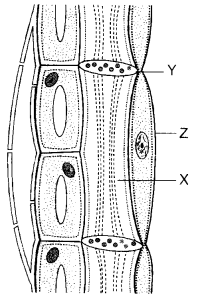
- Label X, Y and Z .
- Which ones of them develop from the same mother cell ?
- X loses its nucleus in mature state. Still it remains alive. How ?
Ans:
- Identification: Phloem tissue.
- Function: Conduction of organic food.
- X – Sieve tube cell.
Y – Sieve plate
Z – Companion cell. - From Same Mother Cell: Sieve tube cell and companion cell.
- Living of Sieve Tube Cells: It is controlled by nucleated companion cells with which they are connected by plasmodesmata.
Q3:
- Identify the figure.
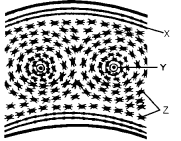
- Label X, Y and Z.
- What is the chemical composition of material of the figure ?
- What is the function of Y
Ans:
- Identification: Section of bone.
- X- Periosteum.
- Y- Haversian canal
- Z- Canaliculus (plural canaliculi)
- Composition,
- Ossein (30-40%)
- Mineral matter
(60-70%) of calcium and magnesium carbonate and phosphate.
- Function of Haversian Canal: To carry nutrients to the interior of the bone.
Q4: What will happen if
- Ligament gets overstretched ?
- Heparin is absent in blood ?
- Striated muscles contract rapidly for longer duration ?
Ans:
- Oversretching of Ligament: Sprain.
- Absence of Heparin in Blood: Blood coagulation occurs inside the blood vessels.
- Striated Muscle Contraction: Fatigue due to accumulation of lactic acid.
Q5:
- Identify figures : A,B and C.
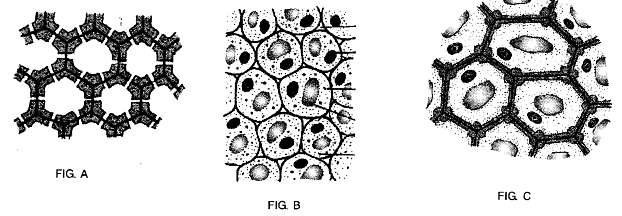
- Which one of them provides both mechanical strength as well as flexibility ?
- Which one of them is commercially exploited to obtain Hemp and Jute ?
- Which one of them can be modified to form air cavities in aquatic plants ?
- Which one of them has heavy deposition of lignin ?
Ans:
- A- T.S sclerenchyma fibres.
- B- T.S parenchyma cells.
- C- T. S collenchyma.
- Mechanical strength and flexibility: Collenchyma.
- Hemp and Jute: Sclerenchyma fibres.
- Aerenchyma: Modification of parenchyma.
- Deposition of Lignin: Sclerenchyma.
Q6: Identify figures A and B.
- Identify figures A and B.
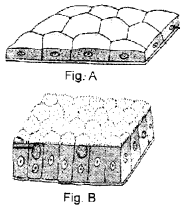
- Which is called tesselated and pavement epithelium ?
- Which one lines gastro-intestinal tract and epiglottis ?
- Which one allows diffusion of substances ?
Ans:
- Identification:
A- Squamous epithelium
B- Ciliated columnar epithelium. - Pavement Epithelium: Squamous epithelium.
- Tesselated Epithelium: Squamous epithelium.
- Gastro-intesinal Tract: Simple columnar epithelium.
- Epiglottis: Stratified columnar epithelium.
- Diffusion of Substances: Simple epithelium, especially squamous one.
Q7: What will happen if
- Bone is dipped in HCl
- Bone is dried ?
Ans:
- Bone Dipped in HCl. Mineral matter dissolves. Only organic matter is left.
- Dried Bone. Organic matter destroyed. Only mineral matter is left.
Q8:
- Identify figures A and B.
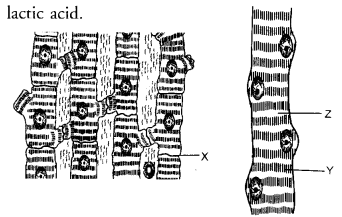
- Label X, Y and Z.
- Which one acts as impulse booster ?
- Which one is under control of our will ?
Ans:
- Identification:
A – Cardiac muscle fibres.
B – Striated muscle fibre. - X- Intercalated disc.
Y- Dark band.
Z- Light band. - Impulse Booster: Intercalated disc.
- Control of Will: Striated or skeletal muscle.
Q9: A person met with an accident in which two long bones of the hand were dislocated. What could be the reason?
Ans: Dislocation of the bones of the hand was caused due to the breakage of the ligament which connects the two bones and keeps them in place.
Q10: A nail is inserted in the trunk of a tree at a height of 1 metre from the ground level. After 3 years, where will the nail be present?
Ans: The nail will remain at the same position even after 3 years. This is because a plant or tree grows from its tip (stem or root) not from the point at which it joins the ground. So, the tree will grow but the nail will remain at the same place on the tree trunk.
Q11: Tissue A and tissue B constitute tissue C. A carries water while B carries food for the plants. Identify A, B, C.
Ans:
A. Xylem
B. Phloem
C. Vascular bundles
Q12: If the tip of a sugarcane plant is removed from the field, even then it keeps on growing in length. Why?
Ans: Removing the tip of the sugarcane does not remove the intercalary meristem of the plant. It is this meristem which increases the length of the plant.
Q13: The root tips of a plant were cut and the plant was replanted. What will happen to the plant and why?
Ans: The plant will die within few days of replanting it. This is because since the root tips are cut, the roots won’t grow because of absence of meristematic tissue. And if the roots will not grow, proper absorption of water and minerals will not occur.
|
84 videos|544 docs|60 tests
|




shortcuts and tricks
,ppt
,MCQs
,mock tests for examination
,practice quizzes
,Important questions
,Extra Questions
,Objective type Questions
,Class 9 Science Chapter 6 HOTS Questions - Tissues
,study material
,Sample Paper
,Exam
,past year papers
,Semester Notes
,Free
,Class 9 Science Chapter 6 HOTS Questions - Tissues
,Previous Year Questions with Solutions
,video lectures
,Class 9 Science Chapter 6 HOTS Questions - Tissues
,Viva Questions
,Summary
;



HOTS Questions: Tissues Free PDF Download
Importance of HOTS Questions: Tissues
HOTS Questions: Tissues Notes
HOTS Questions: Tissues Class 9
Study HOTS Questions: Tissues on the App
|
© EduRev
|
Education Revolution
|


|




