CBSE Class 4  >  Class 4 Notes  >  Worksheets with solutions  >  Worksheet: Building With Bricks - 1

Worksheet: Building With Bricks - 1

Q1: Multiple Choice Questions (MCQs).

(i) Bhajan decided to buy the new bricks from Brickabad. He bought three thousand bricks. How much did he pay? 
(a) ₹4000
(b) ₹5000 
(c) ₹6000     
(d) ₹7000


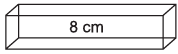
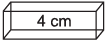
(ii) Choose the longest brick.
(a) 

Q1: Multiple Choice Questions (MCQs).
(b) 

Q1: Multiple Choice Questions (MCQs).
(c) 

Q1: Multiple Choice Questions (MCQs).
(d) 

Q1: Multiple Choice Questions (MCQs).


(iii) Bricks are made from? Tick the correct answer?
(a) Stone
(b) Soil
(c) Wood
(d) Glass


(iv) There are four very old cave paintings. Which one is oldest?

Q1: Multiple Choice Questions (MCQs).

(a) 4200 years old

(b) 8500 years old

(c) 1500 years old

(d) 5800 years old


(v) Which of these are the faces of a brick which is used for wall construction?
(a) 

Q1: Multiple Choice Questions (MCQs).
(b) 

Q1: Multiple Choice Questions (MCQs).
(c) 

Q1: Multiple Choice Questions (MCQs).
(d) 

Q1: Multiple Choice Questions (MCQs).


Q2: Fill in the Blanks

(i) One hundred thousand bricks = 1 ______ bricks.
(ii) A brick has __________ faces.


Q3: Answer the following Questions.

(i) One brick cost ₹ 15/-
20 bricks cost ₹Q3: Answer the following Questions.

(ii) Muniya wants to make a wall 1 meter long. If the length of a brick is 20 cm then tell how many bricks will she need to put in a line?
Q3: Answer the following Questions.(iii) A contractor pays ₹ 5000 for 500 bricks. Find out the cost of 1 brick?

(iv) Bhajan went to buy bricks. The price was given for one thousand bricks. The prices were also different for different types of bricks. Old bricks - Rs 1200 for one thousand bricks new bricks from Intapur - Rs 1800 for one thousand bricks, new bricks from Brickabad - Rs 2000 for one thousand Bricks. What is the price of 1000 new bricks from Intapur?

(v) Bhajan went to buy bricks. The price was given for one thousand bricks. The prices were also different for different types of bricks. Old bricks - Rs 1200 for one thousand bricks new bricks from Intapur - Rs 1800 for one thousand bricks, new bricks from Brickabad - Rs 2000 for one thousand Bricks. Bhajan decided to buy the new bricks from Brickabad. He bought three thousand bricks. How much did he pay?

(vi) Bhajan went to buy bricks. The price was given for one thousand bricks. The prices were also different for different types of bricks. Old bricks - Rs 1200 for one thousand bricks new bricks from Intapur - Rs 1800 for one thousand bricks, new bricks from Brickabad - Rs 2000 for one thousand Bricks. Tell me what he will pay if he buys 2000 new bricks from Intapur.

(vii) Which of the two walls is stronger?

Q3: Answer the following Questions.

(viii) If a brick costs ₹ 5/-, then what is the cost of 350 bricks?

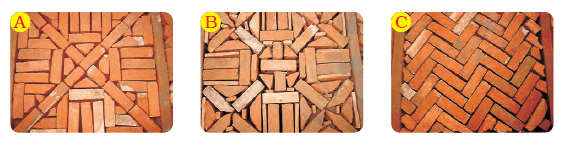
(ix) Which of the following patterns is/are symmetrical?
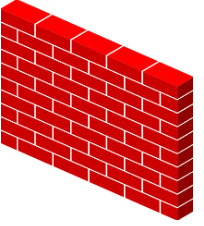
Q3: Answer the following Questions.(x) In the given wall how many bricks are used?
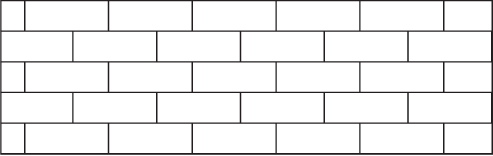
Q3: Answer the following Questions.

You can access the solutions to this worksheet here.

The document Worksheet: Building With Bricks - 1 is a part of the Class 4 Course Worksheets with solutions for Class 4.
All you need of Class 4 at this link: Class 4

FAQs on Worksheet: Building With Bricks - 1

1. How do you calculate the number of bricks needed to build a wall?
Ans. To find the number of bricks required, multiply the length, height, and width of the wall, then divide by the volume of a single brick. For example, if a wall is 10 metres long, 2 metres high, and 0.5 metres thick, and each brick measures 0.2m × 0.1m × 0.05m, divide the total wall volume by individual brick volume to get the exact quantity needed for construction.
2. What's the difference between a half brick and a full brick in wall construction?
Ans. A full brick spans the entire thickness of the wall, while a half brick covers only half that thickness. In bonding patterns, half bricks are placed horizontally to offset full bricks, creating stronger joints and preventing vertical cracks. This arrangement distributes weight evenly across the structure, making walls more stable and durable over time.
3. Why do bricks need to be arranged in a specific pattern when building?
Ans. Brick bonding patterns-like running bond, Flemish bond, and header bond-distribute load evenly and prevent weakness along vertical lines. Without proper arrangement, walls develop cracks and become structurally unstable. The overlapping pattern ensures that vertical joints don't align, which would create planes of weakness where the wall could easily fracture or collapse.
4. How do I figure out the surface area of bricks for estimating materials in CBSE Class 4 problems?
Ans. Surface area of a brick is calculated using the formula: 2(length × width + width × height + height × length). For a standard brick measuring 20cm × 10cm × 5cm, add all six face areas together. This helps estimate how many bricks cover a given wall surface and determines material costs and quantities needed for construction projects.
5. What are the basic dimensions of a standard brick used in building calculations?
Ans. Standard bricks typically measure 20 centimetres in length, 10 centimetres in width, and 5 centimetres in height. These uniform dimensions simplify calculations for walls, arches, and structures. When solving Class 4 worksheet problems on building with bricks, using these standard measurements ensures accuracy and makes mental maths easier during competitive exams and classroom assessments.
Explore Courses for Class 4 exam
Get EduRev Notes directly in your Google search
Related Searches
past year papers, Semester Notes, shortcuts and tricks, practice quizzes, Previous Year Questions with Solutions, Objective type Questions, pdf , Free, mock tests for examination, Sample Paper, ppt, MCQs, video lectures, Important questions, Summary, Worksheet: Building With Bricks - 1, Worksheet: Building With Bricks - 1, Viva Questions, Extra Questions, study material, Exam, Worksheet: Building With Bricks - 1;