Multiplication and Division


Multiplication as Repeated Addition
Adding the same number again and again is called repeated addition.
Aryan has 5 tricycles. Each tricycle has 3 wheels. What is the total number of wheels in all the tricycles?

There are 3 + 3 + 3 + 3 + 3 = 15 wheels in all.
The number 3 is added 5 times. We write this multiplication fact as 5 × 3 = 15.
We read it as 5 times 3 is 15, or 5 threes are 15, or 5 into 3 is 15.
Repeated addition of the same number is called multiplication.
For example, 4 × 2 = 8 is a multiplication fact. The sign × is the sign of multiplication. Instead of adding the same number many times, we use multiplication to find the answer quickly.
More Examples of Multiplication
Study the following.
Here are 4 baskets with 2 mangoes in each.
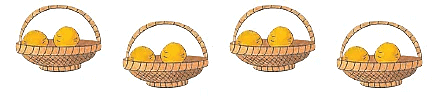
How many mangoes are there in all?
By adding repeatedly we get 2 + 2 + 2 + 2 = 8 mangoes in all.
Using multiplication we write 4 × 2 = 8 and read it as 4 times 2 is 8 or 4 multiplied by 2 is 8.
Multiplication on the Number Line
Multiplication is repeated addition. We can show multiplication on the number line by skip counting.
Let us find 3 × 5.

3 × 5 means take 3 skips of 5 starting from 0.
After 3 skips of 5 we reach 15. So, 3 × 5 = 15.
Properties of Multiplication
Order Property of Multiplication
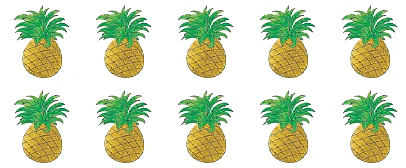
There are 2 rows with 5 pineapples each. This gives the multiplication fact 2 × 5 = 10.
If we think in columns, there are 5 columns with 2 pineapples each. This gives 5 × 2 = 10.
Since the product is the same, 2 × 5 = 5 × 2 = 10.
We may multiply numbers in any order; the product remains the same. This is called the order property of multiplication.
Multiplicative Property of 1
Five groups of one can be written as 5 × 1 = 1 + 1 + 1 + 1 + 1 = 5.
One group of five is 1 × 5 = 5.
So, 5 × 1 = 1 × 5 = 5.
Any number multiplied by 1 equals that number. This is called the multiplicative property of 1.

Multiplicative Property of 0
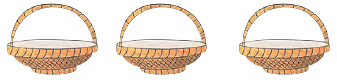
There are 3 empty baskets - this means 3 groups of nothing.
So, 3 × 0 = 0.
By the order property, 3 × 0 = 0 × 3 = 0.
Any number multiplied by 0 equals 0. This is called the multiplicative property of 0.
Multiplication Tables
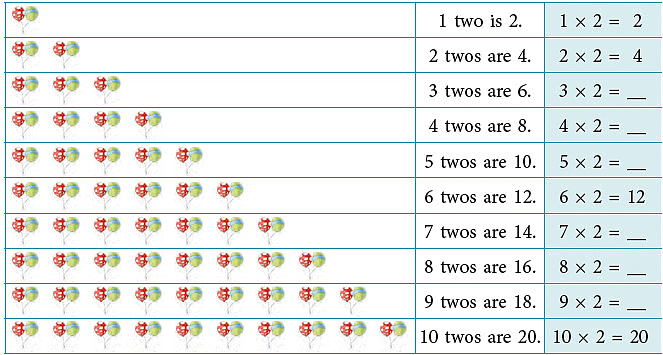
You have already learnt and memorised tables of 1 to 5 in Class 1. Let us revise and build more tables.
Multiplication Table of 2
Count and build the table of 2.
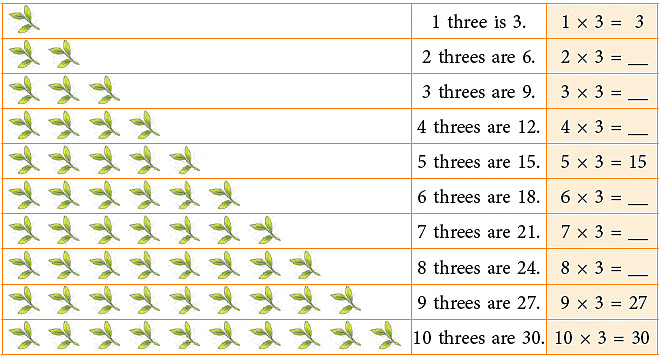
Multiplication Table of 3
Count and build the table of 3.
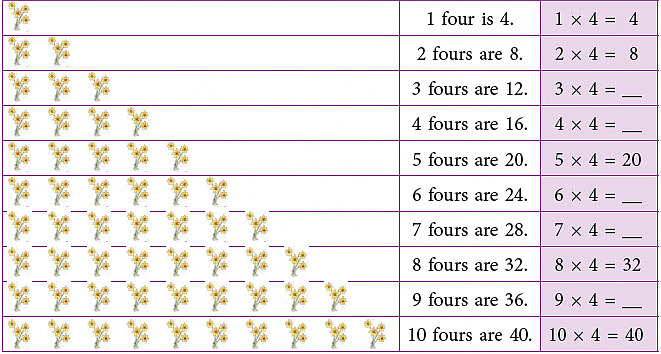
Multiplication Table of 4
Count and build the table of 4.
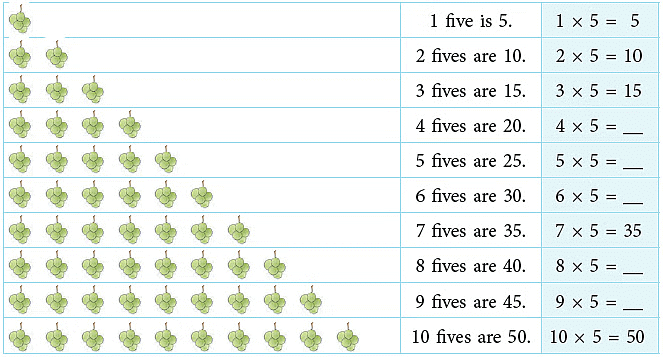
Multiplication Table of 5
Count and build the table of 5.
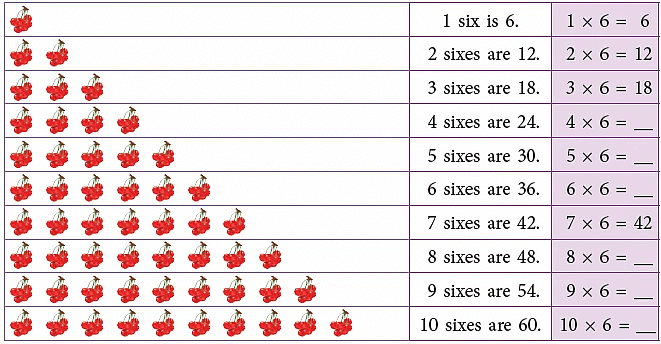
Multiplication Table of 6
Count and build the table of 6.
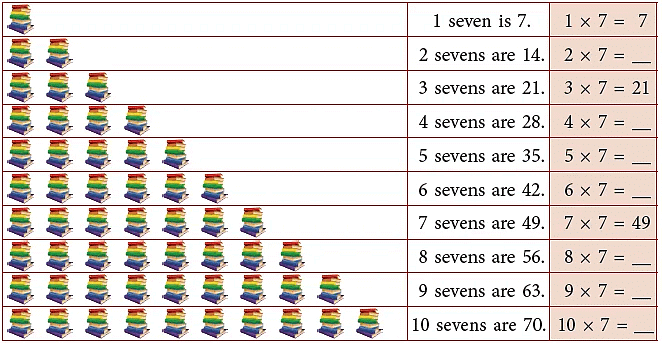
Multiplication Table of 7
Count and build the table of 7.
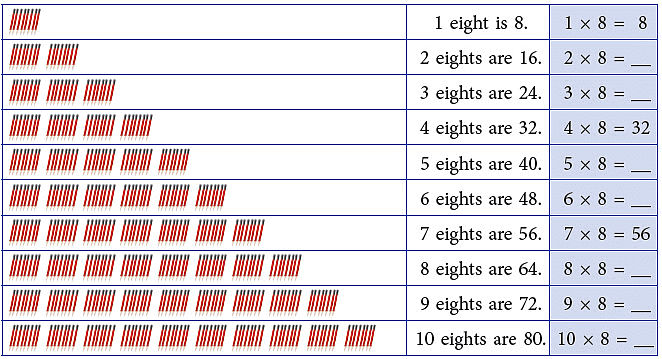
Multiplication Table of 8
Count and build the table of 8.
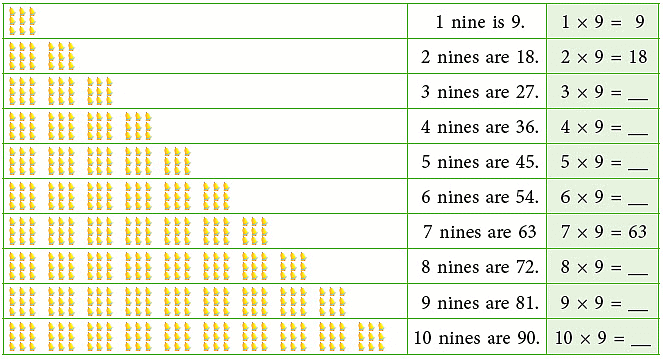
Multiplication Table of 9
Count and build the table of 9.
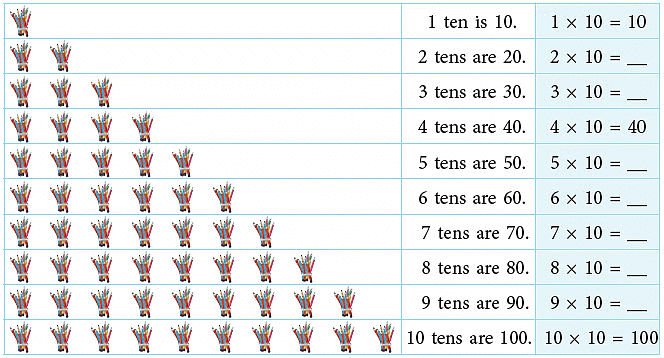
Multiplication Table of 10
Count and build the table of 10.
Problems Based on Real Life Situations
Example 1: There are 6 bananas in a bunch. There are 9 bunches. How many bananas are there in all?
Bananas in 1 bunch = 6
Bananas in 9 bunches = 9 × 6 = 54
Example 2: Reena has 5 pairs of gloves, 3 pairs of socks and 8 pairs of bangles.
How many items are there in total?
Number of gloves = 5 pairs = 5 × 2 = 10
Number of socks = 3 pairs = 3 × 2 = 6
Number of bangles = 8 pairs = 8 × 2 = 16
Total number of items = 10 + 6 + 16 = 32
What is Division
Division means equal sharing or equal grouping.
Equal Sharing
1. Mamta wants to share 4 chocolates between 2 of her friends Sonu and Bunty. How many chocolates will each of them get?
First, she gives one chocolate each to Sonu and Bunty.
Now both have 1 chocolate each.
Mamta now has 2 chocolates left. Again she gives 1 chocolate each to Sonu and Bunty.
Now Mamta has 0 chocolates and her friends have 2 chocolates each.
So, if we divide (share equally) 4 chocolates between 2, each one of them gets 2.
We say that 4 divided by 2 is 2 and write 4 ÷ 2 = 2.

2. Mohit has 10 packets of chips. He wants to share them equally with his cousin. How many packets will each one of them get?
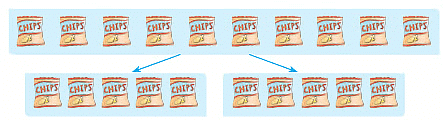
Clearly, each one of them will have 5 packets of chips.
We say that 10 divided by 2 is 5 and write 10 ÷ 2 = 5.
Equal Grouping
Let us divide 12 balloons into three equal groups. How many balloons will each group contain?
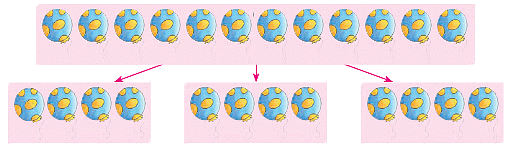
Clearly, each group will contain 4 balloons.
We write 12 ÷ 3 = 4 and read it as 12 divided by 3 is 4.
In the division fact 12 ÷ 3 = 4:
- 12 is called the dividend.
- 3 is called the divisor.
- 4 is called the quotient.
Note: '÷' is the symbol of division.
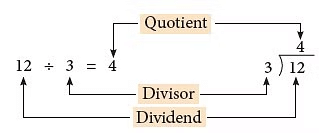
Thus, division means dividing or separating into equal groups.
Division as Repeated Subtraction
We know that multiplication is repeated addition. Similarly, division is repeated subtraction.
Sidhu was ill. The doctor gave him 12 tablets. He had to take 2 tablets daily. For how many days did the medicine last?
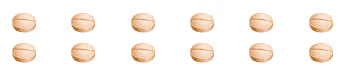
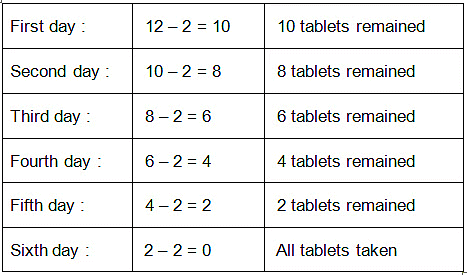
The last 2 tablets were taken on the sixth day. The medicine lasted 6 days. Here, 2 has been subtracted 6 times.
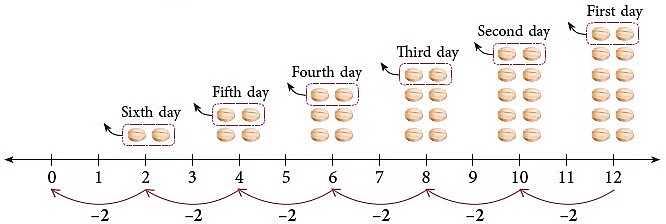
The repeated subtraction sentence is:
12 - 2 - 2 - 2 - 2 - 2 - 2 = 0
This can be written in division form as 12 ÷ 2 = 6.

Division as Repeated Subtraction on the Number Line
How many times can you subtract 5 from 25?

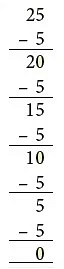
Start at 25. Jump backwards 5 steps at a time till you reach 0. The number of jumps is 5.
So, 25 ÷ 5 = 5. You can subtract 5 five times from 25.
Relation between Multiplication and Division
The picture shows 12 balls arranged in groups of 4.

This shows the multiplication fact 3 × 4 = 12 and the division fact 12 ÷ 4 = 3.
12 balls can also be arranged in groups of 3 as shown.

This shows the multiplication fact 4 × 3 = 12 and the division fact 12 ÷ 3 = 4.
Thus, we observe that the
- multiplication fact 3 × 4 = 12 gives the division fact 12 ÷ 4 = 3.
- multiplication fact 4 × 3 = 12 gives the division fact 12 ÷ 3 = 4.
By the order property of multiplication we know that, 3 × 4 = 4 × 3 = 12.
So, the multiplication fact, 3 × 4 = 12 or 4 × 3 = 12, gives two related division facts, 12 ÷ 4 = 3 and 12 ÷ 3 = 4.
A few examples are given below.
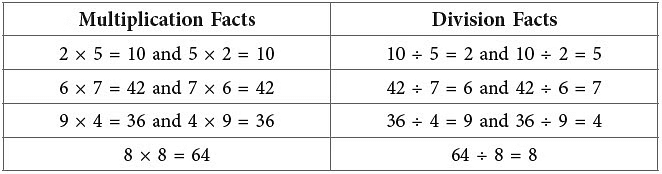
Multiplication and division are inverse operations.
For every multiplication fact with two different factors, there can be two related division facts and vice-versa. However, when both factors are the same, a multiplication fact gives only one division fact. For example, 5 × 5 = 25 gives 25 ÷ 5 = 5.
Division using Multiplication Tables
Let us find 18 ÷ 6.
Recite the table of 6 until you reach 18.
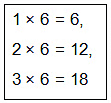
Since 3 times 6 is 18, 18 ÷ 6 = 3.
Similarly, to find 32 ÷ 8, recite the table of 8 until you reach 32.
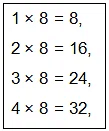
Since 4 times 8 is 32, 32 ÷ 8 = 4.
Terms Related to Division
In a division sum:
- the number to be divided is called the dividend.
- the number by which we divide is called the divisor.
- the answer we get after division is called the quotient.

Properties of Division
1. Division of a number by itself
Three bananas are shared equally among 3 girls. Each girl gets 1 banana.
This gives 3 ÷ 3 = 1.
Any number divided by itself gives 1.
2. Division of a number by 1
There are 5 laddoos in a plate. When all the 5 laddoos are given to 1 child, the child gets all 5 laddoos.
This gives 5 ÷ 1 = 5.
3. Division of 0 by any number
Zero divided by any number except 0 is zero.
Examples: 0 ÷ 7 = 0, 0 ÷ 8 = 0.
If 0 objects are distributed among any number of children, each child gets nothing.
Long Division Method
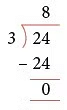
Example 1: Divide 24 by 3.
Step 1. Arrange the numbers as
that is,
Step 2. Recite the table of 3 till you reach 24.
1 × 3 = 3, 2 × 3 = 6, 3 × 3 = 9, 4 × 3 = 12,
5 × 3 = 15, 6 × 3 = 18, 7 × 3 = 21, 8 × 3 = 24
Step 3. Stop at 24 and write 8 as the quotient.
Step 4. Write 24 below 24 and subtract.
Thus, 24 ÷ 3 = 8.
Division with Remainder
Look at the following examples.

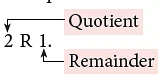
There are 7 notebooks and 3 girls. Each girl gets 2 notebooks when divided equally and 1 notebook remains.
We write this as: 7 = 3 times 2 and 1.
Now, suppose there are 13 apples and 6 boys. How many apples does each boy get when divided equally? How many apples remain?
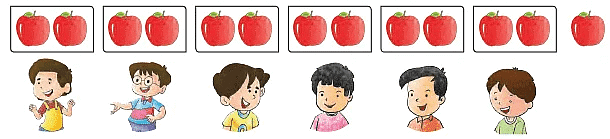
13 = 6 times 2 and 1.
Each boy gets 2 apples and 1 apple remains. When 13 is divided by 6, the quotient is 2 and the remainder is 1.
Problems Based on Real Life Situations
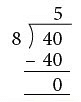
Example: 40 pencils are to be packed equally in 8 boxes. How many pencils will be there in each box?
Total number of pencils = 40
Number of boxes = 8
Each box has (40 ÷ 8) pencils = 5 pencils.
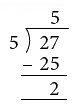
Example: Annie wants to put 27 flowers equally in 5 vases. She keeps the remaining flowers with herself. How many flowers did she keep with herself?
Total number of flowers = 27
Number of vases = 5
Each vase has (27 ÷ 5) flowers = 5 flowers and 2 remain.
Each vase has 5 flowers and 2 flowers remain with Annie.
FAQs on Multiplication and Division
| 1. How do I know when to multiply and when to divide in a word problem? |  |
| 2. What's the easiest way to learn multiplication tables for Class 2? | |
| 3. Why do I get confused between multiplication and repeated addition? | |
| 4. How do I check if my division answer is correct? | |
| 5. What are the common mistakes students make when learning division facts? | |