Practice Questions: Percentages

Definition
The term "Percentage" originates from the Latin word "per centum," signifying "by the hundred." It is symbolized by %. For instance, if we express 5%, it is equivalent to 5/100, which simplifies to 0.05.

Finding the Percentage of a Number
- Explain how to calculate a percentage of a given number using the formula:

- Provide examples and step-by-step explanations of solving percentage problems.
Percentage Increase and Decrease
- Discuss how to determine the percentage increase or decrease between two values using the formula: Percentage Change =

- Provide practical examples, such as price changes, population growth rates, or test score improvements.
Applications of Percentages in Real Life
- Examine diverse situations where percentages find common application, including scenarios involving discounts and sales, interest rates, inflation, and fluctuations in the stock market.
- Elaborate on the significance of comprehending percentages in the realm of personal finance and decision-making.
Calculating Percentages in Statistics
- Examine the involvement of percentages in statistics, encompassing tasks like determining proportions, relative frequencies, and percentages in surveys or data analysis.
- Emphasize the importance of percentages in depicting data accurately and facilitating meaningful comparisons.
Solving Percentage Problems
- Present a set of exercises that span various percentage scenarios, incorporating tasks such as calculating percentages, solving for original values, and determining percentage changes.
- Furnish detailed solutions and explanations in a step-by-step manner to assist users in comprehending the problem-solving approach.
Fraction to Percentage Conversion
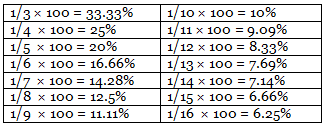
Examples on Percentages
Example1: Luaa spends her monthly salary in the following manner: 20% on house rent, 20% on food, 5 % on transportation, 10% on the education, and 20% on other household expenses. She saves the remaining amount of ₨. 5000 at the end of the month. Find out her monthly salary?
(a) Rs. 35000
(b) Rs. 25000
(c) Rs. 20000
(d) Rs. 30000
Ans: (c)
Sol: Let the monthly salary be x (this represents 100%).
Total expenditure = 20% + 20% + 5% + 10% + 20% = 75% of x = 0.75x.
Therefore savings = 100% - 75% = 25% of x = 0.25x.
Given that 0.25x = 5000.
So x = 5000 ÷ 0.25 = 20,000.
Therefore, her monthly salary = Rs. 20,000.
Example 2: Aman spends 60% of his income. Suppose his income is increased by 21% and his expenditure increases by 5%, then what is the increase in his savings (in percentage)?
(a) 60%
(b) 18%
(c) 40%
(d) 45%
Ans: (d)
Sol: Assume Aman's original income = 100 units.
Original expenditure = 60 ⇒ original savings = 100 - 60 = 40 units.
New income = 100 × 1.21 = 121 units.
New expenditure = 60 × 1.05 = 63 units.
New savings = 121 - 63 = 58 units.
Increase in savings = 58 - 40 = 18 units.
Percentage increase in savings = (Increase ÷ Original savings) × 100 = (18 ÷ 40) × 100 = 45%.
Hence the increase in savings is 45% (option d).
Questions based on Percentages
Q1: A man made a contribution of 7% of his income to a needy person and saved 25% of the balance. If he now has, Rs. 2100 left, then find his actual income?
(a) 9626.26
(b) 9727.27
(c) 3010.75
(d) 10000
Ans: (c)
Sol: Let actual income = X.
Amount contributed = 7% of X = 0.07X. Remaining = X - 0.07X = 0.93X.
He saves 25% of the remaining balance, so amount saved = 0.25 × 0.93X = 0.2325X.
Amount left after saving = Remaining - Saved = 0.93X - 0.2325X = 0.6975X.
Given that this remaining amount is Rs. 2,100, so 0.6975X = 2,100.
Therefore X = 2,100 ÷ 0.6975 ≈ 3,010.752688... ≈ Rs. 3,010.75.
Thus the actual income ≈ Rs. 3,010.75, option (c).
Q2: In an examination, 40% are passing percentage. If a person gets 41 marks and fails by 3 marks, what are the maximum marks?
(a) 110
(b) 100
(c) 120
(d) 150
Ans: (a)
Sol: The passing marks = 41 + 3 = 44.
If maximum marks are m, then 40% of m = 44 ⇒ 0.40m = 44.
So m = 44 ÷ 0.40 = 110.
Therefore maximum marks = 110 (option a).
Q3: Reema saves 51% of his total income of Rs. 15000 per month. Calculate his total spending.
(a) 7350
(b) 7550
(c) 6500
(d) 8560
Ans: (a)
Sol: Money spent = (100% - 51%) of 15,000 = 49% of 15,000.
Amount = (49 ÷ 100) × 15,000 = 0.49 × 15,000 = 7,350.
Therefore money spent = Rs. 7,350 (option a).
Q4: If Jenny's income is 30% more than that of Nikita, how much percent of Nikita's income is less than that of Jenny?
(a) 23.08%
(b) 25.5%
(c) 27.60%
(d) 29%
Ans: (a)
Sol: Let Nikita's income = 100 units. Then Jenny's income = 100 + 30 = 130 units.
Percentage by which Nikita's income is less than Jenny's = [(130 - 100) ÷ 130] × 100 = (30 ÷ 130) × 100 = 23.0769% ≈ 23.08%.
Hence option (a).
Q5: If the price of an article is increased by 18%, determine by how much percent must a user reduce the use, so that expenditure on it remains unchanged?
(a) 13.24%
(b) 16%
(c) 25%
(d) 15.3%
Ans: (d)
Sol:
Let original price = P and original quantity used = Q so original expenditure = P×Q.
New price = P × 1.18. To keep expenditure constant, new quantity Q' must satisfy P×Q = (P×1.18)×Q' ⇒ Q' = Q ÷ 1.18.
Fractional reduction in quantity = 1 - (1 ÷ 1.18) = (1.18 - 1) ÷ 1.18 = 0.18 ÷ 1.18.
Percentage reduction = (0.18 ÷ 1.18) × 100 = (18 ÷ 118) × 100 ≈ 15.2542% ≈ 15.3%.
Therefore the user must reduce use by approximately 15.3% (option d).
FAQs on Practice Questions: Percentages
| 1. How do I solve percentage increase and decrease problems quickly for SSC CGL? |  |
| 2. What's the difference between percentage and percentile in quantitative aptitude questions? | |
| 3. Why do I keep getting wrong answers on compound percentage problems? | |
| 4. How should I approach percentage word problems involving profit, loss, and discounts? | |
| 5. What percentage formula tricks help solve questions involving populations or ratios faster? | |