SSC CGL Exam  >  SSC CGL Notes  >  Quantitative Aptitude  >  Solved Examples Square Roots and Cube Roots - Quantitative Aptitude for SSC CGL

Solved Examples Square Roots and Cube Roots - Quantitative Aptitude for SSC CGL

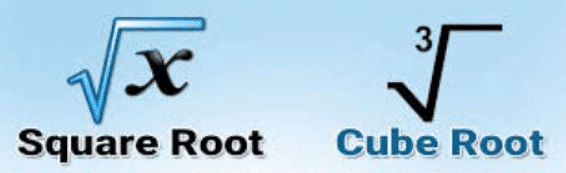
Square Root

The square root of a number y is a number x such that x² = y. It is written as √y = x. For example, √9 = 3, √16 = 4.

Cube Root

The cube root of a number y is a number x such that x³ = y. It is written as ∛y = x. For example, ∛8 = 2, ∛27 = 3.

Cube Root

Important Formulae and Identities

  • √(ab) = √a × √b (both a and b must be non-negative)
  • √(a/b) = √a / √b (b ≠ 0, a and b non-negative)
  • √(a²) = |a|
  • √(a + b) ≠ √a + √b in general (care required)
  • ∛(ab) = ∛a × ∛b
  • ∛(a/b) = ∛a / ∛b (b ≠ 0)
  • To rationalise a denominator containing a square root, multiply numerator and denominator by the conjugate when needed.

Methods and Concepts

Prime-factor method for perfect square and perfect cube

Write the number as a product of prime powers. For a perfect square each prime exponent must be even; for a perfect cube each prime exponent must be a multiple of three. To make the number a perfect square/cube, multiply by the smallest integer that makes every prime exponent satisfy the required multiple.

Rationalisation of denominator (square-root case)

To remove a surd from the denominator of a fraction such as (√a + √b)/(√a - √b), multiply numerator and denominator by the conjugate (√a + √b) to use the identity (√a - √b)(√a + √b) = a - b.

Simplifying expressions with decimals under square root

Use place-value factors: √(m / 10^k) = √m / 10^(k/2). Convert to whole-number square roots when possible.

Solved Examples

Example 1: What is the least number required to multiply to 9720 to make a perfact cube?
(a) 55
(b) 65
(c) 75
(d) 85
Ans: 
(c)

Factorise 9720 into primes.

\(9720 = 2^3 \times 3^5 \times 5^1\)

To make a perfect cube, every prime exponent must be a multiple of 3.

\(2^3\) already has exponent a multiple of 3.

\(3^5\) needs 1 more power of 3 to become \(3^6\).

\(5^1\) needs 2 more powers of 5 to become \(5^3\).

Therefore the smallest multiplier is:

\(3^1 \times 5^2 = 3 \times 25 = 75\)

Hence the required number is 75.

Example 2: If √ 15 = 3.8729 then what is (√5 + √3)/(√5 - √3)?
(a) 7.8729
(b) 6.8729
(c) 5.8729
(d) 4.8729
Ans:
(a)

Rationalise the denominator by multiplying numerator and denominator by the conjugate.

\(\dfrac{\sqrt5+\sqrt3}{\sqrt5-\sqrt3} \times \dfrac{\sqrt5+\sqrt3}{\sqrt5+\sqrt3}\)

\(\dfrac{(\sqrt5+\sqrt3)^2}{(\sqrt5)^2 - (\sqrt3)^2}\)

\(\dfrac{5 + 3 + 2\sqrt{15}}{5 - 3}\)

\(\dfrac{8 + 2\sqrt{15}}{2}\)

\(4 + \sqrt{15}\)

Using \(\sqrt{15}=3.8729\) gives \(4 + 3.8729 = 7.8729\).

Example 3: If √ 1369 = 37 then what is √13.69 + √0.1369 + √ 0.001369 + √ 0.00001369?
(a) 4.0021
(b) 4.1107
(c) 3.1232
(d) 2.1323
Ans: 
(b)

Express each decimal under a common whole number by factoring powers of 10.

\(\sqrt{13.69} = \sqrt{\dfrac{1369}{100}} = \dfrac{\sqrt{1369}}{\sqrt{100}} = \dfrac{37}{10}\)

\(\sqrt{0.1369} = \sqrt{\dfrac{1369}{10000}} = \dfrac{37}{100}\)

\(\sqrt{0.001369} = \sqrt{\dfrac{1369}{1000000}} = \dfrac{37}{1000}\)

\(\sqrt{0.00001369} = \sqrt{\dfrac{1369}{100000000}} = \dfrac{37}{10000}\)

Sum the values:

\(\dfrac{37}{10} + \dfrac{37}{100} + \dfrac{37}{1000} + \dfrac{37}{10000} = 3.7 + 0.37 + 0.037 + 0.0037 = 4.1107\)

Example 4: √(25/16) = ?
(a) 3/4
(b) 5/4
(c) 4
(d) 4/5
Ans:
(b)

Separate numerator and denominator under square root.

\(\sqrt{\dfrac{25}{16}} = \dfrac{\sqrt{25}}{\sqrt{16}} = \dfrac{5}{4}\)

Example 5: √ 54 x √ 6 = ?
(a) 24
(b) 15
(c) 18
(d) 13
Ans: 
(c)

Combine the radicals by multiplication.

\(\sqrt{54} \times \sqrt{6} = \sqrt{54 \times 6}\)

\(\sqrt{324}\)

\(18\)

Hence the value is 18.

Example 6: ∛9261 = ?
(a) 21
(b) 17
(c) 29
(d) 23
Ans:
(a)

Factorise 9261 into primes.

\(9261 = 3^3 \times 7^3\)

Take cube root:

\(\sqrt[3]{9261} = \sqrt[3]{3^3 \times 7^3} = 3 \times 7 = 21\)

Example 7: If √15 = 3.88. What is √(5/3)?
(a) 1.213
(b) 1.293
(c) 1.321
(d) 1.432
Ans:
(b)

Express √(5/3) in terms of √15.

\(\sqrt{\dfrac{5}{3}} = \dfrac{\sqrt5}{\sqrt3} = \dfrac{\sqrt5}{\sqrt3} \times \dfrac{\sqrt3}{\sqrt3} = \dfrac{\sqrt{15}}{3}\)

Using \(\sqrt{15} = 3.88\) gives:

\(\dfrac{3.88}{3} = 1.293\)

Example 8: √(248 + √(51 + √169)) = ?
(a) 15
(b) 12
(c) 13
(d) 16
Ans:
(d)

Evaluate the innermost square root first.

\(\sqrt{169} = 13\)

\(\sqrt{51 + 13} = \sqrt{64} = 8\)

\(\sqrt{248 + 8} = \sqrt{256} = 16\)

Example 9: √ 2025 = ?
(a) 45
(b) 35
(c) 34
(d) 30
Ans: 
(a)

Factorise 2025 into prime powers.

\(2025 = 3^4 \times 5^2\)

Take square root:

\(\sqrt{2025} = \sqrt{3^4 \times 5^2} = 3^2 \times 5 = 9 \times 5 = 45\)

Example 10: √64009 = ?
(a) 803
(b) 363
(c) 253
(d) 347
Ans:
(c)

Recognise or test the nearest integer square. Compute:

\(253^2 = (250 + 3)^2 = 250^2 + 2 \times 250 \times 3 + 3^2 = 62500 + 1500 + 9 = 64009\)

Therefore \(\sqrt{64009} = 253\).

Additional Tips and Shortcuts

  • To check if a number is a perfect square or cube quickly, use its prime exponents: all even exponents ⇒ perfect square; all exponents multiples of 3 ⇒ perfect cube.
  • When rationalising denominators containing two-term surds, use the conjugate; for cube roots with sums, use algebraic identities if applicable.
  • For decimals under a square root, shift decimal point by multiplying/dividing by powers of 10 to convert to a whole number square root.
  • Memorise small squares up to 30² and cubes up to 20³ for quick recognition in competitive tests.

Summary

Understanding prime factorisation, properties of surds and rationalisation are the essential tools for solving square-root and cube-root problems efficiently. Use the stepwise methods above to simplify, evaluate nested radicals and to find the smallest multiplier to reach perfect powers.

The document Solved Examples Square Roots and Cube Roots - Quantitative Aptitude for SSC CGL is a part of the SSC CGL Course Quantitative Aptitude for SSC CGL.
All you need of SSC CGL at this link: SSC CGL
319 videos|366 docs|157 tests
Related Searches
pdf , Previous Year Questions with Solutions, Solved Examples Square Roots and Cube Roots - Quantitative Aptitude for SSC CGL, Objective type Questions, Summary, Important questions, Extra Questions, video lectures, Solved Examples Square Roots and Cube Roots - Quantitative Aptitude for SSC CGL, practice quizzes, past year papers, Viva Questions, shortcuts and tricks, Semester Notes, ppt, study material, Free, Sample Paper, Solved Examples Square Roots and Cube Roots - Quantitative Aptitude for SSC CGL, mock tests for examination, Exam, MCQs;