UPSC Exam  >  UPSC Notes  >  CSAT Preparation  >  Important Formula: HCF & LCM

Important Formula: HCF & LCM

HCF and LCM Formula

The product of two positive integers is equal to the product of their highest common factor and their least common multiple.

Relation: Product of two numbers = (HCF of the two numbers) × (LCM of the two numbers)

Definitions and Basic Ideas

Highest Common Factor (HCF) of two or more integers is the largest integer that divides each of them exactly (without remainder).

Least Common Multiple (LCM) of two or more integers is the smallest positive integer that is exactly divisible by each of them.

Note: The formula product = HCF × LCM holds exactly for two integers. It does not generalise as a straightforward equality involving the product of more than two integers without adjustments.

How to find HCF

You may find the HCF of integers by any of these standard methods:

  • Prime factorization: Factor each number into primes and take the product of common primes with the lowest powers.
  • Division (Euclidean) method: Repeatedly apply division to reduce the pair until the remainder becomes zero; the last non-zero divisor is the HCF.
  • Using the product relation: If you know the LCM of two numbers, then HCF = Product of the two numbers / LCM.

How to find LCM

Common methods to compute LCM are:

  • Prime factorization: Factor each number into primes and take the product of all primes raised to the highest powers that occur in any factorisation.
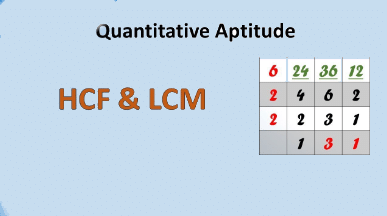
  • Division (also called the ladder or continued division) method: Divide by common prime factors simultaneously until all quotients are 1; multiply the divisors used.
  • Using the product relation: If you know the HCF of two numbers, then LCM = Product of the two numbers / HCF.
How to find LCM

HCF by Prime Factorization Method

Procedure:

  • Express each number as a product of prime factors.
  • Identify prime factors common to all numbers.
  • For each common prime, take the lowest power that appears in all factorizations.
  • Multiply those common prime powers to get the HCF.

Example: Find HCF(100, 125, 180).
Prime factorisations:
\(100 = 2 \times 2 \times 5 \times 5 = 2^2 \times 5^2\)
\(125 = 5 \times 5 \times 5 = 5^3\)
\(180 = 2 \times 2 \times 3 \times 3 \times 5 = 2^2 \times 3^2 \times 5\)
Common primes: only 5 appears in all three. The minimum power of 5 present in all is \(5^1\).
Therefore, HCF(100, 125, 180) = 5.

HCF by Division (Euclidean) Method

Procedure for two numbers:

  • Divide the larger number by the smaller number and obtain the remainder.
  • Replace the larger number by the smaller number and the smaller by the remainder.
  • Repeat the division until the remainder is zero.
  • The last non-zero remainder's divisor is the HCF.

Example: Find HCF of 120 and 180 using the Euclidean algorithm.
\(180 = 120 \times 1 + 60\)
\(120 = 60 \times 2 + 0\)
Remainder becomes zero; the last non-zero divisor is 60.
Therefore, HCF(120, 180) = 60.

LCM by Prime Factorization Method

Procedure:

  • Factor each number into primes.
  • For each distinct prime that appears in any factorisation, take the highest power of that prime occurring in any one factorisation.
  • Multiply these highest powers to obtain the LCM.

Example: Find LCM(25, 35).
Prime factorisations:
\(25 = 5 \times 5 = 5^2\)
\(35 = 5 \times 7 = 5^1 \times 7^1\)
Highest powers: \(5^2\) (from 25) and \(7^1\) (from 35).

Therefore, LCM = \(5^2 \times 7 = 25 \times 7 = 175\).

LCM by Division (Ladder) Method

Procedure (for two or more numbers):

  • Write the numbers in a row.
  • Divide by a common prime (or any prime dividing at least one of the numbers), write the quotients below.
  • Continue dividing the row by primes until all entries become 1.
  • Multiply all the divisors used; the product is the LCM.

Example: Find LCM(25, 35) by the division method.
Divide by 5:
5 | 25, 35
Quotients: 5, 7
Divide by 5 again where applicable:
5 | 5, 7
Quotients: 1, 7
Divide by 7:
7 | 1, 7
Quotients: 1, 1
Multiply the divisors used: \(5 \times 5 \times 7 = 175\).
Therefore, LCM(25, 35) = 175.

Questions and Answers of HCF and LCM

Q1: Calculate the highest number that will divide 43, 91 and 183 and leaves the same remainder in each case
(a) 4
(b) 7
(c) 9
(d) 13
Ans: 
(a)
Here the trick is
Find the Differences between number
Get the HCF (that differences)
We have here 43, 91 and 183
So differences are
183 - 91 = 92,
183 - 43 = 140,
91 - 43 = 48.
Now, HCF (48, 92 and 140)
48 = 2 × 2 × 2 × 2 × 3
92 = 2 × 2 × 23
140 = 2 × 2 × 5 × 7
HCF = 2 × 2 = 4
And 4 is the required number.

Q2: The greatest possible length which can be used to measure exactly the lengths 7 m, 3 m 85 cm, 12 m 95 cm is:
(a) 25 cm
(b) 15 cm
(c) 35 cm
(d) 55 cm
Ans:
(c)
Required length = H.C.F. of 700 cm, 385 cm and 1295 cm = 35 cm.

Q3: Which of the following is greatest number of four digits which is divisible by 15, 25, 40 and 75 is:
(a) 9700
(b) 9600
(c) 9800
(d) 9650
Ans:
(b)
Greatest number of 4-digits is 9999.
Now , find the L.C.M. of 15, 25, 40 and 75 i.e. 600.
On dividing 9999 by 600, the remainder is 399.
Hence, Required number (9999 - 399) = 9600.
Alternatively,
9999/600 = 16.66500
Ignore the decimal points, required number would be 16 * 600 = 9600

Additional Properties and Useful Points

  • If two numbers are coprime (HCF = 1), then their LCM is the product of the numbers.
  • HCF of a set of numbers divides any linear combination of those numbers.
  • LCM of numbers is always a multiple of each number and never less than the largest number in the set.
  • For more than two numbers, compute HCF and LCM pairwise or use prime factorisation across all numbers.

Final remark: Use prime factorisation when factor sizes are small and transparent; use the Euclidean method for large numbers or when handling only two numbers. The division (ladder) method is convenient for three or more numbers to get the LCM quickly.

The document Important Formula: HCF & LCM is a part of the UPSC Course CSAT Preparation.
All you need of UPSC at this link: UPSC

FAQs on Important Formula: HCF & LCM

1. How do you find the Highest Common Factor (HCF) using the Prime Factorization Method?
Ans. To find the HCF using the Prime Factorization Method, follow these steps: 1. Prime factorize both numbers. 2. Identify the common prime factors between the two numbers. 3. Multiply these common prime factors to find the HCF. For example, let's find the HCF of 24 and 36: - The prime factorization of 24 is 2^3 * 3^1. - The prime factorization of 36 is 2^2 * 3^2. - The common prime factors are 2^2 and 3^1. - Multiplying these common prime factors gives the HCF: 2^2 * 3^1 = 12.
2. How do you find the Highest Common Factor (HCF) using the Division Method?
Ans. To find the HCF using the Division Method, follow these steps: 1. Divide the larger number by the smaller number. 2. Divide the remainder of the previous step by the divisor. 3. Continue this process until the remainder becomes zero. 4. The last divisor used is the HCF. For example, let's find the HCF of 24 and 36: - Divide 36 by 24, the quotient is 1 and the remainder is 12. - Divide 24 by 12, the quotient is 2 and the remainder is 0. - The last divisor used, 12, is the HCF.
3. How do you find the Lowest Common Multiple (LCM) using the Prime Factorization Method?
Ans. To find the LCM using the Prime Factorization Method, follow these steps: 1. Prime factorize both numbers. 2. Take the highest power of each prime factor found in either of the numbers. 3. Multiply these prime factors to find the LCM. For example, let's find the LCM of 24 and 36: - The prime factorization of 24 is 2^3 * 3^1. - The prime factorization of 36 is 2^2 * 3^2. - The highest power of 2 is 2^3 and the highest power of 3 is 3^2. - Multiplying these prime factors gives the LCM: 2^3 * 3^2 = 72.
4. How do you find the Lowest Common Multiple (LCM) using the Division Method?
Ans. To find the LCM using the Division Method, follow these steps: 1. Write the given numbers in a row. 2. Divide the row by the smallest prime number that divides at least one of the numbers. 3. Divide the row by the next smallest prime number that divides at least one of the numbers. 4. Repeat the previous step until each number in the row becomes 1. 5. Multiply all the divisors used in the process to find the LCM. For example, let's find the LCM of 24 and 36: - Start with the numbers 24 and 36. - Divide the row by 2, getting 12 and 18. - Divide the row by 2 again, getting 6 and 9. - Divide the row by 3, getting 2 and 3. - Divide the row by 2, getting 1 and 3. - Divide the row by 3, getting 1 and 1. - The divisors used are 2, 2, 3, and 3. - Multiply these divisors to find the LCM: 2 * 2 * 3 * 3 = 36.
5. What is the importance of knowing HCF and LCM in mathematics?
Ans. Knowing the HCF and LCM is important in mathematics for various reasons: - HCF helps in simplifying fractions and finding the smallest common denominator. - LCM helps in adding or subtracting fractions with different denominators. - HCF and LCM are used in solving problems related to ratios, proportions, and fractions. - They are also useful in solving problems related to finding the least number of objects that can be arranged in rows or columns. - In algebra, HCF and LCM are used to simplify expressions and solve equations.
Explore Courses for UPSC exam
Get EduRev Notes directly in your Google search
Related Searches
shortcuts and tricks, Previous Year Questions with Solutions, Semester Notes, Sample Paper, MCQs, Important questions, mock tests for examination, Important Formula: HCF & LCM, video lectures, Viva Questions, ppt, Free, Summary, Important Formula: HCF & LCM, Objective type Questions, Extra Questions, study material, practice quizzes, pdf , past year papers, Important Formula: HCF & LCM, Exam;