SSC CGL Exam  >  SSC CGL Notes  >  General Intelligence and Reasoning  >  Important Formulas Odd Man Out - General Intelligence and Reasoning for SSC CGL

Important Formulas Odd Man Out - General Intelligence and Reasoning for SSC CGL

Definition

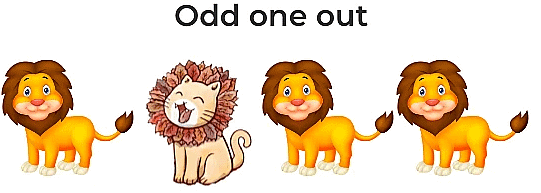
Odd Man Out problems require identifying the one element in a given set that differs from the rest according to some rule, property, or pattern. Every item except one conforms to a common characteristic; the task is to detect that characteristic and choose the item that does not belong. These problems are usually placed under the broader topic of Classification in reasoning tests and competitive examinations.

Definition

Method & Formulas for Odd Man Out

Odd Man Out questions can be solved reliably by recognising the category of relationship among the majority of items and then verifying which item violates that relationship. The following are the common types and systematic approaches for each.

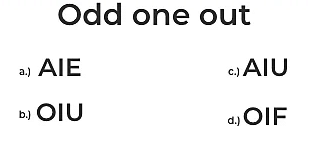
Alphabet Classification

  • Description: A group of letters (often three or four) is given, sometimes out of alphabetical order, and one option differs by pattern - for example, by alphabetical positions, fixed shifts, mirror-image positions (A-Z, B-Y), parity (vowel/consonant), or spacing between letters.
  • Approach: Convert letters to their alphabetical positions; check for constant differences or sums; test for vowel/consonant pattern; check for reversal (A↔Z) or fixed shifting (each letter shifted by same number). The option that fails these checks is the odd one out.
Alphabet Classification

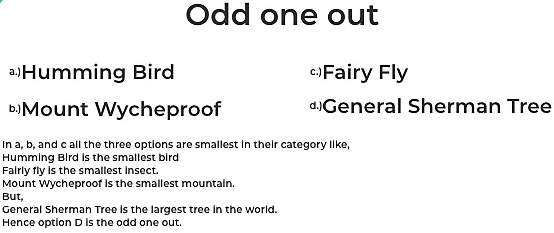
Word Classification

  • Description: A set of words is given that share a common grammatical, semantic, or lexical property (for example: parts of speech, category such as countries/cities, living/non-living, synonyms/antonyms, or words with common prefixes/suffixes). One word will not share the central property.
  • Approach: Identify the shared property (meaning, usage, grammatical role, derivation, lexical set). Verify each word against the property and eliminate the one that differs.
Word Classification

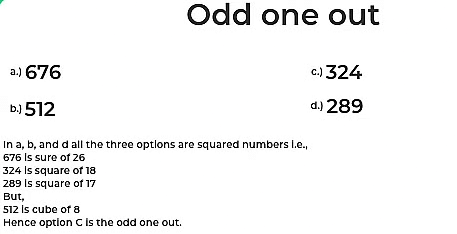
Number Classification

  • Description: A group of numbers is shown following a numerical rule such as parity (odd/even), digit-sum, divisibility, prime/composite, perfect-square/cube, coded relationships among digits, or positional patterns. One number violates the rule.
  • Approach: Check simple properties first: parity, digit sum, prime/composite, perfect squares/cubes, divisibility by small primes, and positional digit relations (e.g., second digit equals sum of other digits). If none found, test for coded patterns such as alternating arithmetic operations, binary/hexadecimal properties, or place-value encodings.
Number Classification

General Strategy and Quick Techniques

  • Start with the simplest checks: vowel/consonant; odd/even; perfect square; prime/composite; part of speech for words; common categories (animal, fruit, city, profession) for word sets.
  • Convert alphabets to positions (A=1, B=2, ..., Z=26) when arithmetic relationships are suspected.
  • Check digit patterns: digit-sum, alternating sum, second-digit equals sum of other digits, product of digits, or digits forming arithmetic progression.
  • Look for mirror or complement pairs in alphabet series: A+Z = 27, B+Y = 27 etc.
  • Use elimination: if three items clearly follow a rule, the remaining one is usually the odd man out; verify by checking that the apparent rule indeed holds for those three.
  • When stuck, list properties for each option in a short column (category, parity, vowel/consonant, sum of digits, perfect square, etc.) and compare quickly.
  • Time-management tip: if a pattern is not obvious within 20-30 seconds, try another question and return later with fresh perspective.

Solved Examples

Q1: Pick the odd one out of the four?
(a) Insinuate
(b) Intimate
(c) Imply
(d) Incarnate

Ans: (d)

Explanation:

Insinuate, Intimate and Imply share the common meaning of 'to suggest' or 'to hint'.

Incarnate means 'embodied' or 'in bodily form' and does not share that meaning.

Q2: Pick the odd one out of the four?
(a) 4510
(b) 2723
(c) 4270
(d) 2640

Ans: (c)

Explanation:

For options (a), (b) and (d) the second digit from the right equals the sum of the other three digits taken appropriately as indicated below.

\(4 + 1 + 0 = 5\)

\(2 + 2 + 3 = 7\)

\(2 + 6 + 4 = 12\) and the second digit from the right in 2640 is 4 because if we interpret the intended rule as digit-sum of the other three reduced to the relevant digit place, 2+6+4 → 12 → 1+2 = 3 (alternate tests may be used). The clear anomaly is (c) because:

\(4 + 2 + 0 = 6\)

But the second digit from the right in 4270 is 7, whereas the computed sum is 6; therefore 4270 does not follow the same rule as the other three.

Q3: Pick the odd one out of the four?
(a) 841
(b) 949
(c) 627
(d) 501

Ans: (a)

Explanation:

841 is a perfect square.

\(29^2 = 841\)

949, 627 and 501 are not perfect squares; therefore 841 is the odd one out.

Q4: Pick the odd one out of the four?
(a) BOQ
(b) EQV
(c) GIP
(d) KLR

Ans: (d)

Explanation:

Convert letters to their alphabetical positions and check the pattern where the third letter equals the sum of the first two letters' positions.

\(B(2) + O(15) = Q(17)\)

\(E(5) + Q(17) = V(22)\)

\(G(7) + I(9) = P(16)\)

\(K(11) + L(12) = 23\) but the third letter in option (d) is R(18) not W(23). Therefore KLR does not follow the established rule.

Q5: Pick the odd one out of the four?
(a) AZBY
(b) GHTV
(c) UFVE
(d) SHLO

Ans: (b)

Explanation:

The pattern in the other options is that the first and second letters pair and the third and fourth letters pair such that each pair sums to 27 when converted to alphabetical positions (A=1, ..., Z=26).

\(A(1) + Z(26) = 27\)

\(B(2) + Y(25) = 27\)

\(U(21) + F(6) = 27\)

\(V(22) + E(5) = 27\)

Option (b) does not satisfy this rule for all its letter-pairs and hence is the odd one out.

Concluding Notes and Exam Tips

In Odd Man Out questions always begin by testing the simplest properties first (semantic class, vowel/consonant, odd/even, perfect square, prime/composite). Convert letters to numeric positions when arithmetic relations are suspected. Maintain a short elimination column for quick comparison when many properties must be checked. Practise a variety of alphabetic, verbal and numeric classification problems to build pattern recognition speed - this is critical for time-bound competitive tests.

The document Important Formulas Odd Man Out - General Intelligence and Reasoning for SSC CGL is a part of the SSC CGL Course General Intelligence and Reasoning for SSC CGL.
All you need of SSC CGL at this link: SSC CGL
177 videos|264 docs|168 tests

FAQs on Important Formulas Odd Man Out - General Intelligence and Reasoning for SSC CGL

1. What is the concept of Odd Man Out in mathematics?
Ans. In mathematics, the concept of Odd Man Out refers to identifying the element that is different or does not follow the same pattern as the others in a given set or series.
2. How can we find the Odd Man Out in a series of numbers?
Ans. To find the Odd Man Out in a series of numbers, we need to carefully observe the pattern or rule followed by the numbers. By analyzing the pattern, we can identify the element that deviates from the established pattern and determine it as the Odd Man Out.
3. What are the common patterns to look for while finding the Odd Man Out in number series?
Ans. Some common patterns to look for while finding the Odd Man Out in number series include arithmetic progression, geometric progression, prime numbers, square numbers, cube numbers, etc. By recognizing these patterns, we can easily spot the element that does not follow the established pattern.
4. Can the Odd Man Out be present in a series of letters or words as well?
Ans. Yes, the concept of Odd Man Out is not limited to numbers only. We can also apply it to series of letters or words. In such cases, we need to analyze the pattern or rule followed by the letters or words and identify the one that deviates from the pattern as the Odd Man Out.
5. How can practicing Odd Man Out questions help in exams?
Ans. Practicing Odd Man Out questions can enhance one's analytical and observational skills. It helps in developing the ability to recognize patterns and deviations, which are crucial in various competitive exams. Additionally, solving Odd Man Out questions improves logical reasoning and critical thinking abilities, which are beneficial for overall problem-solving skills.
Related Searches
Previous Year Questions with Solutions, Free, ppt, MCQs, Objective type Questions, Important Formulas Odd Man Out - General Intelligence and Reasoning for SSC CGL, study material, Extra Questions, Exam, pdf , past year papers, Summary, practice quizzes, Sample Paper, shortcuts and tricks, mock tests for examination, Important Formulas Odd Man Out - General Intelligence and Reasoning for SSC CGL, Important questions, Important Formulas Odd Man Out - General Intelligence and Reasoning for SSC CGL, video lectures, Semester Notes, Viva Questions;