Introduction: Word Formation

Introduction
Word Formation is a type of logical reasoning question that tests a candidate's ability to form meaningful words or analyze patterns using given letters, words, or rules. These questions assess your verbal reasoning, vocabulary, and ability to identify relationships or patterns in words.
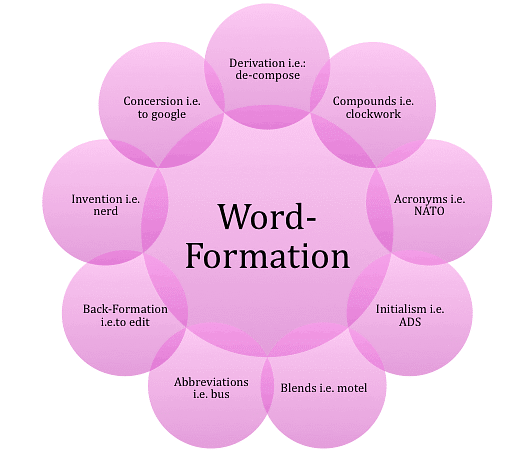
Types of Questions
There are three types of questions based on the word formation which are generally asked in various competitive examinations.
Type 1: Word Formation Using Letters from a Given Word
- In this , we make a real English word by using and rearranging the letters from a word given in the question.
- You can only use the letters that are in the given word, and you can't use a letter more times than it appears in that word.
Directions (Example Nos. 1-2) In the following questions, select the word from the given alternatives that cannot be formed using the letters of the given word.
Example1: CHARACTER
(a) TRACER
(b) CHARTER
(c) HEARTY
(d) CRATE
Ans: (c)
By using the letters of the given word, HEARTY can't be formed because in the given word, letter Y is absent.
Example2: ADMINISTRATION
(a) RATION
(b) MINISTER
(c) MIND
(d) STATION
Ans: (b)
By using the letters of the given word, MINISTER can't be formed because in the given word, letter E is absent.
Directions (Example Nos. 3-4): In each of the following questions, a word has been given, followed by four other words, one of which can be formed by using the letters of the given word. Find that word.
Example 3: DEMOCRACY
(a) SECRECY
(b) MICRO
(c) MARCY
(d) DEMON
Ans: (c)
All the letters of this word are present in the main word.
Hence, 'MARCY' can be formed from the letters of the given word 'DEMOCRACY'.
Example 4: COMPENSATION
(a) TINY
(b) COPY
(c) MENTION
(d) MOTIVE
Ans: (c)
MENTION - All the letters of the word are present in the main word. Hence, 'MENTION' can be formed from the letters of the given word 'COMPENSATION'.
Type 2: Forming Word with Selected Letters of Given Word
- This is a reasoning concept where you create a meaningful English word by using only specific letters chosen from a given word, following certain rules (e.g., selecting letters from particular positions or a subset of letters)
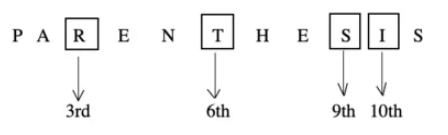
Example 5: If it is possible to make only one meaningful word from the 3rd, the 6th, the 9th and the 10th letters of the word 'PARENTHESIS' using each letter only once, last letter of the word is your answer. If no such word can be formed, your answer is 'X' and if more than one such word can be formed, your answer Y.
(a) R
(b) T
(c) X
(d) Y
Ans: (a)
Since, 3rd, 6th, 9th and 10th letters are R, T, S and I respectively. Hence, only one meaningful word STIR can be formed. last letter of this word is R, so correct option is (a).
Example 6: If it is possible to make a meaningful word 'INTERPRETATION', then which of the following will be the third letter of that word? If more than one such word can be made, then give 'M' as the answer and if no such word can be formed, then give 'X' as the answer.
(a) T
(b) R
(c) M
(d) X
Ans: (c)
Since, 1st, 4th, 7th and 11th letters are I, E, R and T respectively. Hence, three meaningful words RITE, TIRE and TIER can be formed. Since, more than one words are formed from the given letters, so answer is M.
Type 3: Forming Meaningful Words Using Given Letters
- This is a reasoning concept where you create valid, meaningful English words by rearranging a specific set of letters provided in the question
Example 7: How many meaningful English words can be formed by using letters of the word 'ALEP'?
(a) One
(b) Two
(c) Three
(d) More than three
Ans: (c)
Such meaningful words are 'PEAL', 'LEAP' and 'PALE'.
Example 8: How many meaningful English words can be made with the letters IFEL, using each letter only once in each word?.
(a) None
(b) One
(c) Two
(d) Three
Ans: (c)
Such meaningful words are 'FILE' and 'LIFE'.
Type 4: Word Formation by Unscrambling Letters
- In this type of question, a set of English letters is given in a jumbled order. The candidate is required ton arrange these letters to form a meaningful word.
- Always try to place the letters according to the numbers provided in options rather than doing it on the basis of your vocabulary knowledge
Example 9: Select the combination of numbers that forms a meaningful word.
G, N, A, E, H, R
(a) 3, 5, 6, 2, 4, 1
(b) 5, 3, 1, 2, 4, 6
(c) 5, 3, 2, 1, 4, 6
(d) 5, 3, 1, 2, 6, 4
Ans:
(1): 3, 5, 6, 2, 4, 1 → AHRNEG (Not a meaningful word)
(2): 5, 3, 1, 2, 4, 6 → HAGNER (Not a meaningful word)
(3): 5, 3, 2, 1, 4, 6 → HANGER (Meaningful word)
HANGER means "A metal, plastic or wooden object with a hook that is used for hanging up clothes in a cupboard."
(4): 5, 3, 1, 2, 6, 4 → HAGNRE (Not a meaningful word)
Hence, Option (3) is the correct answer.
Example 10: Rearrange the letters A, R, T, Y and D to form a meaningful word and select from the given alternatives, the word which is almost opposite in meaning to the word so formed.
(a) Dirty
(b) Quiet
(c) Quick
(d) Queek
Ans: (c)
The word that can be formed by rearranging the given letters is 'Tardy' which means 'Sluggish' and opposite of this word is 'Quick'.
Type 5: Formation of a Meaningful word by adding letters/words in the given word(s)
- In this type of questions, some words are given and the candidate has to either suffix or prefix same letter in each of the given words to make new meaningful words.
- It also includes questions based on forming two meaningful words by inserting a word in between the given word.
Example 11: Given below are some groups of letters. Which of the options can be joined at the end of these letters to make them meaningful words?
LEN, SAN, WOR, SEE
(a) A
(b) D
(c) B
(d) K
Ans: (b)
Letter D is suffixed to the given words
LEN + D = LEND
SAN + D = SAND
WOR + D = WORD
SEE + D = SEED
Example 12: Which single letter can be prefixed to the following words to form entirely new words?
TILL TABLE PILE TAB PRING
(a) H
(b) S
(c) B
(d) C
Ans: (b)
Letter S is prefixed to the given words
S + TILL = STILL
S + TABLE = STABLE
S + PILE = SPILE
S + TAB = STAB
S + PRING = SPRING
FAQs on Introduction: Word Formation
| 1. What is word formation? |  |
| 2. What are some common types of word formation processes? | |
| 3. How does affixation work in word formation? | |
| 4. Can you provide an example of compounding in word formation? | |
| 5. What is the difference between conversion and blending in word formation? | |