Introduction: Paper Folding | General Intelligence and Reasoning for SSC CGL PDF Download

Introduction
"Paper Folding is a process in which a piece of paper (with certain embedded design pattern) is folded along a certain dotted line and it is asked to select the correct folded pattern."
Queries related to 'Paper Folding' consist of an inquiry illustration depicting a transparent sheet and four response illustrations. The transparent sheet features a certain figurative pattern and one or more dashed lines that signify the axis or axes around which the paper is folded. The task for the candidate is to select an option from the provided choices that closely resembles the design that emerges on the transparent sheet after the folding process.
Example 1: Find the pattern which will appear on the transparent sheet after it is folded along the dotted line.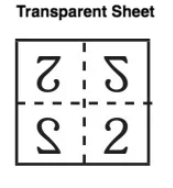
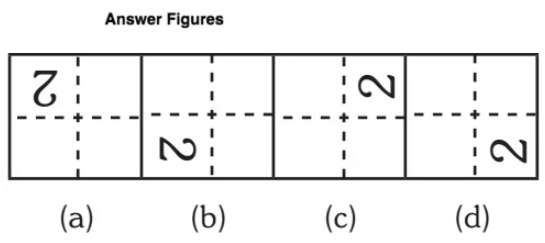 Ans: (a)
Paper will be folded from right to left then down to up. Thus, figure (a) is the correct figure, and the answer is (a).
For problems on Paper Cutting, imagine the process of folding, cutting and opening, and draw indicative diagrams if required
Example 2: Find the pattern which will appear on the transparent sheet after it is folded along the dotted line.
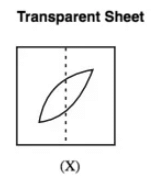
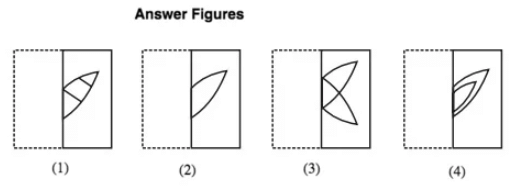 Ans: (3)
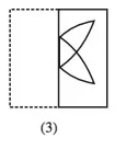 If you fold the paper from left to right from dotted line, the left part figure will go in opposite direction. Please take a transparent paper and draw a similar figure and fold it.Thus, figure (3) is the correct figure, and the answer is (3).
Step-by-Step Guide to Solve Paper Folding Questions
Follow the below steps to solve any kind of paper folding-based questions.
- Step 1: Observation: Observe the paper carefully, and note the shape of the paper.
- Step 2: Visualization: In your mind, carefully visualize the fold. Mostly you will find one-fold questions, which are easy to visualize but sometimes you may encounter more than one-fold questions.
- Step 3: Elimination Method: Once you visualize the final outcome, try to use the elimination method wrong answer which clearly can’t be the answer. Narrow down your choices.
- Step 4: Choose the best match that falls exactly the way you visualize.
Examples
Direction to solve: In each of the following problems, a square transparent sheet (X) with a pattern is given. Determine which of the four options would result in the pattern looking the way you want it to when the transparent sheet is folded at the dotted line.
Example1: In the following problems, a square transparent sheet with a pattern is given. Figure out from amongst the four alternatives how the pattern would appear when the transparent sheet is folded at the dotted line.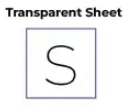
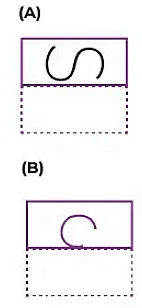
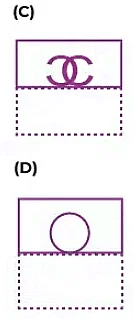
Ans: (d)
Option D is the correct answer. By carefully examining it, we can see that the red marked area will become common when the paper is folded. Both the parts of the curves come together to form a circle in option D.

Example2: In the following problems, a square transparent sheet with a pattern is given. Figure out from amongst the four alternatives how the pattern would appear when the transparent sheet is folded at the dotted line.
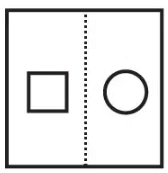
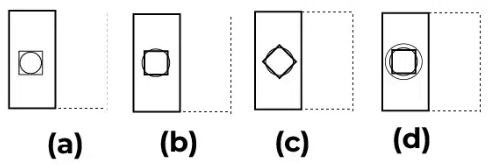
Ans: (b)
Option B is the correct answer. As we can see the diameter of the circle and side of the square are of equal length so options A and D are directly eliminated. Option c gets eliminated as here square in rotate 90 degrees from the original image needs to be formed.
Example 3: In the following problems, a square transparent sheet with a pattern is given. Figure out from amongst the four alternatives how the pattern would appear when the transparent sheet is folded at the dotted line.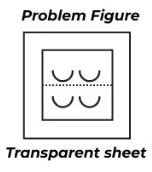
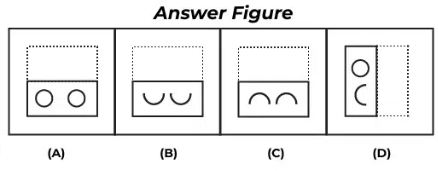
Ans: (a)
Option A is the correct answer. The first half of the paper will complete the circle in the second half. When the upper part of the square sheet is folded downward part of the semi-circle gets inverted and both form a circle.
Example 4: In the following problems, a square transparent sheet with a pattern is given. Figure out from amongst the four alternatives how the pattern would appear when the transparent sheet is folded at the dotted line.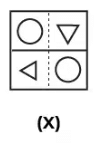
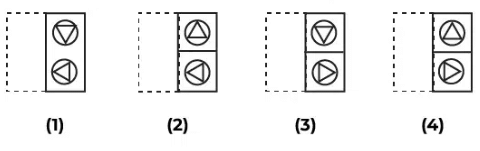 Ans: (3)
Option 3 is the correct answer. The triangle on the upper half will not change but the triangle on the second half will flip horizontally.
Example 5: In the following problems, a square transparent sheet with a pattern is given. Figure out from amongst the four alternatives how the pattern would appear when the transparent sheet is folded at the dotted line.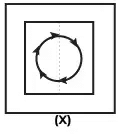
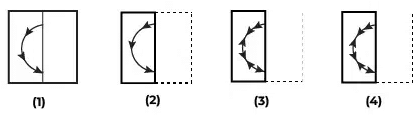 Ans: (3)
Option 3 is the correct answer. When the circle with an arrow is folded arrows in both halves of the paper will face in opposite directions as in option 3.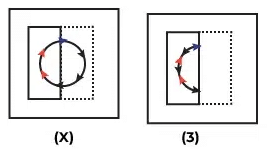
Example 6: In the following problems, a square transparent sheet with a pattern is given. Figure out from amongst the four alternatives how the pattern would appear when the transparent sheet is folded at the dotted line.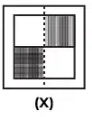
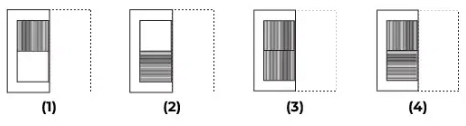 Ans: (4)
The lower portion will not change, as the lines in the upper side are vertical, again there will be no change in the direction of the lines. Option 4 is the correct answer.
|
177 videos|216 docs|200 tests
|




past year papers
,practice quizzes
,Exam
,Introduction: Paper Folding | General Intelligence and Reasoning for SSC CGL
,Objective type Questions
,Extra Questions
,study material
,video lectures
,Introduction: Paper Folding | General Intelligence and Reasoning for SSC CGL
,ppt
,Semester Notes
,Viva Questions
,shortcuts and tricks
,Free
,MCQs
,mock tests for examination
,Important questions
,Sample Paper
,Introduction: Paper Folding | General Intelligence and Reasoning for SSC CGL
,Summary
,Previous Year Questions with Solutions
;



Introduction: Paper Folding Free PDF Download
Importance of Introduction: Paper Folding
Introduction: Paper Folding Notes
Introduction: Paper Folding SSC CGL Questions
Study Introduction: Paper Folding on the App
|
© EduRev
|
Education Revolution
|


|




within 7 days!