Introduction: Completion of Figures | General Intelligence and Reasoning for SSC CGL PDF Download

Introduction
Figures completion involves identifying the absent segment within a figure among the provided choices. The goal is to select an option that, when placed in the missing position, results in a complete figure.
Different types of questions covered in this section are follows
- Rotational Symmetry Through an Angle of 90°
- Diagonally Opposite Parts are Similar
- Adjacent Parts are Laterally / Vertically Inverted Images
- Based on Certain Design and Pattern
Queries related to figure completion are segmented into two components: the question figure and the answer figures. The question figure is presented on the left side, accompanied by the answer figures on the right side. The question figure is intentionally incomplete, with a portion (typically 1/4 of the figure) missing and denoted by a question mark (?). In this scenario, the task for the participant is to select a figure from the provided answer figures that seamlessly integrates into the position of the question mark (?), preserving the same pattern to achieve the full design of the given question figure.
TIPS on cracking Non Verbal Reasoning Questions on Completion of Figures
Time plays a crucial role in all examinations, requiring candidates to finish their exams within a designated timeframe. Competitive exams specifically assess individuals' calculation abilities within strict time constraints, evaluating how rapidly students can navigate a question paper. Consequently, many students struggle to complete their papers within the allotted time. To efficiently tackle government, bank, or other examination papers, it is advisable to employ reasoning techniques and strategies such as Completion of Figures (Non-Verbal Reasoning). These approaches can significantly enhance your ability to solve exam papers swiftly and effectively.
Type - 1 : Rotational Symmetry Through an Angle of 90°
Tip# : In this type of questions, the question figure looks the same if it is rotated by 90° in clockwise or anti-clockwise direction.
Example:
Example1: Identify the missing part of the given figure and select it from given answer figures.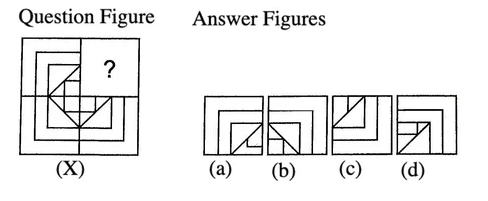
Ans: (b)
Here, all the three equal parts have similar design, if rotated in clockwise direction. So, we can obtain the answer figure for the missing portion by rotating the question figure by 90° clockwise.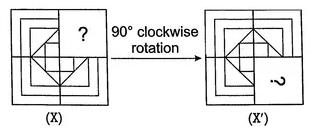 now by comparing figure (X) and(X')
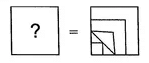 now it is clear that answer figure (b) completes the question figure, which looks like as shown in the below figure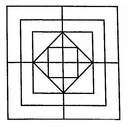
Example2: Identify the missing part of the given figure and select it from given answer figures.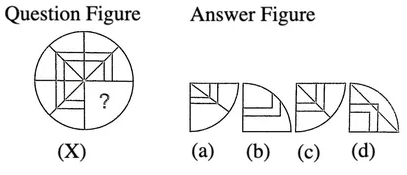 Ans: (c)
Here, all the three equal parts have similar design, if rotated in clockwise direction. So, we can obtain the answer figure for the missing portion by rotating the question figure by 90° clockwise.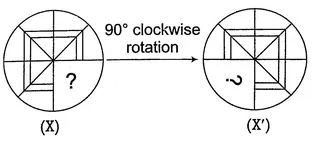 now by comparing figure (X) and(X') we get
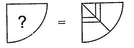 Now, it is quite clear that option (c) will fill the incomplete part of the question figure(X), After completion, the figure will be look like this
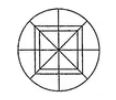 Example3: Which of the answer figures given will complete the pattern of the question figure?
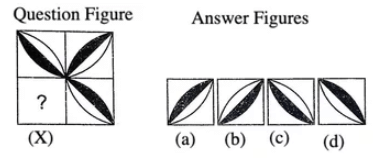 Ans: (b)
Here, all the three equal parts have similar design, if rotated in clockwise direction. So, we can obtain the answer figure for the missing portion by rotating the question figure (X) by 90° in clockwise direction.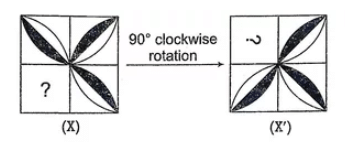 now by comparing figure (X) and (X'), we get
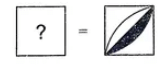 clearly, option figure(b) complete the orignal figure which look like as shown in the below figure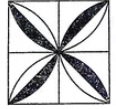
Example - 4 In the following question, complete the missing portion of the question figure by selecting from the given answer figures (a), (b), (c) and (d).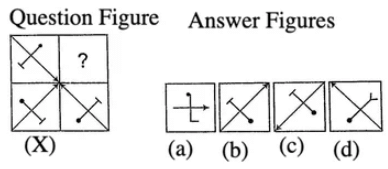
Ans: (c)
Here, all the three equal parts have similar design, if rotated in clockwise direction. So, we can obtain the answer figure for the missing portion by rotating the question figure (X) by rotating the original given figure by 90° clockwise.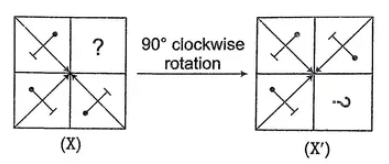 now by comparing figure (X) and (X'), we get
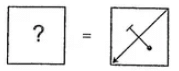 Now, it is clear that option (c) will replace (?) to make the figure complete.
Type - 2 : Diagonally Opposite Parts are Similar
Tip#: In this type of questions, the diagonally opposite parts have similar design and if the figure is rotated through 180° in clockwise/anti-clockwise direction the figure remains the same.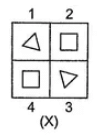 In figure (X), diagonally opposite parts i.e., 1-3 and 2-4 have similar design and figure (X) is rotated through 180° , then figure will change as
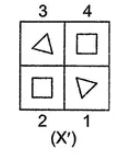 So, figures (X) and (X') are same.
Now, if any of the parts of above figure (X) is missing, then it can be obtained by rotating the figure 180° in clockwise/anti-clockwise direction.
This can be better understood with the help of following examples
Example 1: Identify the missing part of the question figure and select it from given answer figures.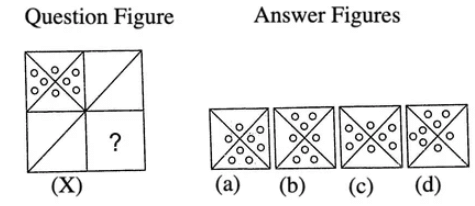
Ans: (c)
Here, the diagonally opposite parts have similar design.
So, we can obtain the answer figure for the missing portion by rotating the question figure by 180°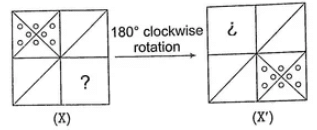 now by comparing figure (X) and (X'), we get
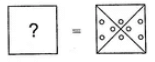 So, it is clear that option (c) will replace (?) to make the question figure complete which look like as shown in the following figure
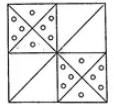 Example2: Identify the missing part of the question figure and select it from given answer figures.
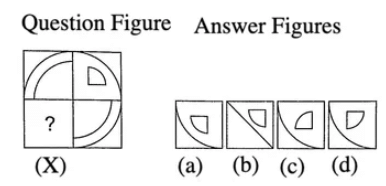 Ans: (a)
Here, the diagonally opposite parts have similar design.
So, we can obtain the answer figure for the missing portion by rotating the question figure by 180°
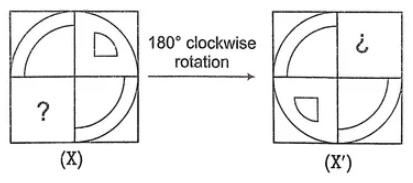 now by comparing figure (X) and (X'), we get
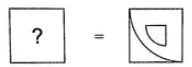 So, it is clear that option (a) complete the question figure X, which looks liks as shon in the following figure.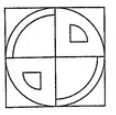
Type - 3 : Adjacent Parts are Laterally/Vertically Inverted Images
Tip# : In this type of questions, the adjacent parts are laterally/vertically inverted images of each other.
Example:
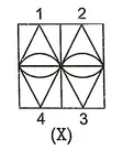 In figure (X), 1 and 2 are laterally inverted images of each other. Similarly, 3 and 4 are laterally inverted image of each other. Also 1-4 and 2-3 are the pairs of vertically inverted images of each other.
If any part of above figure is missing, then it found out by the vertical or lateral inversion of any of the adjacent figure.
This can be better understood with the help of following example
Example1: Identify the missing part of the question figure and select it from given answer figures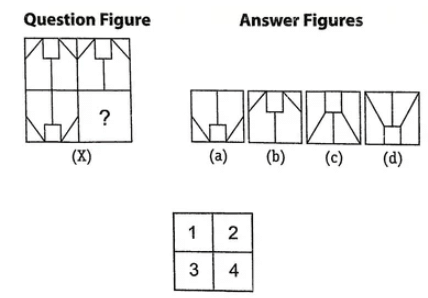
Ans: (a)
Here, the upper two adjacent parts i.e., (1) and (2) have design which are laterally inverted form of each other and the two left side adjacent parts i.e., (1) and (3) have designs which are vertically inverted form of each other. Then, the design in missing part i.e., (4) will be the laterally inverted form of the design in part (3). So, from the answer options given it is clear that design given in option (a) is the correct laterally of (3) and it will replace the (?) to complete the pattern.
Example2: Identify the missing part of the question figure and select it from given answer figures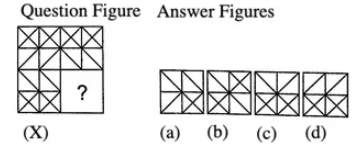 Ans: (d)
Let the figure is Here, the upper two adjacent parts i.e., (1) and (2) have design which are laterally inverted form of each other. Then, the design in missing part i.e., (4) will be the laterally inverted form of the design in part (3). So. from the answer options given it is clear that design given in option (d) is the correct laterally inverted form of (3) and replace the (?) to complete the pattern.
Type - 4 : Based on Certain Design and Pattern
Tip# : In this type of questions, they do not follow any of the patterns discussed in the previous types. These questions contain a certain design or pattern with one of its parts missing. A candidate has to complete the design accordingly.
This can be better understood with the help of following examples
Example1: Identify the missing part of the question figure and select it from the answer figures.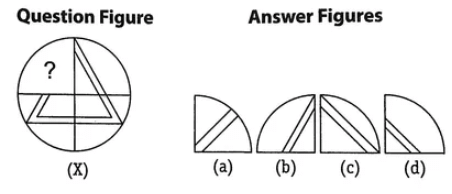 Ans: (b)
Here, by analysis we can observe that the given pattern is of a doubled lined triangle.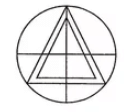 Example2: Identify the missing part of the question figure and select it from the answer figures.
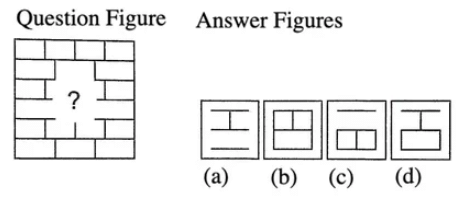 Ans: (d)
Here, by analysis we can observe that in the figure the design of each line repeats itself in alternate lines.
|
177 videos|216 docs|200 tests
|
FAQs on Introduction: Completion of Figures - General Intelligence and Reasoning for SSC CGL
| 1. What is the purpose of completion of figures in exams? |  |
| 2. How can completion of figures help in evaluating a person's analytical skills? | |
| 3. What techniques can be used to enhance performance in completion of figures tasks? | |
| 4. Are completion of figures tasks only relevant for certain subjects or fields? | |
| 5. How can completion of figures tasks be beneficial in real-life situations? | |




shortcuts and tricks
,ppt
,Free
,Sample Paper
,Introduction: Completion of Figures | General Intelligence and Reasoning for SSC CGL
,Summary
,Viva Questions
,past year papers
,study material
,Introduction: Completion of Figures | General Intelligence and Reasoning for SSC CGL
,Previous Year Questions with Solutions
,Objective type Questions
,Introduction: Completion of Figures | General Intelligence and Reasoning for SSC CGL
,video lectures
,MCQs
,Extra Questions
,Exam
,Semester Notes
,mock tests for examination
,Important questions
,practice quizzes
;



Introduction: Completion of Figures Free PDF Download
Importance of Introduction: Completion of Figures
Introduction: Completion of Figures Notes
Introduction: Completion of Figures SSC CGL Questions
Study Introduction: Completion of Figures on the App
|
© EduRev
|
Education Revolution
|


|




within 7 days!