60 Days Timetable for "VARC" CAT Preparation | Verbal Ability & Reading Comprehension (VARC) PDF Download
| Table of contents |

|
| Importance of Verbal Ability (VA) & Reading Comprehension (RC) in CAT Exam |
|
| Weightage of VA & RC in CAT Exam |
|
| Understanding the VARC Syllabus |
|
| 60-Day Time Table |
|

- The VARC section of the CAT often challenges aspirants with tricky comprehension passages and verbal reasoning. But with a focused 60-day plan, even a limited time can lead to strong improvement.
- This timetable breaks down preparation into manageable daily goals, covering reading habits, grammar, vocabulary, and comprehension strategies. Whether you're a beginner or brushing up, this structured approach helps you build confidence and accuracy.
- Stay consistent, track progress weekly, and adapt as needed. With commitment, you can make the most of these 60 days and boost your VARC score effectively.
Importance of Verbal Ability (VA) & Reading Comprehension (RC) in CAT Exam
- Verbal Ability (VA) and Reading Comprehension (RC) constitute a significant and integral section of the CAT Exam.
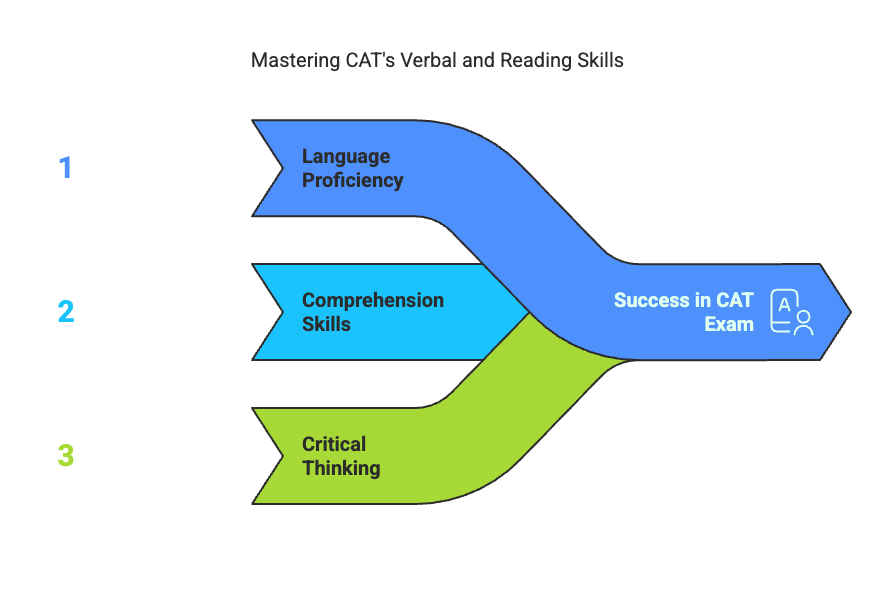
- This section evaluates a candidate's language proficiency, comprehension skills, and critical thinking abilities.
- VA and RC collectively aim to assess how well candidates can understand, analyse, and interpret written information, which is crucial for success in the dynamic and complex business environment.
Weightage of VA & RC in CAT Exam
- Out of the total 66 questions in the CAT Exam, the Verbal Ability & Reading Comprehension section typically accounts for 24 questions. RC accounts for ~16 questions (across 4 passages, 4 questions each), and VA covers ~8 questions (Para Jumbles, Para Summary, Odd One Out, etc.).
- This allocation underscores the substantial weightage placed on the verbal and reading skills of candidates.
- Success in this section requires a balance between a strong command of the English language, a nuanced understanding of various types of written content, and the ability to answer questions with accuracy and efficiency.
Understanding the VARC Syllabus
Before diving into the study plan, let's familiarise ourselves with the chapters that constitute the Quantitative Aptitude syllabus:There are other very important topics which are present in MBA Exams like XAT, SNAP, etc., and we will be covering those in our timetable as well.
60-Day Time Table
Now, let's create a comprehensive day-wise study plan to cover all the topics.
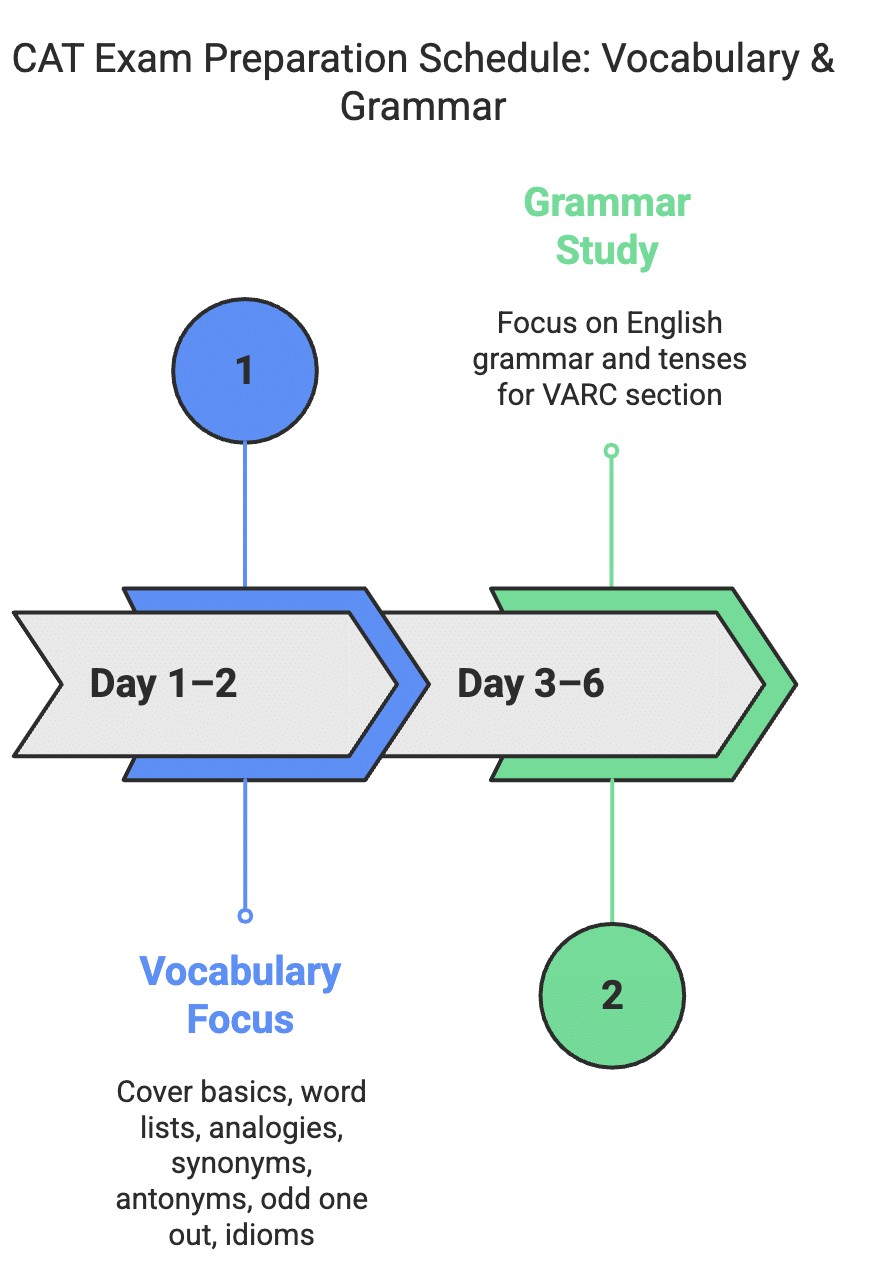
Days 1 to 2: Vocabulary
Vocabulary consists of :- Basics of Vocabulary
- Flashcards for Vocabulary
- Word List for CAT
- Verbal Analogies
- Synonyms
- Antonyms
- Odd One Out
- Idioms and Phrases
- Cover all these topics on days 1 and 2.
- Days 1 to 2 of your CAT Exam preparation should focus on building a strong foundation for the Verbal Ability & Reading Comprehension (VARC) section.
- Mastering vocabulary is essential as it forms the basis for understanding complex texts and answering questions accurately.
- A solid vocabulary is a must for decoding the meaning of unfamiliar words within passages, enhancing comprehension, and ultimately improving your performance in the VARC section.
EduRev Tip
- Create a Routine: Dedicate specific times of day for each topic. Consistent, focused sessions will help reinforce learning.
- Use Flashcards: They are a great tool for memorization. Review them regularly to keep words fresh in your mind.
- Practice with Context: When learning new words, see them in sentences. This helps in understanding usage and nuances.
- Engage in Active Learning: Use the words in your daily conversations or writing. This active application cements your knowledge.
- Test Yourself: Regularly quiz yourself on synonyms, antonyms, and analogies to gauge progress and retention.
- Remember, repetition and active usage are key to mastering vocabulary for the VARC section.
Days 3 to 6: Grammar
Grammar consists of:
- English Grammar
- Grammar Tenses
- Allocate days 3 to 6 of your CAT Exam preparation to focus on grammar, a crucial element for the Verbal Ability & Reading Comprehension (VARC) section.
- A strong grasp of grammar forms the bedrock for understanding and interpreting written passages, enhancing your overall performance in VARC.
- Recognize that grammar is not only important for isolated questions but is integral to the entire VARC section.
- A sound understanding of grammar rules enhances your ability to comprehend passages, answer questions accurately, and effectively express ideas in the written format.
EduRev Tip
- Conceptual Clarity: Understand the fundamental rules of English grammar. Focus on topics like subject-verb agreement, articles, prepositions, and sentence structure. Clear concepts will help you apply grammar rules accurately.
- Practice Regularly: Consistent practice is essential. Solve grammar exercises, take quizzes, and attempt mock tests. Pay attention to tenses (past, present, future) and their correct usage.
- Learn Common Errors: Identify common grammatical errors such as misplaced modifiers, parallelism, and verb tense consistency. Be aware of tricky areas like conditional sentences and reported speech.
- Read Actively: Read a variety of texts—articles, essays, and passages. Observe how grammar is used in context. Analyze sentence structures and identify different tenses.
Days 7 to 10: Learn How to Practice RCs
- Days 7 to 10 of your CAT Exam preparation should be dedicated to getting acquainted with Reading Comprehension (RC).
- Explore EduRev's resources, including videos, documents, and tests, to gain insights into the types of passages, question formats, and overall strategies for effective RC comprehension.
- Use EduRev's educational materials to understand the art of solving RC questions efficiently.
- Watch videos to grasp techniques, explore documents for tips, and engage in practice tests to apply your learning. This holistic approach will equip you with the skills needed to navigate and conquer the RC section during the CAT Exam.
EduRev Tip
- Active Reading: When practicing RC passages, read actively. Focus on understanding the main idea, supporting details, and the author’s tone. Highlight key points or take notes as you read.
- Analyze Passage Structure: Pay attention to the passage structure. Identify the introduction, body paragraphs, and conclusion. Understand how ideas are connected within the passage.
- Predict Answers: Before looking at the questions, try to predict answers based on your understanding of the passage. This helps you approach the questions with a clear context.
Days 11- 20: Start Practising Reading Comprehensions
Students should practice 1 RC every day while they are preparing for CAT exam. You can solve RCs every day from: RC of the Day - 100 RCs
- Day 11-13: RC of the Day
Begin with the "RC of the Day" series, covering a diverse range of topics. Aim to solve one RC daily moving forward, focusing on comprehension and time management. - Day 14-15: Aeon Based RCs
Shift to Aeon-based RCs on EduRev, exploring varied perspectives and complex themes. Practice understanding and extracting information efficiently. - Day 16-17: Topic Wise RCs
Dive into topic-wise RCs provided by EduRev to enhance proficiency in specific subject areas. Focus on extracting key details and identifying main ideas. - Day 18-19: News Based RCs
Explore News-Based RCs on EduRev, mimicking current affairs passages. Practice staying updated with diverse topics and extracting relevant information quickly. - Day 20: CAT Previous Year RCs
Dedicate a day to solving CAT Previous Year RCs on EduRev. Analyse the patterns and question types, understanding the exam's expectations and refining your approach.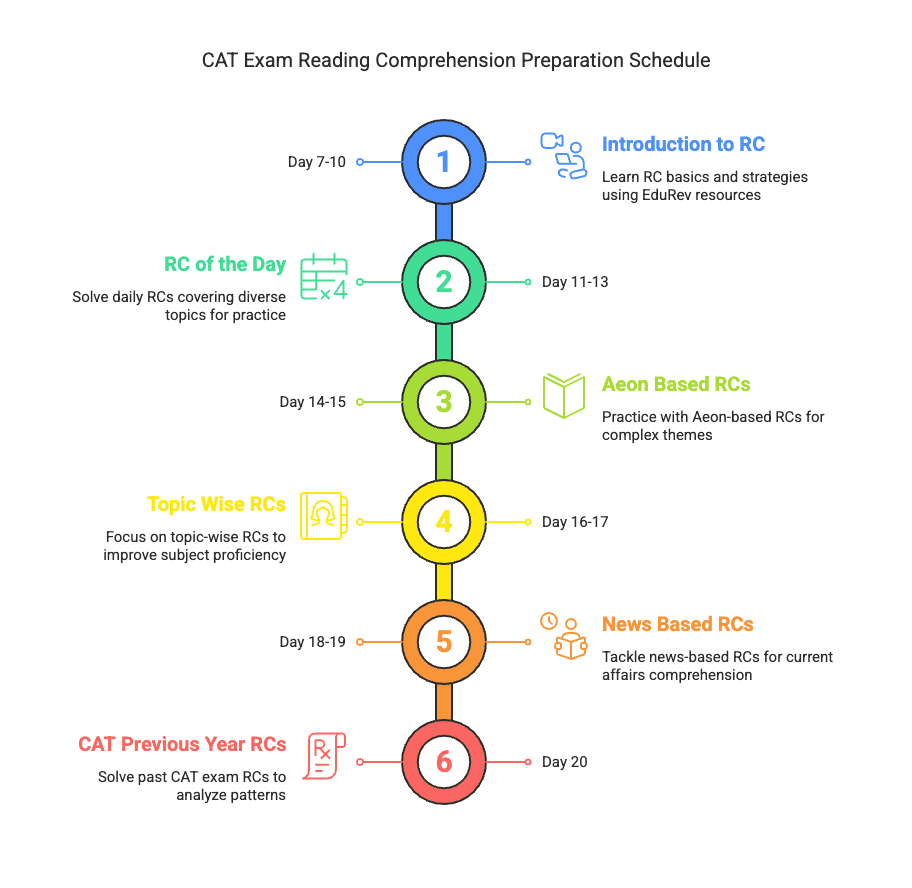
EduRev Tip
- Consistent Practice: Make solving one RC passage a daily habit. Regular practice improves comprehension skills and builds familiarity with different types of passages.
- Focus on Time Management: While practicing, keep an eye on the clock. Allocate a specific time limit for each RC. Gradually work on reducing the time taken without compromising accuracy.
- Analyze Patterns: When solving Aeon-based, topic-wise, and news-based RCs, observe patterns. Identify recurring question types, common themes, and the structure of passages. This awareness will help you approach questions more efficiently.
Days 21 to 30: Important Verbal Topics
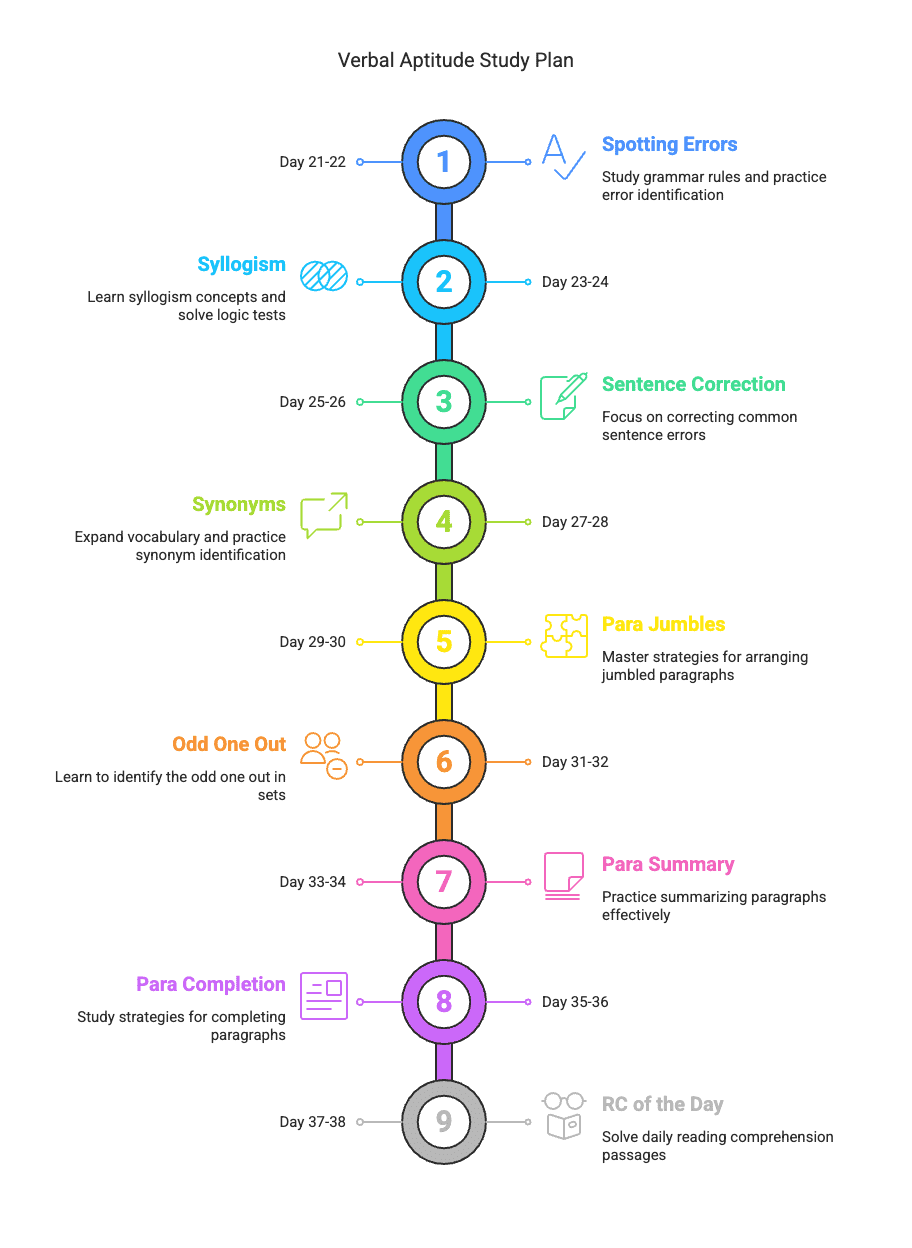
- Day 21-22: Spotting Errors
Begin with EduRev's comprehensive documents on grammar rules and error-spotting techniques. Follow up with video tutorials for visual learning. Practice with EduRev's error-spotting tests to reinforce understanding. - Day 23-24: Syllogism
Use EduRev's detailed documents to grasp the concepts of syllogism. Watch video explanations for clarity. Strengthen your skills with EduRev's syllogism tests to enhance problem-solving abilities. - Day 25-26: Sentence Correction
Dive into EduRev's documents focusing on common sentence correction errors and rules. Complement your learning with video tutorials. Apply knowledge in sentence correction tests provided by EduRev. - Day 27-28: Synonyms
Explore EduRev's synonym documents to expand your vocabulary. Reinforce learning through video tutorials. Test your grasp of synonyms with EduRev's synonym tests for practical application. - Day 29-30: Para Jumbles
Understand para jumbles through EduRev's documents outlining strategies and patterns. Watch video tutorials for additional insights. Practice arranging sentences coherently with EduRev's para jumbles tests.
EduRev Tip
- Structured Approach: Follow a structured approach by starting with theory, then moving to video tutorials, and finally testing your understanding with practice tests.
- Active Engagement: Engage with the material actively. Take notes during videos and discuss concepts with peers.
- Regular Revision: Regularly revisit the topics you’ve studied. This will help you retain the information and improve your ability to spot errors, correct sentences, and solve para jumbles effectively.
Days 31 to 38: Important Verbal Topics
- Day 31-32: Odd One Out
Use EduRev's documents to learn about identifying the odd one out in a set. Watch video explanations for clarity. Enhance your skills by taking Odd One Out tests provided by EduRev. - Day 33-34: Para Summary
Delve into EduRev's documents, providing strategies for summarising paragraphs effectively. Complement your learning with video tutorials. Practice para summary with EduRev's tests to refine your summarisation skills. - Day 35-36: Para Completion
Study EduRev's documents on para completion strategies and common patterns. Watch video tutorials for a deeper understanding. Apply your knowledge in para completion tests provided by EduRev. - Day 37-38: RC of the Day - 100 RCs
Continue with the "RC of the Day" series, covering a diverse range of topics. Aim to solve one RC daily, focusing on comprehension and time management.
EduRev Tip
- Diverse Practice: For ‘Odd One Out’ and paragraph exercises, practice with a wide range of topics to build versatility.
- Summarization Skills: Develop the ability to quickly identify key points for effective paragraph summarization and completion.
- Daily Reading: Incorporate daily reading of ‘RC of the Day’ to improve speed and comprehension, essential for the VARC section.
Days 39 to 59: Supplementary Verbal Topics
Days 39-40: Selecting Words
Days 41-42: Phrasal Verbs
Days 43-44: Cloze Test
Days 45-46: RC of the Day - 100 RCs
Days 47-48: Completing Statements
Days 49-50: Aeon Based RCs
Days 51-52: One Word Substitutes
Days 53-54: Sentence Formation
Days 55-56: News-Based RCs
Days 57-58: Facts, Inference & Judgement
Days 59: Archive for Verbal: CAT, XAT, NMAT, SNAP
EduRev offers a comprehensive learning experience for the above-mentioned topics by providing detailed documents, instructive video tutorials, and a variety of skill-testing tests.
This multifaceted approach proves highly beneficial, ensuring students can grasp concepts through varied mediums and reinforce their understanding with practical application, ultimately enhancing their performance in the CAT Exam.
EduRev Tip
- Diverse Exercises: Engage with a variety of exercises for each topic. For example, use different texts for cloze tests and practice a broad range of phrasal verbs.
- Apply Contextually: Try to use one-word substitutes and phrasal verbs in your daily language. This contextual application aids retention.
- Critical Thinking: For ‘Facts, Inference & Judgement’, focus on developing critical thinking by questioning the information presented in passages.
Day 60: Sectional Test
- Utilising Day 60 for a Sectional Test in Verbal Ability & Reading Comprehension (VARC) is crucial for evaluating your skills and progress.
- These tests from EduRev provide an opportunity to assess your comprehension, vocabulary, and grammar skills in a simulated exam environment, helping you identify strengths and areas that require improvement.
- Taking Sectional Tests aids in developing a sense of timing and efficiency specific to the VARC section.
- Sectional tests also allow you to adapt your strategy based on your performance. Analyse the results to refine your study plan, focusing on specific topics or question types that may need more attention.
- Regular testing is an integral part of a well-rounded preparation strategy, providing insights into your readiness and allowing for strategic adjustments as you approach the CAT Exam date.
EduRev Tip
- Simulate Real Exam Conditions: Treat the sectional test as if it’s the actual CAT exam. This will help you adapt to the pressure and manage time effectively.
- Analyze Performance: After the test, thoroughly review your answers. Identify patterns in the mistakes and focus on those areas in your subsequent study sessions.
- Strategic Revision: Based on the test results, prioritize topics that need more practice. Use EduRev’s resources to strengthen these areas before the next sectional test.
With our timetable, keep your progress tracked and study what matters.
Happy learning with EduRev!!
|
111 videos|450 docs|90 tests
|
FAQs on 60 Days Timetable for "VARC" CAT Preparation - Verbal Ability & Reading Comprehension (VARC)
| 1. How important is Verbal Ability (VA) & Reading Comprehension (RC) in the CAT Exam? |  |
| 2. What is the weightage of VA & RC in the CAT Exam? | |
| 3. What is included in the VARC syllabus for the CAT Exam? | |
| 4. How should I plan my 60-day timetable for VARC CAT preparation? | |
| 5. What are some frequently asked questions related to the importance of VA & RC in the CAT Exam? | |




Viva Questions
,Semester Notes
,Free
,study material
,Exam
,60 Days Timetable for "VARC" CAT Preparation | Verbal Ability & Reading Comprehension (VARC)
,Summary
,practice quizzes
,60 Days Timetable for "VARC" CAT Preparation | Verbal Ability & Reading Comprehension (VARC)
,Extra Questions
,Sample Paper
,MCQs
,ppt
,Objective type Questions
,mock tests for examination
,video lectures
,Important questions
,shortcuts and tricks
,past year papers
,Previous Year Questions with Solutions
,60 Days Timetable for "VARC" CAT Preparation | Verbal Ability & Reading Comprehension (VARC)
;




60 Days Timetable for "VARC" CAT Preparation Free PDF Download
Importance of 60 Days Timetable for "VARC" CAT Preparation
60 Days Timetable for "VARC" CAT Preparation Notes
60 Days Timetable for "VARC" CAT Preparation CAT Questions
Study 60 Days Timetable for "VARC" CAT Preparation on the App
|
© EduRev
|
Education Revolution
|


|




