Worksheet: Modal Verbs | English Grammar Basic - Class 10 PDF Download

Q1: Fill in the blanks with an appropriate modal auxiliary verb.
(i) _______ you lend me your pen?
(a) Can
(b) May
(c) Shall
(d) Could
(ii) You _______ come whenever you want.
(a) can
(b) will
(c) would
(d) Could
(iii) You _______ apply for that job.
(a) might
(b) shall
(c) should
(d) Will
(iv) She _______ arrive anytime soon.
(a) may
(b) can
(c) shall
(d) should
(v) I _______ return your book tomorrow.
(a) would
(b) will
(c) could
(d) should
(vi) Liz ___ gets tired of her job. It is so boring.
(a) Has to
(b) Must
(c) Should
(d) Probably
(vii) Take an umbrella. It ___ rain later.
(a) Has to
(b) Need
(c) Might
(d) Both a & b
(viii)___ you speak any foreign languages?
(a) May
(b) Can
(c) Have
(d) should
Q2: Fill in the blanks with the appropriate form of modals
(i) You _____ visit the doctor immediately as your symptoms are quite severe. (must/ can)
(ii) I ____ like to talk about the great freedom fighters on Independence Day. (would/must)
(iii) ____ you like some sweets that I made yesterday? (would/can)
(iv) _____ you give me a bottle of water? My throat is parched. (could/shall)
(v) One ____ help the old and needy people. (ought to/can)
Q3: In the following passage, one modal needs to be inserted in each line. Write the missing modal along with the word that comes before and the word that comes after it.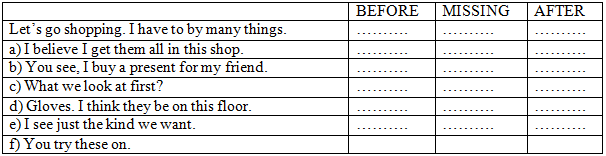
Q4: Complete the passage using suitable modals.
Times have changed. Nowadays, you (a) _______ rush off to travel agent to book tickets for a journey. You (b) _______ sit at home and book them over the Internet. However, the experience of one British couple (c) _______ be a warning to everyone. You (d) _______ assume that if you book on the net, mistakes won’t happen. That’s why you (e) _______ always check bookings carefully. If you don’t, you (f) _______ find yourselves in the wrong part of the world. That’s exactly what happened to Emma Dunn and Raoul Sebastian. They set off from London in a large plane, thinking they were on their way to Sydney, Australia. They (g) _______ understand what was happening when they landed at an airport and were asked to transfer to a much smaller plane. It (h) _______ been quite a shock when they finally discovered they were in Canada. They (i) _______ read their tickets more carefully, because they were booked for Sydney, Nova Scotia, Canda.
Q5: Rewrite the following sentences using the words given in the brackets.
(a) It’s not necessary to buy the cap. (need)
(b) The hotels will be full, possibly. (might)
(c) I’m sure it is the sun cream you are allergic to. (must)
(d) It’s not possible for us to change the weather. (can’t)
(e) Is it a good idea to take it with us this time? (should)
Q6: Complete the following dialogue using the correct modal to fill in each blank.
Dina: I hate to say this, Ragini, but you are in terrible shape.
Ragini: I know, what (a) __________ I do?
Dina: Well, since you are putting on weight, you (b) __________ plan a healthy diet.
Ragini: You are right. I (c) __________ not eat so many chocolates and junk food.
Dina: That’s right, and you (d) __________ also start exercising.
Ragini: (e) __________ I start with walking for an hour every day?
Dina: Yes, but what is most important is that you (f) __________ try to have a healthy lifestyle.
You can find Worksheets Solutions here: Worksheet Solutions: Modal Verbs
|
20 videos|227 docs|18 tests
|
FAQs on Worksheet: Modal Verbs - English Grammar Basic - Class 10
| 1. What are modal verbs and how are they used in English? |  |
| 2. Can modal verbs be used to express past actions? | |
| 3. What is the difference between "can" and "could"? | |
| 4. Are modal verbs followed by the base form of the main verb? | |
| 5. Can modal verbs be used in negative and interrogative sentences? | |





Worksheet: Modal Verbs | English Grammar Basic - Class 10
,Viva Questions
,ppt
,shortcuts and tricks
,Important questions
,Summary
,mock tests for examination
,Exam
,Sample Paper
,Worksheet: Modal Verbs | English Grammar Basic - Class 10
,Previous Year Questions with Solutions
,past year papers
,MCQs
,Worksheet: Modal Verbs | English Grammar Basic - Class 10
,Objective type Questions
,video lectures
,practice quizzes
,Semester Notes
,Extra Questions
,study material
,Free
;




Worksheet: Modal Verbs Free PDF Download
Importance of Worksheet: Modal Verbs
Worksheet: Modal Verbs Notes
Worksheet: Modal Verbs Class 10 Questions
Study Worksheet: Modal Verbs on the App
|
© EduRev
|
Education Revolution
|


|




