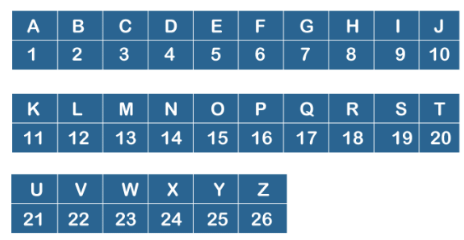
Meaning
An alphabet test is a logical-reasoning exercise that checks a student's ability to use the sequence of the English alphabet, recognise patterns among letters, and apply simple rules to find missing letters, arrange letters, or transform letter groups. These tests train alphabetical order skills, pattern recognition, and quick mental mapping between letters and their positions in the alphabet.
Types of Alphabet Tests
- Letter Arrangement: Involves arranging a set of letters in a specific order according to certain rules or patterns.
- Example: Arrange the letters in alphabetical order or reverse alphabetical order.
- Letter Series: A series of letters follows a pattern; the task is to identify that pattern and find the next letter(s) in the series.
Example: AB, CD, EF, GH, __ (Answer: IJ) - Letter Analogies: Identify the relationship between a pair of letters and apply the same relationship to another pair.
Example: A is to B as C is to __ (Answer: D, since A comes before B and C comes before D in the alphabet) - Letter Substitution / Coding: Replace one or more letters with other letters according to a given rule or code. This may include direct substitution, positional coding (using alphabet positions), or pattern-based changes.
Example: In the word "CAT," replace 'C' with 'F' and 'T' with 'W' to form a new word. (Result: "FAW")
How to recognise common patterns
- Constant step patterns: Letters increase or decrease by a fixed number of positions (for example, every +2 letters: B, D, F, ...).
- Paired or grouped patterns: Letters may appear in pairs that move together (for example, AB, CD, EF) or alternate between two subsequences.
- Mirror or reverse patterns: A pattern may use reverse alphabetical order within a segment (for example: Z, Y, X, then A, B, C).
- Positional coding: Letters are treated as numbers using their alphabetical positions (A = 1, B = 2, ..., Z = 26) for calculations and substitutions.
- Replacement rules: A fixed rule may replace every letter or letters at certain positions (for example, shift each letter three places forward).
Strategies for Solving Alphabet Tests
- Know the alphabet sequence well: Be able to count forwards and backwards quickly and recall positions of common letters like A, E, M, N, Z.
- Check differences: Look at how many positions separate consecutive letters (for example, +1, +2, -1), to detect constant-step patterns.
- Use letter positions: Convert letters to their numeric positions (A = 1, B = 2, ...) when the pattern depends on arithmetic operations.
- Look for alternation: Check whether two different sub-patterns are interleaved (for example, odd and even positions following separate rules).
- Eliminate wrong choices: In multiple-choice questions, cross out letters that clearly do not fit the observed pattern.
- Write short notes: For longer series, note down the position numbers beneath letters to make pattern detection easier.
- Practice regularly: Speed and accuracy improve with practice; begin with simple series and advance to mixed patterns.
Solved Examples
(i) Arrange the following letters in alphabetical order: M, P, A, T, S.
Ans: A, M, P, S, T
Sol: Write the given letters clearly: M P A T S.
Recall the alphabetical order around these letters: A, M, P, S, T.
Place the letters in ascending (A → Z) order: A, M, P, S, T.
(ii) What letter comes next in the series? B, D, F, H, __.
Ans: J
Sol: List the letters with their positions: B(2), D(4), F(6), H(8).
Observe the pattern in positions: 2 → 4 → 6 → 8 (each increases by 2).
Add 2 to the last position: 8 + 2 = 10, which is the position of J.
Therefore, the next letter is J.
(iii) If 'ACE' is coded as '1-3-5,' how is 'BAD' coded?
Ans: 2-1-4
Sol: Understand the coding rule: each letter is represented by its alphabetical position (A = 1, B = 2, C = 3, D = 4, E = 5).
Find positions of letters in "BAD": B → 2, A → 1, D → 4.
Write them in the same order: 2-1-4.
Practice Problems (for self-practice)
- 1. Arrange in alphabetical order: G, B, R, K.
- 2. Find the next two letters: C, F, I, L, __, __.
- 3. If DOG is coded as 4-15-7, what is the code for CAT?
- 4. A is to Z as B is to __ (identify the relationship and answer).