EmSAT Achieve Exam  >  EmSAT Achieve Notes  >  Chemistry  >  What is Addtition Reaction?

What is Addtition Reaction?

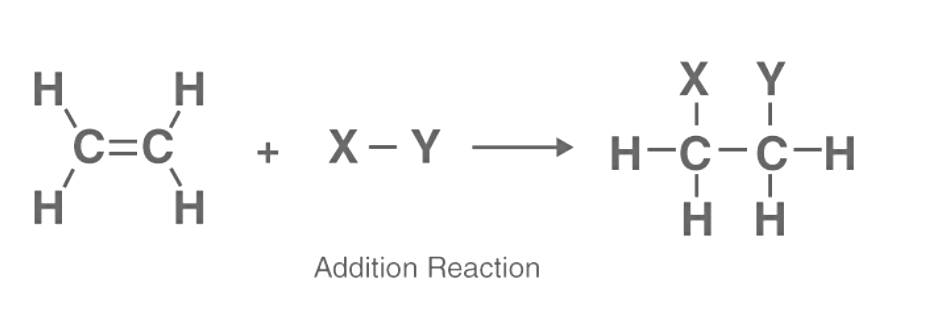
Put plainly in the realm of organic chemistry, an addition reaction denotes a chemical process where two or more reactants combine to produce a singular, larger product.

Addition Reaction Explanation

However, only chemical compounds with multiple bond characteristics can engage in an addition reaction, typically involving the breaking of a double or triple bond to form requisite single bonds. Essentially, an addition reaction operates in reverse compared to a decomposition reaction, where a compound disintegrates into one or more elements or compounds. Examining an instance of an addition reaction, consider the hydrochlorination of propane (an alkene), illustrated by the following equation:
CH3CH = CH2 + HCl → CH3C+HCH3 + Cl- → CH3CHClCH
Addition Reaction Explanation

Types of Addition Reactions

  • For polar addition reactions there are two classifications, namely:
    • Electrophilic Addition reactions
    • Nucleophilic Addition reactions 
  • For non-polar addition reactions, we have two classifications, namely:
    • Free radical addition reactions
    • Cycloadditions reactions

Electrophilic addition

An electrophilic addition reaction can be described as an addition reaction in which a reactant with multiple bonds as in a double or triple bond undergoes its π bond broken and two new σ bonds are formed.
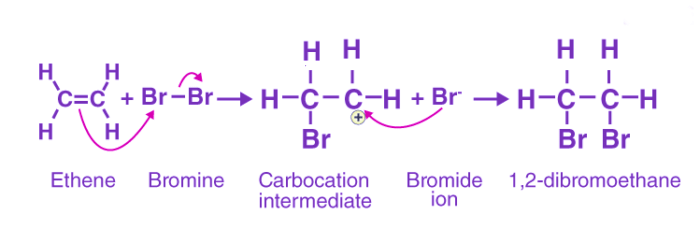
Electrophilic addition

Nucleophilic Addition

A nucleophilic addition reaction is an addition reaction where a chemical compound with an electron-deficient or electrophilic double or triple bond, a π bond, reacts with a nucleophile which is an electron-rich reactant with the disappearance of the double bond and creation of two new single, or σ, bonds.
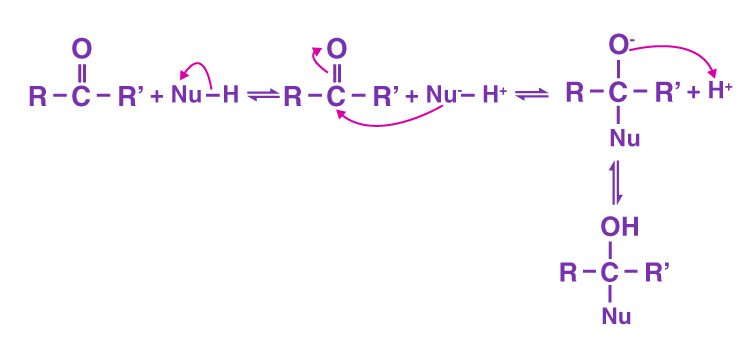
Nucleophilic Addition

The document What is Addtition Reaction? is a part of the EmSAT Achieve Course Chemistry for EmSAT Achieve.
All you need of EmSAT Achieve at this link: EmSAT Achieve

FAQs on What is Addtition Reaction?

1. What is an addition reaction in chemistry?
Ans. An addition reaction in chemistry is a reaction where two or more reactants combine to form a single product without the loss of any atoms or groups.
2. Can you provide an example of an addition reaction?
Ans. One example of an addition reaction is the reaction between hydrogen gas and chlorine gas to form hydrogen chloride.
3. What are the types of addition reactions?
Ans. The two main types of addition reactions are electrophilic addition and nucleophilic addition.
4. What are the key points to remember about addition reactions?
Ans. Key points about addition reactions include the formation of a single product, no loss of atoms or groups, and the involvement of electrophiles or nucleophiles.
5. How do addition reactions differ from other types of chemical reactions?
Ans. Addition reactions differ from other types of reactions, such as substitution or elimination reactions, by involving the addition of atoms or groups to a molecule without any atoms being lost.
Explore Courses for EmSAT Achieve exam
Get EduRev Notes directly in your Google search
Related Searches
Extra Questions, Objective type Questions, Exam, Summary, study material, Viva Questions, practice quizzes, Important questions, pdf , What is Addtition Reaction?, Previous Year Questions with Solutions, MCQs, Sample Paper, video lectures, ppt, What is Addtition Reaction?, What is Addtition Reaction?, past year papers, shortcuts and tricks, Semester Notes, Free, mock tests for examination;