Class 6 Exam > Class 6 Notes > Computer Science for Class 6 > Chapter Notes: Intro to Computer Programming
Intro to Computer Programming Chapter Notes | Computer Science for Class 6 PDF Download

Introducing Computer Programming
Computer programs are set of instructions that enable a computer to interact with the user, peripherals and information. These instructions are written in a language called computer programming language. The process of writing computer programs is called computer programming. While writing a program using a computer programming language, such as C, you need to follow the syntax of that language. A programming language also provides operators that enable you to perform various tasks, such as computing and manipulating values of variables, compare values of different variables of same data types and test multiple conditions.Developing Flowchart
Flowchart is a technique that allows you to represent computer program graphically. Using flowchart you can easily understand the logic of a program. A flowchart represents the logical and operational steps to be performed within the system for transforming the input process into output. Flowchart serves as a basis for discussion and communication between the system analysts and the programmers.
To create a flowchart, you need to use the following symbols
- Start and Stop symbol
- Processing symbol
- Flow Line symbol
- Input / Output symbol
- Decision making symbol
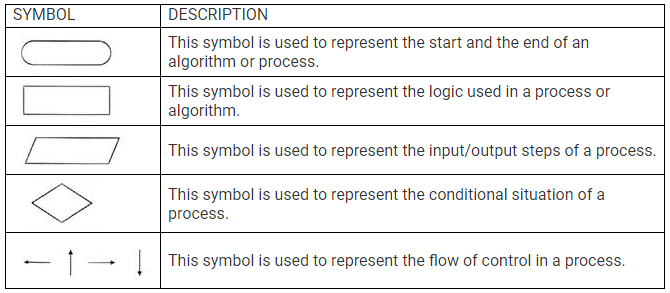
While creating a flow chart you need to keep the following points in your mind
- While creating a flow chart only a single flow line comes out from a process symbol.
- Flow direction of a process will always indicate either from left to right or from top to bottom.
- In decision box only one flow line enters and multiple flow lines can come out.
- Only a single flow line comes out from starting process and enters single flow line in stop process.
- Every flowchart contains a logical start and a logical end.
Illustrative Example
The following figure displays the flowchart of a program for printing grade of employ according to his or her salary: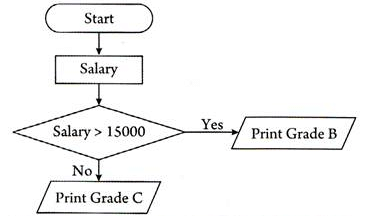
The document Intro to Computer Programming Chapter Notes | Computer Science for Class 6 is a part of the Class 6 Course Computer Science for Class 6.
All you need of Class 6 at this link: Class 6
|
39 videos|28 docs|6 tests
|

FAQs on Intro to Computer Programming Chapter Notes - Computer Science for Class 6
| 1. What are the basic symbols used in creating a flowchart? |  |
| 2. What is the importance of flowchart symbols in creating a flowchart? | |
Ans. Flowchart symbols help to visualize the steps of a process, making it easier to understand and analyze complex processes or algorithms.
| 3. How can flowcharts be helpful in computer programming? | |
Ans. Flowcharts can be helpful in computer programming as they provide a visual representation of the logic and flow of a program, making it easier for programmers to understand and debug their code.
| 4. What are some common input and output devices used in computers? | |
Ans. Common input devices include keyboards, mice, and scanners, while common output devices include monitors, printers, and speakers.
| 5. Can you explain the history of computers briefly? | |
Ans. The history of computers dates back to the 1940s when the first electronic computers were developed. Over the years, computers have evolved from large, room-sized machines to the compact devices we use today.
Related Exams
About this Document

4.61/5
Rating

Apr 18, 2025
Last updated
Document Description: Chapter Notes: Intro to Computer Programming for Class 6 2025 is part of Computer Science for Class 6 preparation.
The notes and questions for Chapter Notes: Intro to Computer Programming have been prepared according to the Class 6 exam syllabus. Information about Chapter Notes: Intro to Computer Programming covers topics
like Introducing Computer Programming, Developing Flowchart and Chapter Notes: Intro to Computer Programming Example, for Class 6 2025 Exam. Find important definitions, questions, notes, meanings, examples, exercises and tests below for Chapter Notes: Intro to Computer Programming.
Introduction of Chapter Notes: Intro to Computer Programming in English is available as part of our Computer Science for Class 6
for Class 6 & Chapter Notes: Intro to Computer Programming in Hindi for Computer Science for Class 6 course.
Download more important topics related with notes, lectures and mock test series for Class 6
Exam by signing up for free. Class 6: Intro to Computer Programming Chapter Notes | Computer Science for Class 6
Description
Full syllabus notes, lecture & questions for Intro to Computer Programming Chapter Notes | Computer Science for Class 6 - Class 6 | Plus excerises question with solution to help you revise complete syllabus for Computer Science for Class 6 | Best notes, free PDF download
Information about Chapter Notes: Intro to Computer Programming
In this doc you can find the meaning of Chapter Notes: Intro to Computer Programming defined & explained in the simplest way possible. Besides explaining types of
Chapter Notes: Intro to Computer Programming theory, EduRev gives you an ample number of questions to practice Chapter Notes: Intro to Computer Programming tests, examples and also practice Class 6
tests


Related Searches
Semester Notes
,mock tests for examination
,Sample Paper
,MCQs
,Summary
,Intro to Computer Programming Chapter Notes | Computer Science for Class 6
,Free
,Important questions
,ppt
,past year papers
,Exam
,shortcuts and tricks
,study material
,Extra Questions
,video lectures
,Previous Year Questions with Solutions
,Intro to Computer Programming Chapter Notes | Computer Science for Class 6
,Objective type Questions
,Viva Questions
,Intro to Computer Programming Chapter Notes | Computer Science for Class 6
,practice quizzes
;



Additional Information about Chapter Notes: Intro to Computer Programming for Class 6 Preparation
Chapter Notes: Intro to Computer Programming Free PDF Download
The Chapter Notes: Intro to Computer Programming is an invaluable resource that delves deep into the core of the Class 6 exam.
These study notes are curated by experts and cover all the essential topics and concepts, making your preparation more efficient and effective.
With the help of these notes, you can grasp complex subjects quickly, revise important points easily,
and reinforce your understanding of key concepts. The study notes are presented in a concise and easy-to-understand manner,
allowing you to optimize your learning process. Whether you're looking for best-recommended books, sample papers, study material,
or toppers' notes, this PDF has got you covered. Download the Chapter Notes: Intro to Computer Programming now and kickstart your journey towards success in the Class 6 exam.
Importance of Chapter Notes: Intro to Computer Programming
The importance of Chapter Notes: Intro to Computer Programming cannot be overstated, especially for Class 6 aspirants.
This document holds the key to success in the Class 6 exam.
It offers a detailed understanding of the concept, providing invaluable insights into the topic.
By knowing the concepts well in advance, students can plan their preparation effectively.
Utilize this indispensable guide for a well-rounded preparation and achieve your desired results.
Chapter Notes: Intro to Computer Programming
Chapter Notes: Intro to Computer Programming Notes offer in-depth insights into the specific topic to help you master it with ease.
This comprehensive document covers all aspects related to Chapter Notes: Intro to Computer Programming.
It includes detailed information about the exam syllabus, recommended books, and study materials for a well-rounded preparation.
Practice papers and question papers enable you to assess your progress effectively.
Additionally, the paper analysis provides valuable tips for tackling the exam strategically.
Access to Toppers' notes gives you an edge in understanding complex concepts.
Whether you're a beginner or aiming for advanced proficiency, Chapter Notes: Intro to Computer Programming Notes on EduRev are your ultimate resource for success.
Chapter Notes: Intro to Computer Programming Class 6 Questions
The "Chapter Notes: Intro to Computer Programming Class 6 Questions" guide is a valuable resource for all aspiring students preparing for the
Class 6 exam. It focuses on providing a wide range of practice questions to help students gauge
their understanding of the exam topics. These questions cover the entire syllabus, ensuring comprehensive preparation.
The guide includes previous years' question papers for students to familiarize themselves with the exam's format and difficulty level.
Additionally, it offers subject-specific question banks, allowing students to focus on weak areas and improve their performance.
Study Chapter Notes: Intro to Computer Programming on the App
Students of Class 6 can study Chapter Notes: Intro to Computer Programming alongwith tests & analysis from the EduRev app,
which will help them while preparing for their exam. Apart from the Chapter Notes: Intro to Computer Programming,
students can also utilize the EduRev App for other study materials such as previous year question papers, syllabus, important questions, etc.
The EduRev App will make your learning easier as you can access it from anywhere you want.
The content of Chapter Notes: Intro to Computer Programming is prepared as per the latest Class 6 syllabus.
|
© EduRev
|
Education Revolution
|


|








Signup on EduRev and stay on top of your study goals
10M+ students crushing their study goals daily