IGCSE Year 10 > Year 10 Notes > Chemistry for GCSE/ > Titration Calculations
Titration Calculations

Titration Calculations
- Titrations: Titrations serve as a technique for evaluating the concentration of solutions.
- Acid-Base Titrations: Among various types, acid-base titrations hold significant importance. They ascertain the precise amount of alkali necessary to neutralize a given quantity of acid, and vice versa.
- Calculations in Titrations: During titrations, you might encounter scenarios where you need to compute the moles present in a specific amount, the concentration, or the volume required to neutralize either an acid or a base.
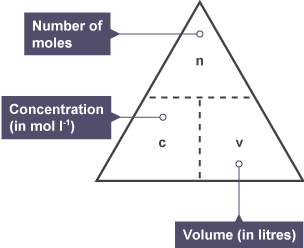
- Utilizing Formula Triangle: Upon completing a titration and determining the average titre, you can proceed to calculate the unknown variable by employing the formula triangle as demonstrated below.
Concentration Moles Formula Triangle
MULTIPLE CHOICE QUESTIONTry yourself: What is the purpose of acid-base titrations?
The document Titration Calculations is a part of the Year 10 Course Chemistry for GCSE/IGCSE.
All you need of Year 10 at this link: Year 10
About this Document

4.88/5 Rating

Apr 29, 2026 Last updated
Related Exams
Document Description: Titration Calculations for Year 10 2026 is part of Chemistry for GCSE/IGCSE preparation. The notes and questions for Titration Calculations have been prepared according to the Year 10 exam syllabus. Information about Titration Calculations covers topics like and Titration Calculations Example, for Year 10 2026 Exam. Find important definitions, questions, notes, meanings, examples, exercises and tests below for Titration Calculations.
Introduction of Titration Calculations in English is available as part of our Chemistry for GCSE/IGCSE for Year 10 & Titration Calculations in Hindi for Chemistry for GCSE/IGCSE course. Download more important topics related with notes, lectures and mock test series for Year 10 Exam by signing up for free. Year 10: Titration Calculations
Description
Titration Calculations of Chemistry covers all the important topics, helping you prepare for the Year 10 exam on EduRev. Start for free!
Information about Titration Calculations
In this doc you can find the meaning of Titration Calculations defined & explained in the simplest way possible. Besides explaining types of Titration Calculations theory, EduRev gives you an ample number of questions to practice Titration Calculations tests, examples and also practice Year 10 tests



Related Searches
pdf , mock tests for examination, ppt, Titration Calculations, Titration Calculations, Important questions, Extra Questions, Viva Questions, past year papers, practice quizzes, Titration Calculations, Semester Notes, study material, Previous Year Questions with Solutions, Free, Objective type Questions, Sample Paper, MCQs, Summary, shortcuts and tricks, Exam, video lectures;