IGCSE Year 10 > Year 10 Notes > Geography for GCSE/ > Photographs & Pictorial Material
Photographs & Pictorial Material

Photographs & Pictorial Material
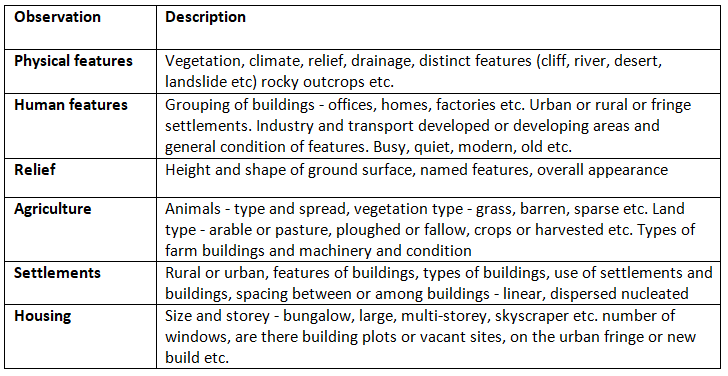
- "Describe" is typically the instruction used for photographs.
- This focuses on honing observational abilities and comprehending the contents of the image.
- When describing, it's important to pay attention to:
Field Sketches
- Should include location/site number, title, and compass direction
- Includes the key features at a site:
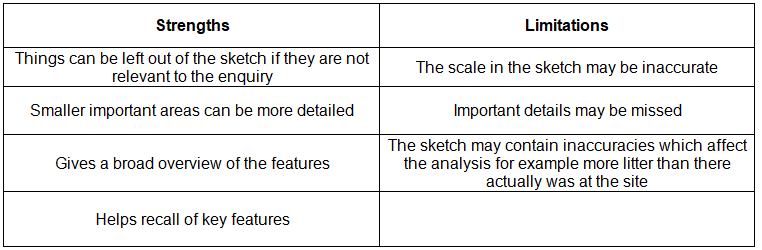
- In geography exams, students may be required to sketch and label key features from photographs.
- Precision in artistry is not the focus; however, identifying crucial elements like rivers, coastlines, and hills is essential.
- Adhere to geographical sketching guidelines:
- Begin by framing your sketch with a box.
- Always use a pencil for drawing.
- Utilize colors to emphasize specific features.
- Employ a ruler for creating straight lines and arrows.
- Direct arrows towards the feature, not the label.
- Avoid crossing arrow lines.
- Write labels horizontally next to the arrow using a pen.
MULTIPLE CHOICE QUESTIONTry yourself: What is the purpose of sketching key features from photographs in geography exams?
The document Photographs & Pictorial Material is a part of the Year 10 Course Geography for GCSE/IGCSE.
All you need of Year 10 at this link: Year 10
FAQs on Photographs & Pictorial Material
| 1. What is the importance of field sketches in documenting scientific research? |  |
Ans. Field sketches play a crucial role in capturing the details of a site or specimen that may not be easily conveyed through photographs. They provide a visual record that can aid in accurate documentation and analysis of the natural world.
| 2. How can photographs be used to supplement field sketches in scientific research? | |
Ans. Photographs can provide additional details and perspectives that may not be captured in field sketches. They can also serve as a reference for further analysis and comparison, enhancing the overall documentation process.
| 3. What are some best practices for capturing high-quality photographs in the field? | |
Ans. To capture high-quality photographs in the field, it is important to pay attention to lighting, framing, and focus. Using a good camera with appropriate settings and techniques can help ensure clear and detailed images.
| 4. How can field sketches and photographs be used in conjunction with each other to enhance scientific research outcomes? | |
Ans. By combining field sketches and photographs, researchers can create a comprehensive visual record that captures both the fine details of sketches and the realistic representation of photographs. This can lead to a more thorough and accurate analysis of the subject matter.
| 5. What are some common challenges faced when using field sketches and photographs in scientific research, and how can they be overcome? | |
Ans. Common challenges include issues with lighting, accuracy, and the time-consuming nature of creating detailed sketches. These challenges can be overcome by using proper equipment, techniques, and practices to ensure that the documentation is as accurate and informative as possible.
About this Document

4.85/5 Rating

Apr 20, 2026 Last updated
Related Exams
Document Description: Photographs & Pictorial Material for Year 10 2026 is part of Geography for GCSE/IGCSE preparation. The notes and questions for Photographs & Pictorial Material have been prepared according to the Year 10 exam syllabus. Information about Photographs & Pictorial Material covers topics like and Photographs & Pictorial Material Example, for Year 10 2026 Exam. Find important definitions, questions, notes, meanings, examples, exercises and tests below for Photographs & Pictorial Material.
Introduction of Photographs & Pictorial Material in English is available as part of our Geography for GCSE/IGCSE for Year 10 & Photographs & Pictorial Material in Hindi for Geography for GCSE/IGCSE course. Download more important topics related with notes, lectures and mock test series for Year 10 Exam by signing up for free. Year 10: Photographs & Pictorial Material
Description
Photographs & Pictorial Material of Geography covers all the important topics, helping you prepare for the Year 10 exam on EduRev. Start for free!
Information about Photographs & Pictorial Material
In this doc you can find the meaning of Photographs & Pictorial Material defined & explained in the simplest way possible. Besides explaining types of Photographs & Pictorial Material theory, EduRev gives you an ample number of questions to practice Photographs & Pictorial Material tests, examples and also practice Year 10 tests



Related Searches
practice quizzes, Objective type Questions, Summary, Exam, MCQs, mock tests for examination, Important questions, Extra Questions, study material, Viva Questions, Semester Notes, Previous Year Questions with Solutions, shortcuts and tricks, Photographs & Pictorial Material, Photographs & Pictorial Material, Free, video lectures, Sample Paper, pdf , ppt, Photographs & Pictorial Material, past year papers;