IGCSE Year 10 > Year 10 Notes > Economics for GCSE/ > Measurement of Unemployment
Measurement of Unemployment

The Claimant Count & Labour Force Survey
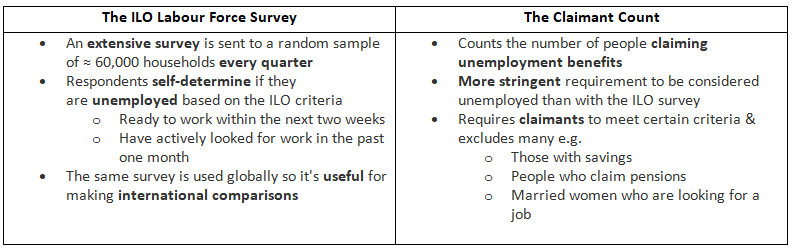
- Unemployment is often measured using two different approaches: The International Labour Organisation (ILO) Survey and The Claimant Count.
The Differences Between the ILO Labour Force Survey & The Claimant Count
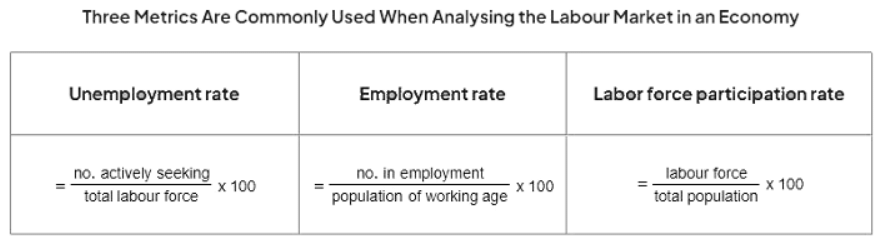
Calculating the Unemployment Rate
- The employment rate may rise even while the unemployment rate increases:
- This scenario might occur due to heightened immigration, leading to an expansion in the working-age population.
- Alternatively, it could stem from individuals transitioning from economic inactivity to employment.
- Unemployment rates fail to account for hidden unemployment that occurs over the long term:
- This situation arises when individuals actively seek employment but eventually abandon their job search, becoming economically inactive.
- Paradoxically, this could lower the unemployment rate as fewer individuals are actively pursuing employment opportunities.
The document Measurement of Unemployment is a part of the Year 10 Course Economics for GCSE/IGCSE.
All you need of Year 10 at this link: Year 10
FAQs on Measurement of Unemployment
| 1. How is unemployment measured in the UK? |  |
Ans. Unemployment in the UK is measured using two main methods: the Claimant Count and the Labour Force Survey.
| 2. What is the Claimant Count? | |
Ans. The Claimant Count is a measure of unemployment that counts the number of people claiming unemployment-related benefits from the government.
| 3. How is the Labour Force Survey conducted? | |
Ans. The Labour Force Survey is a survey conducted by the Office for National Statistics to gather data on employment and unemployment in the UK through interviews with households.
| 4. How is the unemployment rate calculated using these measures? | |
Ans. The unemployment rate is calculated by dividing the number of unemployed individuals by the total number of people in the labor force and multiplying by 100.
| 5. Why is it important to accurately measure unemployment? | |
Ans. Accurate measurement of unemployment helps policymakers and economists understand the state of the economy, assess the effectiveness of labor market policies, and make informed decisions to address unemployment issues.
About this Document

4.69/5 Rating

Apr 29, 2026 Last updated
Related Exams
Document Description: Measurement of Unemployment for Year 10 2026 is part of Economics for GCSE/IGCSE preparation. The notes and questions for Measurement of Unemployment have been prepared according to the Year 10 exam syllabus. Information about Measurement of Unemployment covers topics like and Measurement of Unemployment Example, for Year 10 2026 Exam. Find important definitions, questions, notes, meanings, examples, exercises and tests below for Measurement of Unemployment.
Introduction of Measurement of Unemployment in English is available as part of our Economics for GCSE/IGCSE for Year 10 & Measurement of Unemployment in Hindi for Economics for GCSE/IGCSE course. Download more important topics related with notes, lectures and mock test series for Year 10 Exam by signing up for free. Year 10: Measurement of Unemployment
Description
Measurement of Unemployment of Economics covers all the important topics, helping you prepare for the Year 10 exam on EduRev. Start for free!
Information about Measurement of Unemployment
In this doc you can find the meaning of Measurement of Unemployment defined & explained in the simplest way possible. Besides explaining types of Measurement of Unemployment theory, EduRev gives you an ample number of questions to practice Measurement of Unemployment tests, examples and also practice Year 10 tests



Related Searches
Measurement of Unemployment, Previous Year Questions with Solutions, practice quizzes, study material, Sample Paper, Free, Measurement of Unemployment, Extra Questions, mock tests for examination, Viva Questions, MCQs, video lectures, Summary, shortcuts and tricks, pdf , ppt, Measurement of Unemployment, Exam, past year papers, Semester Notes, Objective type Questions, Important questions;