30 days Study Plan for NEET | NEET Mock Test Series - Updated 2026 Pattern PDF Download
| Table of contents |

|
| Mastering NCERT for NEET |
|
| 30 Days NEET Schedule |
|
| (i) Days 1 - 10 |
|
| (ii) Days 11 - 14 |
|
| (iii) Days15 - 17 |
|
| (iv) Days 18 - 20 |
|
| (v) Days 21- 22 |
|
| (vi) Days 23 - 30 |
|

Getting ready for the NEET exam feels like tackling a tough mountain. But once you conquer it and get into a top medical school, you're one step closer to becoming a doctor, fulfilling your dream.
With just a month left to the NEET 2024 exam, you must make the most of your final preparations to succeed on their first attempt.
EduRev has created a 30-day planner for NEET that will guide you in effectively utilizing your time to achieve a high score and secure your place in medical courses. Whether you've been studying for a while or just getting started, Follow this planner to maximize your chances of success.

Exam Pattern
Understanding the syllabus and exam pattern is the first and most important step in preparing for any exam, including NEET.
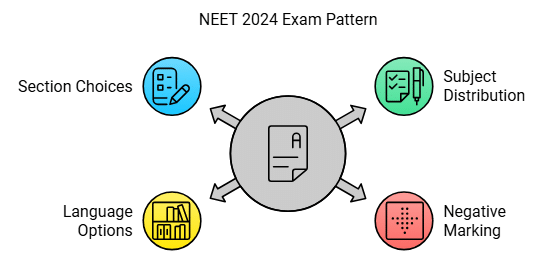
In the latest NEET 2024 exam pattern, there will be a total of 200 questions. Candidates need to answer 180 questions, with 45 questions each in Physics, Chemistry, Botany, and Zoology, each carrying 4 marks.
For every wrong answer, there's a negative marking of 1 mark. So, it's crucial to be careful and avoid guessing.
In the new NEET (UG) test pattern, each subject is split into two sections: Section A with 35 questions and Section B with 15 questions. Candidates can choose to attempt any 10 questions from Section B, as there's an internal choice provided. This doesn't change the total number of questions or the time allocated for the exam. All questions are multiple-choice.
Note: Candidates can opt for a Question Paper in any of the 13 languages listed below: English, Hindi, Assamese, Bengali, Gujarati, Malayalam, Kannada, Marathi, Odia, Tamil, Telugu, Urdu, and Punjabi.
Mastering NCERT for NEET
Based on the analysis of past years' papers, it's clear that many questions in the NEET exam are derived from the NCERT textbooks. This indicates the importance of thoroughly revising the NCERT material. By now, we expect that many of you have already gone through the NCERT textbooks extensively. This means you've studied the content thoroughly, understood the concepts, and familiarized yourself with the topics covered in the NEET syllabus
If still confused ?? you can refer to our NEET bible which we have created after talking to our toppers

Tips to prepare for NEET in 30 days
The NEET exam covers a lot of topics, and now when u have 30 days to study, you need a clever plan. You should understand how the exam is structured and concentrate on the topics that are asked the most.After studying past NEET exam papers, we've figured out which chapters are most important and carry more weightage.
Check our Videos How to score 360/360 to know more in detail.
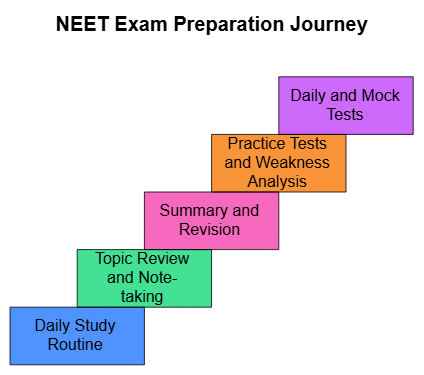
- Study each subject for at least 3 hours daily (totaling 9 hours for all subjects).
- Spend 1.5 hours to learn and review the topic after the test. Make handwritten notes for better understanding.
- Even if you haven't finished learning a topic in 3 hours, move on to the next subject. You can come back to unfinished topics later.
- Spend an hour before bed summarizing what you've learned that day using your notes.
- Spend an hour each morning revising your summary and notes from the previous day.
- use the last 6 days, solve previous NEET questions, and take practice tests. Identify weak areas and spend extra time revising them after each test.
- Take 1 minor test every day and one mock test every day. After taking this test, the results would reveal your weaker topics. Spend 2 hours studying/revising your weaker topics after taking the test.
30 Days NEET Schedule

A plan for 30 days is provided below you can revise the chapters and then attempt their topic wise tests
(i) Days 1 - 10
(ii) Days 11 - 14
Once you've revised all the chapters and attempted topic-wise tests, it's time to start practicing chapter-wise previous year's questions. This helps reinforce what you've learned and gives you a feel for the types of questions that might appear in the exam.
Biology class 11 chapter wise pyqs
Biology class 12 chapter wise pyqs
(iii) Days15 - 17
Chemistry class 11 chapter wise Previous year papers
Chemistry class 12 chapter wise previous year papers
(iv) Days 18 - 20
Physics class 11 chapterwise previous year qestions
Physics class 12 chapterwise previous year questions
(v) Days 21- 22
Diagrams are crucial in NEET Biology preparation. It's important to allocate dedicated time and effort to creating diagrams for all chapters. This practice will help you effectively answer diagram-based questions in the exam.
As every second counts, We've made a special course just for diagrams to help you save time and make your study effective. It gives you all the information and guidance you need to master diagram-based questions.
(vi) Days 23 - 30
“You should always have a clear strategy before attempting the exam, right from the start of the paper to the end of the paper, you should precisely know what you are going to do every minute. If you’re attempting a paper without a strategy, you’re taking a big risk.” - AIR 4 AIIMS 2019 Topper Chetanya Mittal.
Practice NEET Mock tests for your final revision and to enhance your time management abilities. Giving these tests build confidence and provide a predicted rank for evaluating performance.
We hope this helps you in preparing NEET effectively and quickly.
Happy learning with EduRev!!
|
1 videos|19 docs|71 tests
|
FAQs on 30 days Study Plan for NEET - NEET Mock Test Series - Updated 2026 Pattern
| 1. How can I effectively use NCERT books for NEET preparation? |  |
| 2. What is the significance of the 30 days study plan for NEET? | |
| 3. How should I manage my time during the 30 days NEET schedule? | |
| 4. What are some effective revision techniques for the last days before NEET? | |
| 5. Can I rely solely on NCERT books for NEET preparation? | |



|
1 videos|19 docs|71 tests
|
30 days Study Plan for NEET | NEET Mock Test Series - Updated 2026 Pattern
,mock tests for examination
,Important questions
,past year papers
,shortcuts and tricks
,Objective type Questions
,30 days Study Plan for NEET | NEET Mock Test Series - Updated 2026 Pattern
,Viva Questions
,30 days Study Plan for NEET | NEET Mock Test Series - Updated 2026 Pattern
,video lectures
,ppt
,Sample Paper
,study material
,Previous Year Questions with Solutions
,practice quizzes
,Summary
,Exam
,Extra Questions
,Free
,MCQs
,Semester Notes
;



30 days Study Plan for NEET Free PDF Download
Importance of 30 days Study Plan for NEET
30 days Study Plan for NEET Notes
30 days Study Plan for NEET NEET Questions
Study 30 days Study Plan for NEET on the App
|
© EduRev
|
Education Revolution
|


|




