IGCSE Year 10 > Year 10 Notes > History for GCSE/ > Was the Policy of Appeasement Justified?
Was the Policy of Appeasement Justified?

What was Appeasement?
- Appeasement entailed yielding to demands to prevent war. Advocates of appeasement utilized diplomacy and treaties to accommodate aggressive nations.
- Britain and France adopted the policy of appeasement during the 1930s.
- Neville Chamberlain is closely associated with appeasement.
- Chamberlain, like many others, suffered personal losses during World War I, with his brother falling in combat in 1915.
- The trauma of World War I deeply affected Chamberlain and the British populace, fueling a strong desire to avert another global conflict.
- In 1937, Chamberlain assumed office as the British Prime Minister and sought to appease Hitler's foreign policy objectives.
- Not all British politicians supported appeasement; Winston Churchill notably opposed it. He stated that: An appeaser is one who feeds a crocodile, hoping it will eat him last
MULTIPLE CHOICE QUESTION
Try yourself: What does the policy of appeasement entail?
Motivations for Appeasement
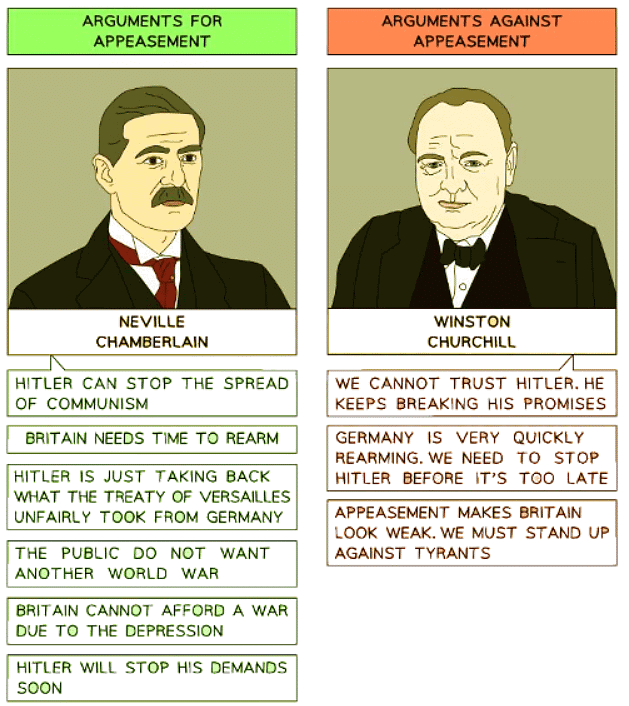 An illustration showing the arguments for and against the policy of Appeasement
The document Was the Policy of Appeasement Justified? is a part of the Year 10 Course History for GCSE/IGCSE.
All you need of Year 10 at this link: Year 10
FAQs on Was the Policy of Appeasement Justified?
| 1. What was the policy of Appeasement during World War II? |  |
Ans. Appeasement was a foreign policy strategy adopted by Britain and France in the 1930s to avoid conflict with Nazi Germany by giving in to its demands in the hopes of maintaining peace.
| 2. What were the motivations behind the policy of Appeasement? | |
Ans. The motivations for Appeasement included a desire to avoid another devastating war like World War I, a lack of military readiness, fear of communism, and a belief that giving in to Hitler's demands would prevent further aggression.
| 3. Was the policy of Appeasement justified in hindsight? | |
Ans. In hindsight, many historians argue that Appeasement was not justified as it ultimately failed to prevent World War II and allowed Hitler to expand his power and aggression unchecked.
| 4. How did the policy of Appeasement impact the course of World War II? | |
Ans. The policy of Appeasement emboldened Hitler and allowed him to annex Austria, Czechoslovakia, and eventually invade Poland, leading to the outbreak of World War II.
| 5. What were the consequences of the policy of Appeasement for Britain and France? | |
Ans. The consequences of Appeasement for Britain and France included a loss of credibility and influence on the world stage, as well as a realization that peaceful negotiations with aggressive dictators may not always be effective.
About this Document

4.60/5 Rating

Apr 29, 2026 Last updated
Related Exams
Document Description: Was the Policy of Appeasement Justified? for Year 10 2026 is part of History for GCSE/IGCSE preparation. The notes and questions for Was the Policy of Appeasement Justified? have been prepared according to the Year 10 exam syllabus. Information about Was the Policy of Appeasement Justified? covers topics like and Was the Policy of Appeasement Justified? Example, for Year 10 2026 Exam. Find important definitions, questions, notes, meanings, examples, exercises and tests below for Was the Policy of Appeasement Justified?.
Introduction of Was the Policy of Appeasement Justified? in English is available as part of our History for GCSE/IGCSE for Year 10 & Was the Policy of Appeasement Justified? in Hindi for History for GCSE/IGCSE course. Download more important topics related with notes, lectures and mock test series for Year 10 Exam by signing up for free. Year 10: Was the Policy of Appeasement Justified?
Description
Was the Policy of Appeasement Justified? of History covers all the important topics, helping you prepare for the Year 10 exam on EduRev. Start for free!
Information about Was the Policy of Appeasement Justified?
In this doc you can find the meaning of Was the Policy of Appeasement Justified? defined & explained in the simplest way possible. Besides explaining types of Was the Policy of Appeasement Justified? theory, EduRev gives you an ample number of questions to practice Was the Policy of Appeasement Justified? tests, examples and also practice Year 10 tests



Related Searches
Sample Paper, Free, Exam, Was the Policy of Appeasement Justified?, practice quizzes, shortcuts and tricks, Was the Policy of Appeasement Justified?, Important questions, Extra Questions, Previous Year Questions with Solutions, Viva Questions, Semester Notes, Summary, video lectures, ppt, study material, past year papers, MCQs, pdf , mock tests for examination, Was the Policy of Appeasement Justified?, Objective type Questions;