How to Participate in Science Olympiad | Science Olympiad Class 6 PDF Download
| Table of contents |

|
| What is NSO? |
|
| Eligibility Criteria |
|
| Steps to Participate in NSO |
|
| Exam Pattern and Syllabus |
|
| Syllabus |
|
| Benefits |
|
| Preparation Tips and Tricks |
|

What is NSO?
The National Science Olympiad (NSO) is an engaging competition organized by the Science Olympiad Foundation (SOF) for students from grades 1 to 12. It focuses on enhancing students' reasoning and problem-solving abilities in science and mathematics. The NSO encourages students to develop their logical thinking skills, boosts their confidence, and helps them tackle challenging and complex problems with ease, all while making learning fun and rewarding.

Eligibility Criteria
- The Science Olympiad Foundation (SOF) mandates that schools register their students for participation.
- Schools not yet registered can complete the registration process by sending an email to the SOF.
- The SOF NSO (National Science Olympiad) is open to students from classes 1 to 12..
- Application forms must be completed and submitted solely through the student's respective school; individual applications are not accepted by the Science Olympiad Foundation.
- Science is compulsory subjects for all students intending to participate.
- Participation in the examination is restricted to students from recognized boards such as CBSE, ICSE, and state boards.
Steps to Participate in NSO
To take part, students simply need to follow these simple instructions:
Accessing Registration forms:
- Students in classes 1 to 12 are eligible to participate in the SOF NSO.
- Registration forms are given to all the schools that are already part of SOF.
- Schools not yet registered can request prospectuses by emailing info@sofworld.org or making a phone call.
Completing and Returning Forms:
- After all the students have submitted their forms, schools are required to return the registration forms to SOF, completely filled out and in good order, by the specified deadline.
Roll Numbers:
- A teacher from the school should fill out the School Registration Form (SRF) and the Students' Registration Sheet (SRS) as per the given instructions and send them to the SOF office before the deadline.
- Based on the forms, SOF will register the school and the students, and will then generate roll numbers for all the students.
- Once the school and students are registered, SOF will send the question papers and instructions for conducting the exam. Any school can be a center for SOF NSO without paying a fee, but at least 10 students must be registered from each school to participate.
Registration Fee Details:
- Schools in India, Bangladesh, Bhutan, and Nepal must pay SOF a registration fee of Rs 125 (including GST) per student.
- Schools can also charge an additional Rs 25 per student for teacher support and other expenses.
- For other countries, the registration fee is US$9, and schools can charge an extra US$1 for additional costs.
Fee Exemption:
- No registration fee is required for students with severe physical disabilities or for children of Indian soldiers martyred in defense operations.
No Individual Registrations:
- It's important to note that individual student registrations are not accepted. Students should register through their respective schools to participate in the NSO.
Exam Pattern and Syllabus
Pattern:
- The NSO exam comprises three stages for students.
- Section I covers Verbal and Non-Verbal Reasoning for grades 1 to 5.
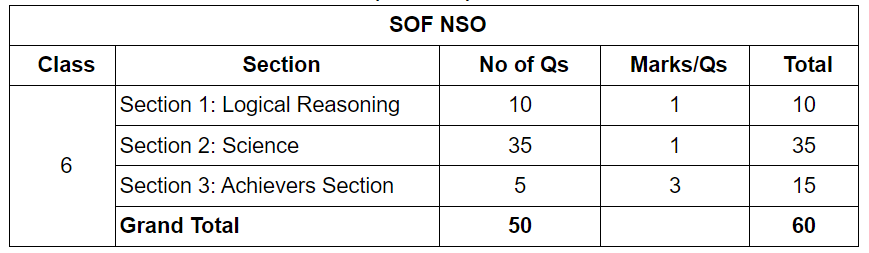
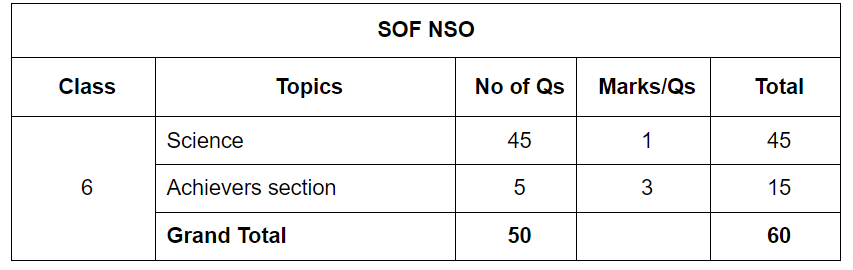
- Section II focuses on the Science Syllabus.
- Section III emphasizes high-order thinking questions, with difficulty increasing across grades.
- The question paper includes 35 objective-type questions for Classes 1 to 4 and 50 for Classes 5 to 10.
- Duration: Students have 60 minutes to complete it.
NSO Exam Pattern for Class 6 (Level 1)
NSO Exam Pattern for Class 6 (Level 2)
Note: There is no negative marking.
Syllabus
Logical Reasoning (Section - 1): Verbal and Non-Verbal Reasoning
- Series Completion and Inserting
- Analogy and Classification
- Coding-Decoding
- Blood Relations
- Direction Sense Test
- Logical Venn Diagrams
- Alpha-Numeric Sequence Puzzle
- Mathematical Operations
- Analytical Reasoning
- Mirror Images and Water Images
- Embedded Figures, Figure Formation
- Figure Matrix
- Paper Folding and Paper Cutting
- Cubes and Dice
- Dot Situation
Science Section (Section - 2): Science
- Food and its Components
- Materials Around Us
- States of Water
- Methods of Separation
- The World of Living (Parts of Plants, Grouping of Plants and Animals, Adaptations in Plants and Animals, Characteristics of Living Beings, Life Cycle of Plants and Animals)
- Exploring Magnets
- Measurement of Length and Motion
- Temperature and its Measurement
- Beyond Earth
- Natural Resources (Air, Water, Forests, Sun: The Source of Energy, Soil, Rocks and Minerals, Fossil Fuels, Renewable and Non-Renewable Resources).
Achiever's Section (Section 3):
- This section may contain questions that are more challenging and are designed to assess a student's deeper comprehension of scientific principles.
- The syllabus is as per Section – 2 .
Benefits

- Enhanced Problem-Solving Skills: Science Olympiads challenge students to think critically and solve complex problems, improving their analytical and logical reasoning abilities.
- Deepened Understanding of Scientific Concepts: Preparation for Olympiads often requires a deeper and broader understanding of math concepts than standard curricula, fostering a more profound comprehension of the subject.
- Increased Academic Performance: The skills and knowledge gained from Olympiad preparation can lead to better performance in school mathematics and other related subjects.
- Preparation for Higher Education: Participation in Olympiads can be a valuable experience for students planning to pursue STEM fields in college, providing them with a strong foundation in advanced mathematics.
- Networking Opportunities: Olympiads often bring together like-minded students, allowing participants to network with peers, mentors, and professionals in the field of mathematics.
- International Exposure: Many Olympiads, such as the National Science Olympiad (NSO), provide opportunities for international travel and cultural exchange, broadening students' horizons.
- Improved Self-Confidence: Successfully solving challenging problems and competing in Olympiads can boost a student’s confidence in their mathematical abilities and overall academic skills.
- Enhanced Time Management: Preparing for Olympiads requires effective time management and organizational skills, which are beneficial in all areas of life.
These benefits, along with the intellectual growth and personal development that come from participating in Olympiad competitions, make them highly rewarding experiences for students.
Preparation Tips and Tricks
Preparing for the Class 6 Science Olympiad may seem difficult, but it's an exciting chance. Instead of just a test, view it as an adventure to discover the world of numbers and logic. With enthusiasm and dedication, you can approach it successfully, enjoying the process of learning and solving problems.
To support you on this journey, we've prepared some useful tips and tricks

Preparation:
- Understand the syllabus thoroughly and plan to cover topics each day.
- Choose a consistent time and place for studying to maintain regularity.
- Focus on learning with a clear conceptual understanding.
- Take notes while studying, highlighting key points and important topics for easier revision.
- After completing the syllabus, practice chapter-wise questions and mock tests to identify strengths and weaknesses and improve accordingly.
- Once confident with the syllabus, solve previous year's question papers to understand the exam pattern, enhance time management skills, and improve speed and accuracy.
Exam Strategies:
- Stay calm and focused. Take deep breaths and read instructions carefully.
- Effective time management. Allocate time for each section based on strengths and question numbers.
- Careful reading. Analyze questions before attempting answers and identify keywords.
- Utilize the elimination technique. Eliminate wrong options if uncertain about an answer.
- Double-check. Review answers to avoid mistakes before submitting.
Bonus Tips:
- Stay curious! Experiment, ask questions, and explore the world of numbers and logic.
- Make Science fun by using digital whiteboards and interactive problem-solving platforms, calculating distances, travel time, and costs for trips.
- Believe in yourself. Have confidence in your preparation and give your best effort.
Remember:
- NSO is challenging yet rewarding; focus on learning and enjoying the journey.
- Celebrate achievements, learn from mistakes, and keep your passion alive.
|
70 videos|150 docs|104 tests
|
FAQs on How to Participate in Science Olympiad - Science Olympiad Class 6
| 1. What is the eligibility criteria for participating in the NSO for Class 6? |  |
| 2. What are the steps to participate in the NSO exam? | |
| 3. What is the exam pattern and syllabus for Class 6 NSO? | |
| 4. What are the benefits of participating in the NSO for Class 6 students? | |
| 5. What are some preparation tips and tricks for the NSO exam? | |



Sample Paper
,Semester Notes
,video lectures
,practice quizzes
,Viva Questions
,How to Participate in Science Olympiad | Science Olympiad Class 6
,Objective type Questions
,past year papers
,MCQs
,Free
,study material
,mock tests for examination
,Important questions
,Summary
,shortcuts and tricks
,ppt
,Previous Year Questions with Solutions
,Extra Questions
,How to Participate in Science Olympiad | Science Olympiad Class 6
,Exam
,How to Participate in Science Olympiad | Science Olympiad Class 6
;



How to Participate in Science Olympiad Free PDF Download
Importance of How to Participate in Science Olympiad
How to Participate in Science Olympiad Notes
How to Participate in Science Olympiad Class 6 Questions
Study How to Participate in Science Olympiad on the App
|
© EduRev
|
Education Revolution
|


|




within 7 days!