CBSE Class 6  >  Class 6 Notes  >  Social Studies  >  Worksheet: Family and Community

Worksheet: Family and Community

Multiple Choice Questions (MCQs)

Q1: What type of family includes several generations living together?
(a) 
Nuclear family
(b) Joint family
(c) Extended family
(d) Single-parent family

Q2: What is the primary role of parents in a family?
(a) 
To make money
(b) To provide education
(c) To help children grow into happy individuals
(d) To discipline children

Q3: In Indian languages, which of the following terms refers to 'aunt'?
(a) 
Chacha
(b) Bua
(c) Nana
(d) Mausi

Q4: What does 'dharma' refer to in Indian culture?
(a) 
Happiness
(b) Duty
(c) Family
(d) Religion

Q5: Who helped Kamal Parmar in teaching the children?
(a) 
His friends
(b) Teachers from a nearby school
(c) Government officials
(d) Local businesses

Fill in the Blanks

Q1: Shalini lives in __________ with her family.

Q2: Tenzing's father runs a small __________ store.

Q3: In many Indian languages, there is no specific word for __________.

Q4: Families often share their resources, showing __________ and commitment.

Q5: The Bhil community took action to help the environment and their __________.

True or False

Q1: A nuclear family consists of a couple and their children.

Q2: Kamal Parmar provided free tuition classes only during the day.

Q3: In Indian culture, families are not usually interconnected.

Q4: Shalini received a fancy silk dress for the festival of Onam.

Q5: The Bhil community planted trees to help with water conservation.

Match the Following
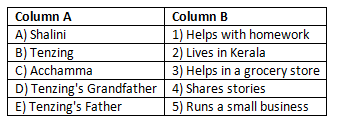
Match the Following

You can access the solutions to this worksheet here.

The document Worksheet: Family and Community is a part of the Class 6 Course Social Studies for Class 6.
All you need of Class 6 at this link: Class 6

FAQs on Worksheet: Family and Community

1. What are the different types of families and how do they work together in a community?
Ans. Families vary in structure-nuclear families (parents and children), joint families (extended relatives), and single-parent families. Each type functions differently within communities by sharing responsibilities, resources, and cultural values. Understanding family diversity helps students recognise how various household structures contribute equally to neighbourhood and social harmony in CBSE Class 6 Social Studies.
2. How do roles and responsibilities change between family members?
Ans. Family members have distinct roles based on age, gender, and capability-parents provide care and guidance, children contribute through studies and household help, and elders offer wisdom. These responsibilities shift over time as individuals mature. Learning about role distribution helps students understand family dynamics and interdependence within households and how it impacts community functioning.
3. What is the difference between a family and a community, and why do both matter?
Ans. A family is a small unit bound by blood or law, while a community comprises multiple families and individuals sharing geographical space and common interests. Communities provide safety, support networks, schools, and markets that families cannot supply alone. Both strengthen each other-families form the foundation, and communities create the larger social structure for collective living.
4. What responsibilities do community members have towards each other?
Ans. Community members share duties like maintaining public spaces, helping neighbours during emergencies, respecting cultural practices, and participating in local governance or group activities. These collective responsibilities foster trust, safety, and social cohesion. When individuals contribute-whether through volunteering, following rules, or supporting local initiatives-the entire community benefits from stronger bonds and better living conditions.
5. How do traditions and customs keep families and communities connected?
Ans. Traditions and customs-festivals, rituals, food practices, and celebrations-create shared identity and emotional bonds across generations and neighbourhoods. They transmit values, history, and cultural heritage while bringing people together regularly. Participating in community festivals and family customs strengthens relationships, preserves cultural identity, and reinforces the sense of belonging that holds communities and families together.
Explore Courses for Class 6 exam
Get EduRev Notes directly in your Google search
Related Searches
ppt, Previous Year Questions with Solutions, past year papers, Worksheet: Family and Community, video lectures, practice quizzes, pdf , shortcuts and tricks, Worksheet: Family and Community, Extra Questions, Exam, Summary, Important questions, Viva Questions, Semester Notes, Objective type Questions, mock tests for examination, Worksheet: Family and Community, study material, MCQs, Sample Paper, Free;