Human and Artificial Intelligence

Human Intelligence
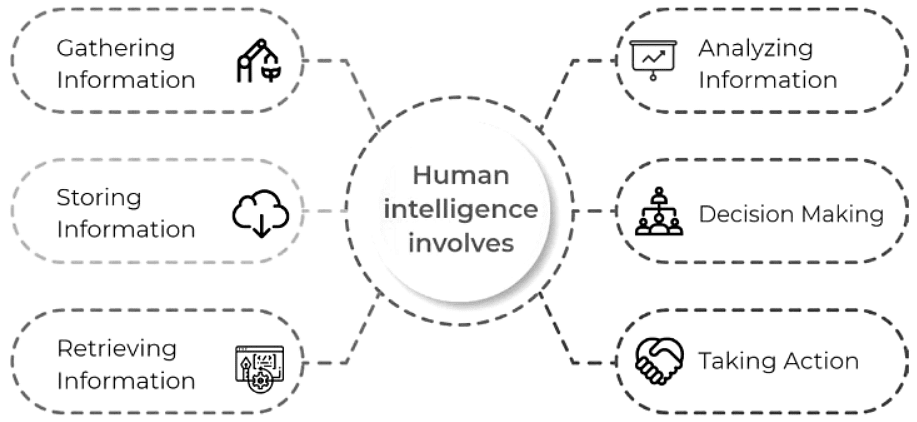
Human intelligence is a remarkable and multifaceted trait that encompasses a range of cognitive abilities.
Here are some aspects that define and exemplify natural human intelligence:
- Ability to Observe, Recognize, and Understand:
- Observation: Humans can perceive their environment through senses, gathering information about the world around them.
- Recognition: We can identify patterns, faces, objects, and situations, making sense of complex stimuli.
- Understanding: We interpret and comprehend the information we observe, forming insights and knowledge.
- Ability to Make 'Smart' Decisions and Solve Problems:
- Decision-Making: Humans can evaluate situations, consider possible outcomes, and choose the best course of action based on reasoning and experience.
- Problem-Solving: We can approach challenges methodically, using logic, creativity, and critical thinking to find solutions.
- Ability to Learn and Increase Knowledge:
- Learning: Humans have the capacity to acquire new skills, information, and behaviors through experience, study, and instruction.
- Knowledge Accumulation: We continually build upon our existing knowledge, integrating new information to enhance our understanding and capabilities.
Human intelligence is not limited to these abilities but also includes emotional intelligence, creativity, adaptability, and social skills. It is the combination of these traits that enables humans to navigate the complexities of life, innovate, and progress.
Examples of Natural Human Intelligence
- Scientific Discovery: The ability to observe natural phenomena, formulate hypotheses, conduct experiments, and understand the underlying principles of the universe.
- Artistic Creativity: The capacity to create art, music, literature, and other forms of expression that evoke emotions and convey complex ideas.
- Social Interaction: The skill to navigate social relationships, understand others' emotions and perspectives, and communicate effectively.
- Technological Innovation: The ingenuity to develop new technologies and tools that solve problems and improve the quality of life.
Human intelligence is a dynamic and evolving trait, allowing us to adapt to new challenges and continuously push the boundaries of what we can achieve.
Artificial Intelligence
Machines or computers, while remarkable in their capabilities, fundamentally differ from human intelligence.
Here are key points to consider when discussing the intelligence of machines:
Characteristics of Artificial Intelligence
- Created by Humans: Machines are designed, programmed, and operated by humans. Their capabilities and limitations are defined by the algorithms and data provided by human developers.
- Lack of Brains: Machines do not possess biological brains. Instead, they rely on electronic circuits and processors to perform tasks. Their "thinking" is based on mathematical computations and logical operations.
- Inability to Sense, Feel, or Express: Machines do not have sensory organs, emotions, or the ability to experience subjective feelings. While they can be equipped with sensors to detect environmental changes, they do not "feel" in the way humans do.
- Training and Limitations:
- Machines can be trained using data and machine learning algorithms to perform specific tasks. However, their understanding is limited to the patterns and information they have been exposed to during training.
- They cannot generalize knowledge beyond their programmed or learned capabilities without human intervention.
Should We Term Computers as Intelligent?
- Functional Intelligence:
- Computers can perform specific tasks with a level of efficiency and accuracy that may surpass human ability. For example, they can process vast amounts of data quickly, recognize patterns, and execute complex calculations.
- This type of intelligence is functional and task-specific. It is based on predefined rules, algorithms, and data inputs.
- Artificial Intelligence (AI):
- The term "artificial intelligence" is used to describe the ability of machines to mimic aspects of human intelligence. This includes learning from data (machine learning), recognizing speech or images, playing games, and making decisions based on logic.
- AI can be seen as a simulation of intelligence, rather than true understanding or consciousness.
- Limitations:
- AI lacks the ability to truly understand context, experience emotions, or possess consciousness. Their "intelligence" is a result of human programming and training, confined to the scope of their design.
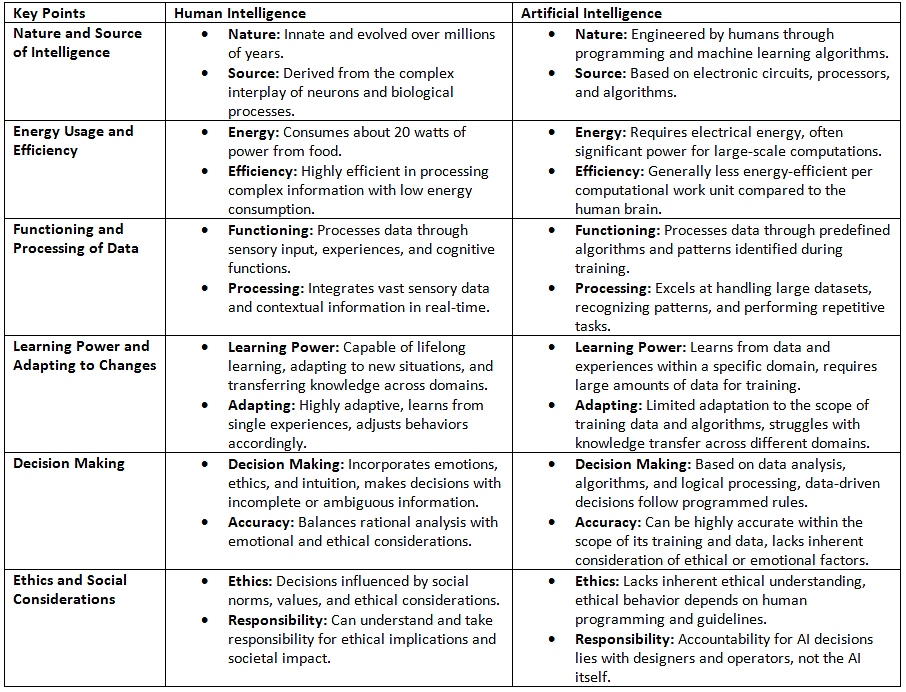
Human vs Artificial Intelligence