Worksheet Solutions: Fractions - 1

Fill in the Blanks
Q1: When 4 children share 1 roti equally, each child gets ______ roti.
Ans: 1/4
When a whole item (roti) is divided into 4 equal parts, each part is 1/4 of the whole.
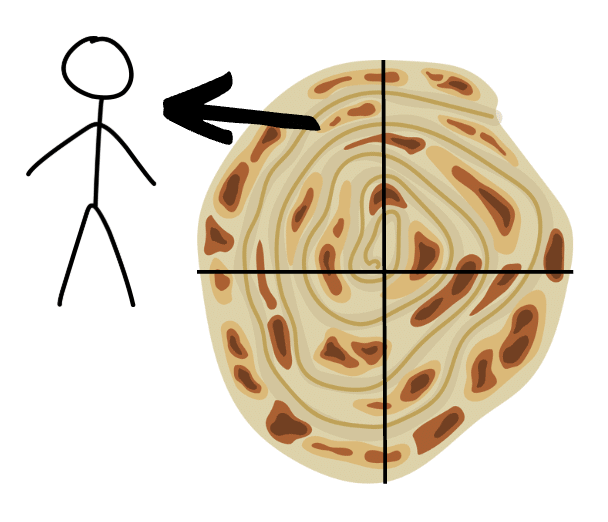
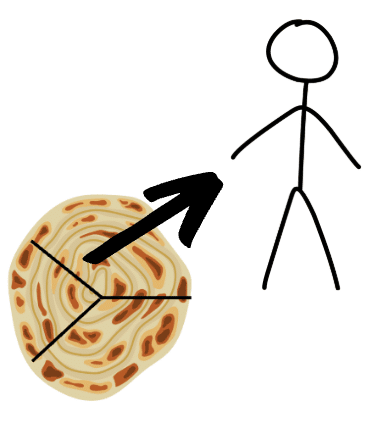
Q2: A whole roti is divided into 3 equal pieces. Each piece is ______ of the roti.
Ans: 1/3
When something is divided into 3 equal parts, each part is represented as 1/3 of the whole.
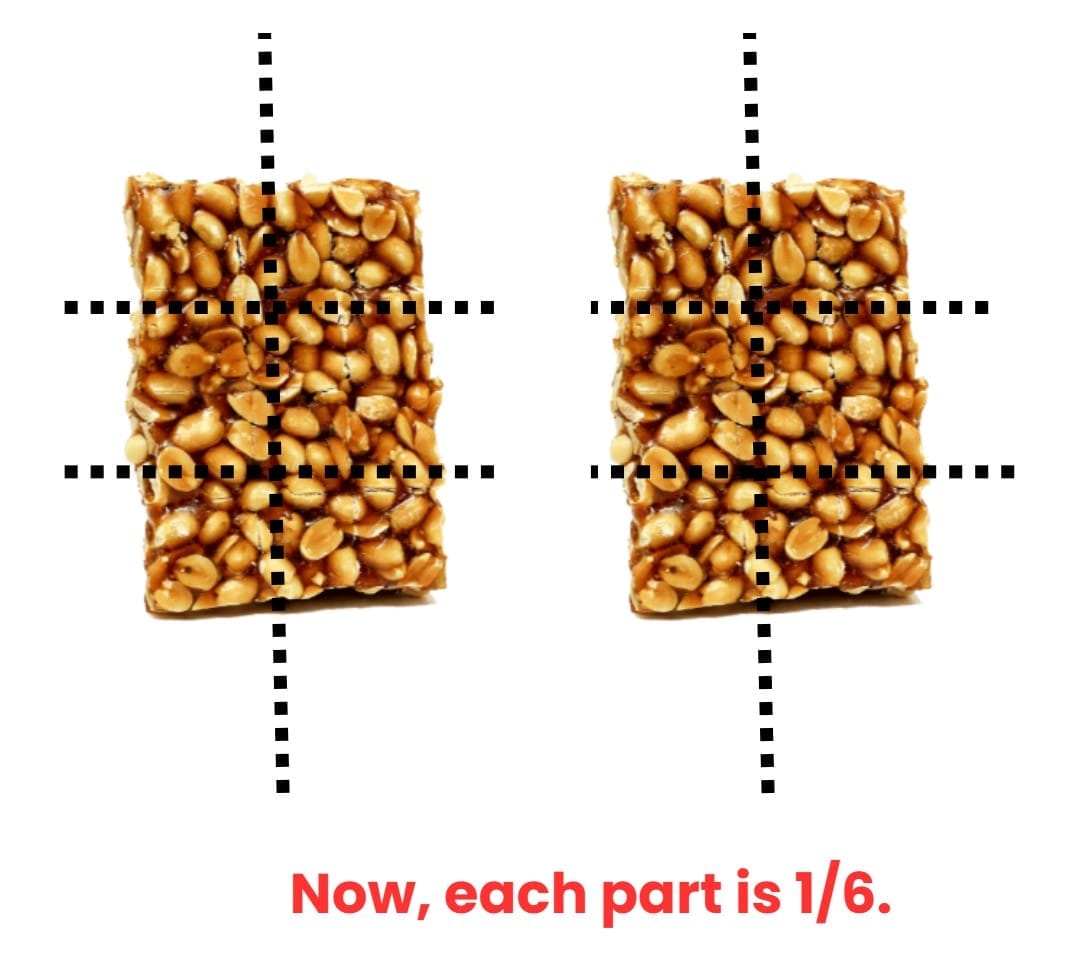
Q3: If 2 chikkis are divided equally among 6 children, each child gets ______ chikki
Ans: 1/3
Two chikkis divided among 6 children means each child gets a fraction 2/6, which simplifies to 1/3 of a chikki.
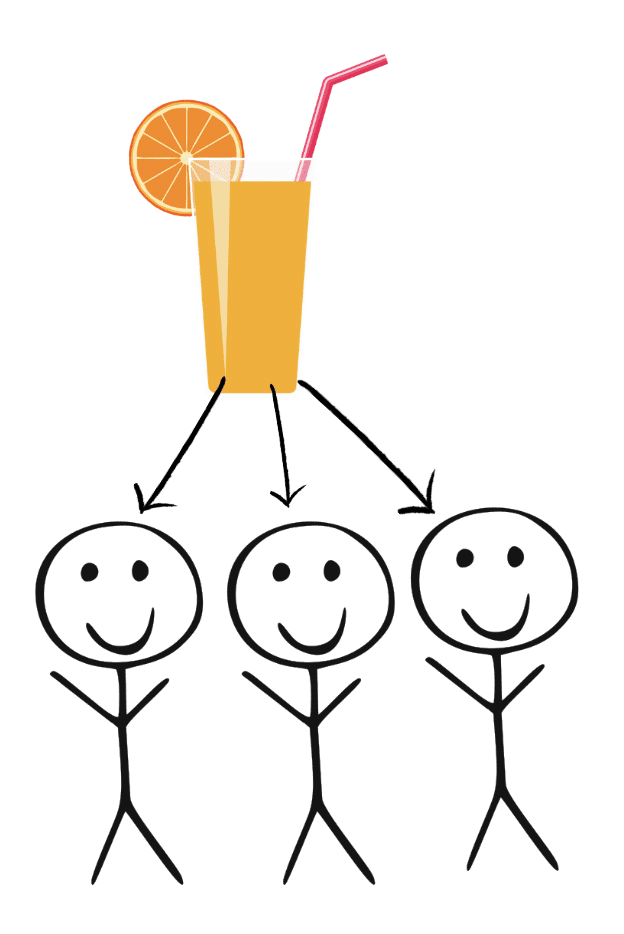
Q4:If 1 glass of juice is equally shared between 3 children, each child gets ______ glass of juice.
Ans: 1/3
Sharing 1 glass equally among 3 children results in each child receiving 1/3 of the glass.
Q5: To compare fractions with different denominators, we convert them to have the same ______.
Ans: denominator
Fractions need to be converted to have the same denominator so that their sizes can be compared directly.
True or False
Q1: The fraction 1/2 is smaller than 1/4.
Ans: False
Explanation: 1/2 is equal to one part out of two, which is larger than 1/4 (one part out of four). Therefore 1/2 > 1/4.
Q2: When 5 children share 2 cakes equally, each child's share is 2/5 of a cake.
Ans: True
Explanation: Dividing 2 cakes equally among 5 children gives each child 2/5 of a cake.
Q3: The fraction 3/6 is equivalent to 1/2.
Ans: True
Explanation: 3/6 can be simplified by dividing numerator and denominator by 3: 3/6 = (3÷3)/(6÷3) = 1/2, so they are equivalent.
Q4: The number line can only represent whole numbers, not fractions.
Ans: False
Explanation: Fractions can be placed on a number line between whole numbers. For example, 1/2 lies halfway between 0 and 1.
Q5: Adding 1/4 and 2/4 results in 3/4.
Ans: True
Explanation: When fractions have the same denominator, add the numerators: 1/4 + 2/4 = (1+2)/4 = 3/4.
Match the Following
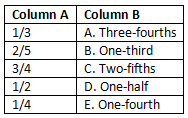
Ans:
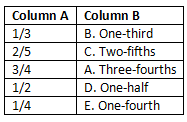
Answer the following Questions
Q1. Are  equivalent fractions? Why?
Sol: Here, the simplest form of is:

The simplest form of is:
The simplest form of is:
Since the simplest forms of and are the same, they are equivalent fractions.
But the simplest form of is different, so it is not equivalent to the other two.
Q2. Add the following fractions and express the result as a mixed fraction: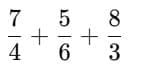
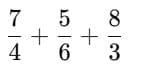
Here, the LCM of 4, 6, and 3 is 12.
Now, expressing the fractions with denominator 12, we get:
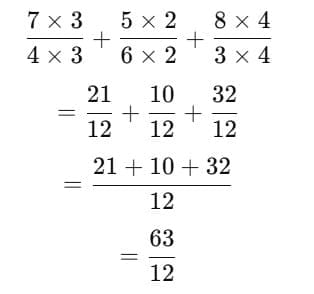
Now, convert into a mixed fraction:
Simplifying :
Therefore,  is the correct answer.
Q3. Subtract as indicated:
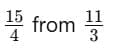 Sol: Given,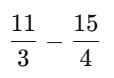
Here, the LCM of 3 and 4 is 12.
Now, convert both fractions into like fractions:
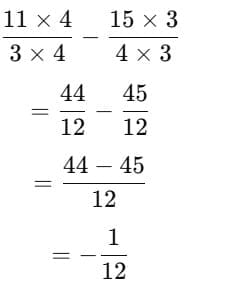
Q4. Compare the following fraction and justify your answer:

Given fractions are and .
Here, the LCM of denominators 4 and 3 is 12.
Now, converting both fractions to like fractions:
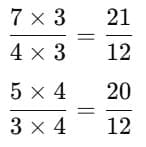
Since ,
Word Problems
Q1: Aman mixes 7/9 liters of lemon juice with 5/6 liters of orange juice to make fruit punch. What is the total volume of fruit punch he has made?
Sol: Given:
Lemon juice = L
Orange juice = L
Total volume of fruit punch
First, find the LCM of 9 and 6.
LCM of 9 and 6 = 18
Convert the fractions into like fractions:
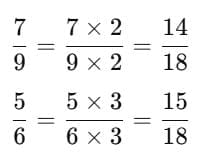
Now, add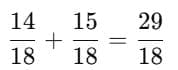
Converting into a mixed fraction, 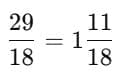
Therefore, The total volume of fruit punch is liters.
Q2: Rina's school is 11/15 km from her home. She rides her bicycle for 2/5 km from her home daily and then walks the remaining distance to reach her school. How much distance does she walk daily?
Sol: Given:
Total distance from home to school = km
Distance covered by bicycle = km
Distance walked
Find the LCM of 15 and 5.
LCM = 15
Convert into denominator 15:
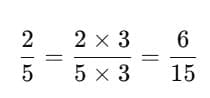
Now subtract:
Simplify:
Therefore, Rina walks km daily.
Q3: Mohan takes 5/3 minutes to complete a swimming lap, while his friend Sohan takes 8/5 minutes to do the same. Who completes the lap faster and by how much?
Sol: Given:
Time taken by Mohan = minutes
Time taken by Sohan = minutes
To compare, convert both fractions to like denominators.
LCM of 3 and 5 = 15
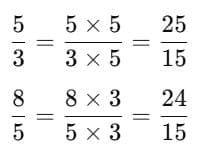
Since
Sohan takes less time, so Sohan is faster.
Difference in time:
Sohan completes the lap faster by minute.
FAQs on Worksheet Solutions: Fractions - 1
| 1. How do I add and subtract fractions with different denominators? |  |
| 2. What's the difference between proper fractions, improper fractions, and mixed numbers? | |
| 3. How do I simplify or reduce fractions to their lowest terms? | |
| 4. Why do I need to find equivalent fractions when comparing fractions? | |
| 5. How do I multiply and divide fractions correctly in these worksheet problems? | |