Worksheet: Perimeter and Area - 1

Multiple Choice Questions (MCQs)
Q1: What is the perimeter of a rectangle with a length of 15 cm and a width of 10 cm?
(a) 25 cm
(b) 30 cm
(c) 40 cm
(d) 50 cm
Q2: A square has a perimeter of 24 cm. What is the length of one side?
(a) 4 cm
(b) 6 cm
(c) 8 cm
(d) 12 cm
Q3: The area of a rectangle is 54 square units. If its length is 9 units, what is its width?
(a) 5 units
(b) 6 units
(c) 7 units
(d) 8 units
Q4: A triangle has a perimeter of 20 cm. If two of its sides are 8 cm and 6 cm, what is the length of the third side?
(a) 4 cm
(b) 6 cm
(c) 8 cm
(d) 10 cm
Q5: A rectangular park is 30 meters long and 20 meters wide. What is the area of the park?
(a) 50 square meters
(b) 100 square meters
(c) 400 square meters
(d) 600 square meters
Fill in the Blanks
Q1: The perimeter of a square with a side length of 5 cm is _______.
Q2: A rectangular field has a length of 10 m and a width of 5 m. The perimeter of the field is _______.
Q3: If the area of a square is 64 square units, the length of one side is _______ units.
Q4: The perimeter of a triangle with sides of 7 cm, 8 cm, and 9 cm is _______.
Q5: A rectangular garden has an area of 48 square meters and a width of 6 meters. The length of the garden is _______ meters.
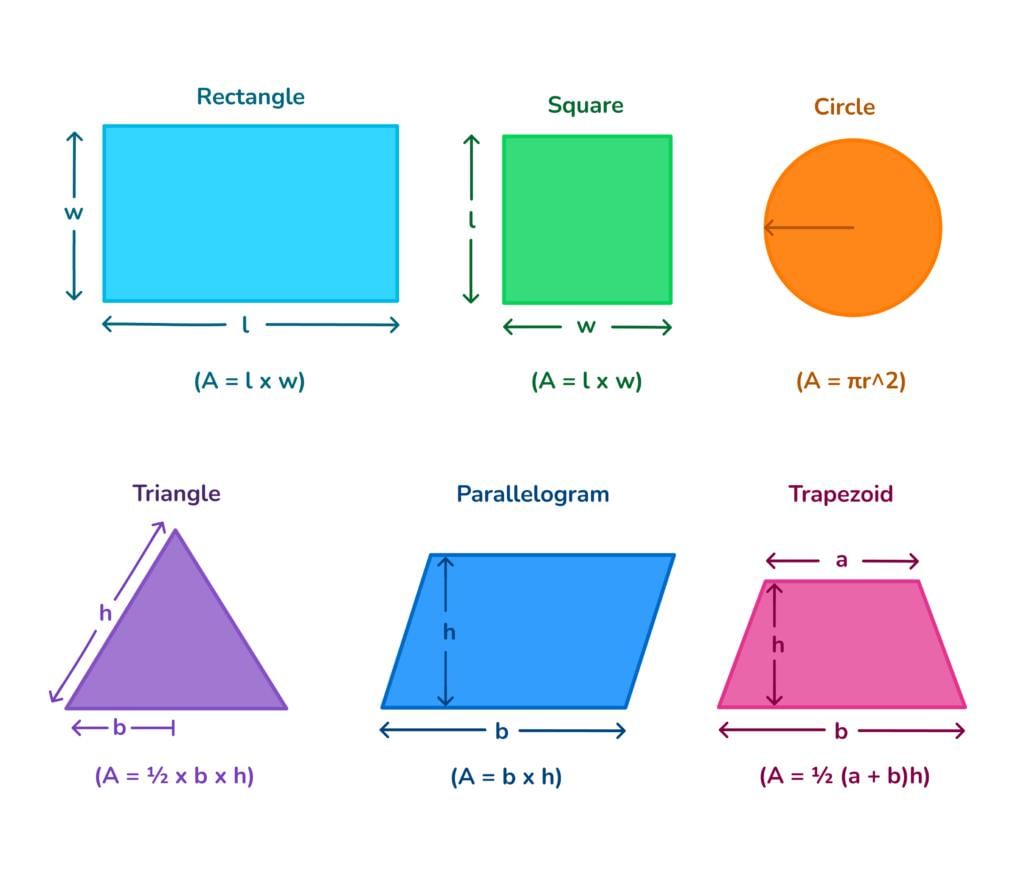 Area of different figures
True/False
Q1: The area of a rectangle is always greater than its perimeter.
Q2: The perimeter of a square is four times the length of one side.
Q3: A triangle with all sides equal has a perimeter that is three times the length of one side.
Q4: If a rectangle has an area of 36 square units and a width of 4 units, its length must be 9 units.
Q5: A square and a rectangle with the same perimeter have the same area.
Answer the following Questions
Q1: Draw a square with a side length of 5 units. Calculate its perimeter and area.
Q2: A square-shaped playground has a side length of 150 m. The cost of fencing the playground is ₹12 per meter. What will be the total cost of fencing?
Q3: A farmer wants to plant a rectangular field with a length of 100 meters and a width of 40 meters. What is the area of the field?
Q4: A rectangular parking area is 120 m long and 60 m wide. If each car requires 20 sq. m of space, what is the maximum number of cars that can be parked in the area?
Q5: Draw a rectangle with a length of 8 units and a width of 4 units. Calculate the perimeter and area.
You can access the solutions to this worksheet here.
FAQs on Worksheet: Perimeter and Area - 1
| 1. How do I find the perimeter of a rectangle when only length and width are given? |  |
| 2. What's the difference between calculating perimeter and area, and why do we need both? | |
| 3. Can I calculate the area of a square using the same method as a rectangle? | |
| 4. Why do I get different answers when I confuse length with width in perimeter calculations? | |
| 5. How should I approach worksheet problems that mix perimeter and area questions together? | |