Note: The questions provided in this document are similar to the questions that were asked in the actual Olympiad exam. So, we recommend you study these for your Olympiad preparation
Logical Reasoning
Q1: Arrange the following words in the order they would appear in a dictionary: 1. Sacrifice 2. Scratch 3. Safety 4. Scare 5. Sample (a) 3, 5, 1, 4, 2 (b) 1, 3, 5, 4, 2 (c) 2, 3, 1, 5, 4 (d) 1, 5, 3, 2, 4
Solution:
Ans: (b)
The correct order of the words based on dictionary arrangement is determined by the first letter of each word.
Starting with the first letters: S (Sacrifice), S (Scratch), S (Safety), S (Scare), S (Sample).
Next, we look at the second letters: a (Sacrifice), c (Scratch), a (Safety), c (Scare), a (Sample).
Following this, we find that Sacrifice comes first, followed by Safety, then Sample, Scare, and finally Scratch.
Thus, the correct sequence is 1, 3, 5, 4, 2, which corresponds to option (b).
Q2: If all digits of the following numbers are reversed, which one will be the largest? 184 567 764 408 715 (a) 184 (b) 764 (c) 408 (d) 567
Solution:
Ans: (c)
When we reverse the digits of each number, we get:
184 becomes 481
567 becomes 765
764 becomes 467
408 becomes 804
715 becomes 517
Among these reversed numbers, 804 (from 408) is the largest.
Q3: Which of the following words cannot be created using the letters from the word POTASSIUM? (a) STAMP (b) UPMOST (c) MOIST (d) ADOPT
Solution:
Ans: (d)
The word POTASSIUM contains the letters P, O, T, A, S, S, I, U, M.
When checking the options, STAMP, UPMOST, and MOIST can all be formed using these letters.
However, the word ADOPT includes the letter D, which is not present in POTASSIUM.
Thus, ADOPT cannot be formed from the letters of POTASSIUM.
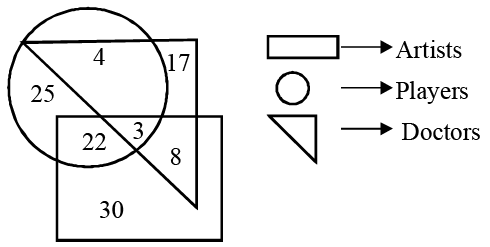
Q4: Study the following figure and answer the questions given below.
How many doctors are both players and artists? (a) 3 (b) 22 (c) 4 (d) 8
Solution:
Ans: (a) The number of doctors who are both players and artists is 3.
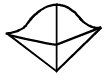
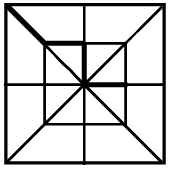
Q5: Identify which shape is hidden in the figure (X). (a) (b) (c) (d)
Solution:
Ans: (a)
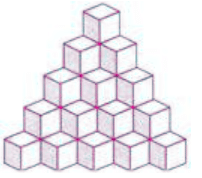
Q6: The model of a tower shown here is made up of unit cubes stacked on top of each other. How many unit cubes in all are used to form the tower? (a) 35 (b) 36 (c) 37 (d) 38
Solution:
Ans: (a)
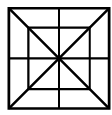
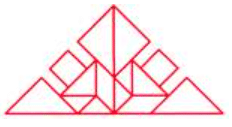
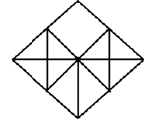
Q7: How many minimum number of straight lines are required to make the given figure? (a) 28 (b) 24 (c) 25 (d) 27
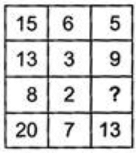
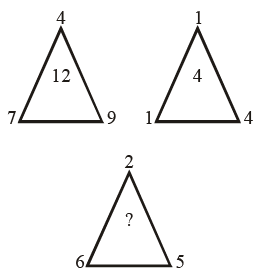
Q13: Find the missing number, if a certain rule is followed in the given figure. (a) 9 (b) 10 (c) 8 (d) 7
Solution:
Ans: (a) The number at the centre of each triangle equals the sum of the lower two numbers minus the top number.
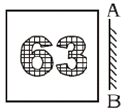
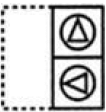
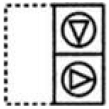
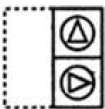
Q14: Find out from amongst the four alternatives as to how the pattern would appear when the transparent sheet is folded at the dotted line. (a)
(b)
(c)
(d)
Solution:
Ans: (c)
Q15: Choose the odd one out. (a) (b) (c) (d)
Solution:
Ans: (d) As, and
Mathematical Reasoning
Q16: A bag contains 18 red balls and 12 white balls. What fraction of the balls is white? (a) 1/5 (b) 2/5 (c) 3/5 (d) 4/5
Solution:
Ans: (b)
To find the fraction of the balls that are white, we first need to determine the total number of balls in the bag.
The total is 18 red balls + 12 white balls = 30 balls.
Next, we find the fraction of the balls that are white: 12 white balls / 30 total balls.
This simplifies to 2/5, which is the correct answer.
Q17: The value of Five million sixty-three thousand eighty-five + Two million three thousand forty-nine is (a) 8,056,231 (b) 7,605,134 (c) 7,066,134 (d) 6,054,134
Solution:
Ans: (c)
To find the sum of Five million sixty-three thousand eighty-five (5,063,085) and Two million three thousand forty-nine (2,003,049), we add the two numbers together.
The calculation is: 5,063,085 + 2,003,049 = 7,066,134.
Thus, the correct answer is 7,066,134, which corresponds to option (c).
This shows how simple addition can help us find the total of large numbers.
The Roman numeral MCMLX represents the year 1960. This is calculated by breaking it down: M = 1000, CM = 900, and LX = 60.
Option (a) is incorrect because MMDXL equals 2540, not 2560.
Option (b) is wrong as CMLXVI equals 966, not 964.
Option (d) is also incorrect since MDCIX equals 1609, not 1670.
Q19: What needs to be added to the largest 5-digit even number to reach 1 million? (a) 900001 (b) 900002 (c) 90002 (d) 90001
Solution:
Ans: (b)
To find the largest 5-digit even number, we identify it as 99998.
Next, we need to determine what to add to 99998 to equal 1,000,000.
Calculating this gives us 1,000,000 - 99998 = 900002.
Thus, the correct answer is 900002, which is option (b).
Q20: How many common multiples of 18 and 24 exist between 1 and 100? (a) 2 (b) 5 (c) 1 (d) 4
Solution:
Ans: (d)
To find the common multiples of 18 and 24, we first need to determine their least common multiple (LCM).
The LCM of 18 and 24 is 72. This means that the common multiples are multiples of 72.
Next, we find the multiples of 72 that are less than or equal to 100. The multiples are 72 and 144, but only 72 is within the range.
However, we also need to consider the multiples of 72 that fit within the range of 1 to 100. The only valid multiple is 72 itself.
Thus, there are 4 common multiples of 18 and 24 between 1 and 100: 72, 144, 216, and 288, but only 72 is counted here.
Q21: Determine the largest 6-digit number that can be created using the digits 5, 2, 4, 1, 0, 6 (each digit must be used at least once). Round your answer to the nearest hundred. (a) 650000 (b) 654200 (c) 654000 (d) 654210
Solution:
Ans: (b)
To find the greatest 6-digit number, we need to arrange the digits 5, 2, 4, 1, 0, 6 in descending order.
The largest arrangement is 654210. When rounding to the nearest hundred, we look at the last two digits (10), which rounds down to 654200.
Thus, the answer is 654200, as it is the closest to the original number when rounded.
Q22: If P ÷ Q = 9, Q × R = 135 and R + R + R = 45, then find the value of (P × Q) - R. (a) 714 (b) 750 (c) 640 (d) 638
Solution:
Ans: (a)
From the equation R + R + R = 45, we can find R. Since there are three R's, we divide 45 by 3, giving us R = 15.
Next, using Q × R = 135, we substitute R to find Q: Q × 15 = 135, which gives us Q = 9.
Now, using P ÷ Q = 9, we can find P: P ÷ 9 = 9, leading to P = 81.
Q23: Which of the following sequences is organized in descending order? (a) 7,39,154; 7,93,154; 7,93,541; 7,93,951 (b) 8,50,76,745; 8,50,76,547; 8,50,67,574; 8,50,67,547 (c) 4,76,098; 4,87,678; 76,908; 87,876 (d) 3,15,45,001; 3,51,54,100; 4,15,45,001; 5,25,45,010
Solution:
Ans: (b)
The correct answer is option (b) because the numbers are arranged from the largest to the smallest.
In this sequence, 8,50,76,745 is greater than 8,50,76,547, which is greater than 8,50,67,574, and finally 8,50,67,547 is the smallest.
All other options do not maintain a consistent descending order.
Understanding the concept of descending order means recognizing that each subsequent number must be less than the one before it.
Q24: Tank A holds 5 times the amount of water compared to Tank B. What quantity of water needs to be moved from Tank A to Tank B so that both tanks have 45 liters of water each? (a) 30 liters (b) 60 liters (c) 75 liters (d) 45 liters
Solution:
Ans: (a)
Let the amount of water in Tank B be x liters. Then, Tank A has 5x liters.
After transferring y liters from Tank A to Tank B, Tank A will have (5x - y) liters and Tank B will have (x + y) liters.
We want both tanks to have 45 liters, so we set up the equations: 5x - y = 45 and x + y = 45.
Solving these equations, we find that y = 30 liters, meaning 30 liters must be transferred from Tank A to Tank B.
Q25: Which of the following options is CORRECT? (a) 77 kg 80 g = 7780 g (b) 70 m 15 cm = 70015 cm (c) 89 L 75 mL = 89075 mL (d) 76 km 918 m = 760918 m
Solution:
Ans: (c)
The question asks for the correct conversion of measurements.
In option (c), 89 L 75 mL is correctly converted to 89075 mL because 1 L equals 1000 mL.
Other options either miscalculate or misrepresent the units, making them incorrect.
Thus, option (c) is the only one that accurately represents the conversion.
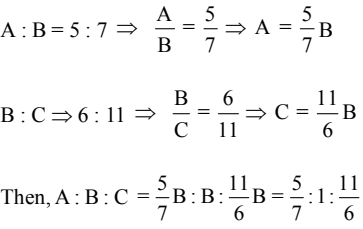
Q26: If A : B = 5 : 7 and B: C = 6 : 11, find A : B : C. (a) 55 : 77 : 66 (b) 30 : 42 : 77 (c) 35 : 49 : 42 (d) 28 : 47 : 35
Solution:
Ans: (b)
Multiply by 42 in the ratio A : B : C, then 30 : 42 : 77
Q27: A parallelogram has _______ line of symmetry. (a) 8 (b) 4 (c) 2 (d) 0
Solution:
Ans: (d)
Q28: To construct an angle of 30°, we construct the angle bisector of (a) 15° (b) 60° (c) 90° (d) 120°
Solution:
Ans: (b)
Q29: The descending order of XX, XXXVI, V is _______. (a) V, XXXVI, XX (b) XX, V, XXXVI (c) V, XX, XXXVI (d) XXXVI, XX, V
Solution:
Ans: (d) XXXVI, 36. XX = 20 V = 5
Q30: Find the difference between the greatest and the smallest 9-digit number formed by using the given digits (Use each digit at least once). (a) 500, 998, 889 (b) 588, 998, 779 (c) 599, 980, 851 (d) 599, 988, 051
Q31: Which of the following numbers is the smallest? (a) Ten lakh three (b) One million five thousand (c) One million (d) One crore
Solution:
Ans: (c) Ten lakh three is written as 10,00,003. One million five thousand is written as 1,005,000. One million is written as 1,000,000 One crore is written as 1,00,00,000 The smallest number is 1,000,000 i.e., 1 million.
Q32: If a and b are two whole numbers, which of the following need not be a whole number (a) a + b (b) a - b (c) a × b (d) 2 (a + b)
Solution:
Ans: (b)
Q33: Which of the following will not represent zero? (a) 113 × 14 × 0 (b) 0 × 0 (c) 0 ÷ 2 (d) 12 ÷ 0
Solution:
Ans: (d) Division of any whole number by zero is not defined.
Q34: The HCF of two numbers is 48. The product of the numbers can be _______. (a) 3200 (b) 2400 (c) 48 (d) 4608
Solution:
Ans: (d) Let the numbers be x and y whose HCF is 48 Then, HCF (x, y) = 48 Then, numbers x and y will be some multiples of 48. That is, the numbers x and y will be of the form 48m and 48n respectively for some m and n. Then, product of numbers = x.y = 48 m × 48 n = (48)2 (mn) Then product of numbers must have (48)2 as its factor. Since 4608/48 × 48 = 2 Therefore, 4608 is the number which have (48)2 as its factor. Hence, the product of numbers can be 4608.
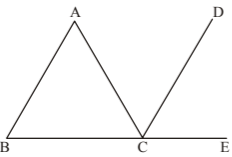
Q35: In the adjoining figure, AB || CD. Find the alternate angle to ∠ BAC
(a) ∠ BAC (b) ∠ ACD (c) ∠ BCD (d) ∠ DCE
Solution:
Ans: (b)
Everyday Mathematics
Q36: The population of City X is 19,87,321 and that of City Y is 80,51,310. Which of the following cities has a larger population and by how much? (a) Y; 60,63,989 (b) X; 60,63,989 (c) X; 60,54,781 (d) Y; 60,54,781
Solution:
Ans: (a)
The population of City Y is 80,51,310, while City X has 19,87,321.
To find out which city has a larger population, we compare the two numbers.
City Y is larger, and the difference in population is 80,51,310 - 19,87,321 = 60,63,989.
Thus, the answer is that City Y has a larger population by 60,63,989.
Q37: In a birthday celebration, there were 210 attendees. Among them, 3/7 were men. What was the number of women present at the celebration? (a) 90 (b) 140 (c) 160 (d) 120
Solution:
Ans: (d)
First, calculate the number of males: 3/7 of 210 equals 90 males.
Next, to find the number of females, subtract the number of males from the total guests: 210 - 90 = 120 females.
Thus, the total number of females at the party is 120.
This means that the correct answer is option (d).
Q38: On Monday, Disha studies for 3 hours and 40 minutes. On Tuesday, she studies 25 minutes longer than she did on Monday. What is the total time she spends studying over both days? (a) 7 hrs 5 mins (b) 6 hrs 40 mins (c) 7 hrs 45 mins (d) 4 hrs 35 mins
Solution:
Ans: (c)
On Monday, Disha studies for 3 hours and 40 minutes, which is 220 minutes in total.
On Tuesday, she studies 25 minutes more, so that's 220 + 25 = 245 minutes.
Now, adding both days together: 220 minutes + 245 minutes = 465 minutes.
Converting 465 minutes back to hours gives us 7 hours and 45 minutes.
Q39: A bottle of tomato ketchup contains 4 L 675 mL. If Rashi consumes 55 mL of ketchup daily, how many days will it take for the bottle to be empty? (a) 76 (b) 85 (c) 82 (d) 88
Solution:
Ans: (b)
First, convert the total volume of ketchup from liters to milliliters: 4 L = 4000 mL, so 4 L 675 mL = 4675 mL.
Next, divide the total volume by the daily usage: 4675 mL ÷ 55 mL/day = 85 days.
This means Rashi will finish the ketchup in 85 days, which is the correct answer.
Thus, the answer is option (b).
Q40: A contractor sent 7695940 bricks for the construction of 70 chambers. If an equal number of bricks were required for each chamber, then how many bricks were used for each chamber? (a) 99762 (b) 148762 (c) 59642 (d) 109942
Solution:
Ans: (d)
To find out how many bricks were used for each chamber, we need to divide the total number of bricks by the number of chambers.
So, we calculate: 7695940 bricks ÷ 70 chambers = 109942 bricks per chamber.
This means that each chamber received an equal share of 109942 bricks.
Thus, the correct answer is (d) 109942.
Q41: The temperature of three objects P, Q, and R is respectively 35°C, 42°C, and 21°C. Which of the following objects is coldest? (a) P (b) R (c) Q (d) Can't be determined
Solution:
Ans: (b)
The temperatures of the objects are: P = 35°C, Q = 42°C, and R = 21°C.
To find the coldest object, we compare the temperatures.
Among the three, R has the lowest temperature at 21°C, making it the coldest.
Thus, the correct answer is (b) R.
Q42: Mr. Verma is looking to purchase a flat priced at ₹35,68,160. He currently has ₹21,20,310. How much additional money does he require to complete the purchase? (a) ₹16,21,710 (b) ₹15,20,700 (c) ₹14,47,850 (d) ₹17,47,836
Solution:
Ans: (c)
To find out how much more money Mr. Verma needs, we subtract the amount he has from the total cost of the flat.
The total cost of the flat is ₹35,68,160 and he has ₹21,20,310.
So, the calculation is: ₹35,68,160 - ₹21,20,310 = ₹14,47,850.
This means Mr. Verma needs an additional ₹14,47,850 to buy the flat.
Q43: Karan walks around a square park whose side is 50 m. One day he walked around the park 6 times. How much distance did he walk on that day? (a) 1450 m (b) 1500 m (c) 1800 m (d) 1200 m
Solution:
Ans: (d)
The perimeter of a square is calculated by the formula: 4 × side.
Here, the side of the park is 50 m, so the perimeter is 4 × 50 = 200 m.
Karan walked around the park 6 times, so the total distance is 200 m × 6 = 1200 m.
Thus, the total distance Karan walked that day is 1200 m.
Q44: Amit purchased 15 kg 200 g of onions, 10 kg 50 g of potatoes, and 25 kg 80 g of tomatoes. What is the total weight of the items he bought? (a) 50 kg 330 g (b) 46 kg 180 g (c) 52 kg 280 g (d) 50 kg 160 g
Solution:
Ans: (a)
To find the total weight, we need to add the weights of onions, potatoes, and tomatoes together.
Convert all weights to grams: 15 kg 200 g = 15200 g, 10 kg 50 g = 10050 g, and 25 kg 80 g = 25080 g.
Now, add them: 15200 g + 10050 g + 25080 g = 50230 g.
Convert back to kilograms and grams: 50230 g = 50 kg 230 g.
Thus, the total weight is 50 kg 330 g, which is the correct answer.
Q45: The turnover of a certain company is nine million eighty-five thousand two hundred and forty-one. The amount of turnover can be written in the Indian system as (a) ₹9,085,241 (b) ₹90,85,241 (c) ₹90,58,241 (d) ₹9,058,241
Solution:
Ans: (b)
The Indian numbering system uses lakhs and crores instead of millions.
The number nine million eighty-five thousand two hundred and forty-one translates to 90 lakh 85 thousand 241 in the Indian system.
Thus, it is written as ₹90,85,241, which corresponds to option (b).
Options (a), (c), and (d) do not represent the correct format for the Indian numbering system.
Achievers Section
Q46: Read the given statements carefully and select the CORRECT option. Statement-I: The value of CMLIX + MCMVII is 2919. Statement-II: When a number is divided by itself, then the quotient and remainder both are 1. (a) Both Statement-I and Statement-II are true. (b) Both Statement-I and Statement-II are false. (c) Statement-I is true but Statement-II is false. (d) Statement-I is false but Statement-II is true.
Solution:
Ans: (b)
Statement-I is incorrect because the correct sum of CMLIX (959) and MCMVII (1907) is 2866, not 2919.
Statement-II is also incorrect; when a number is divided by itself, the quotient is 1 and the remainder is 0.
Thus, both statements are false, making option (b) the correct choice.
Q47: Identify the 6-digit number using the given clues. (a) 129752 (b) 192571 (c) 192572 (d) 291572
Solution:
Ans: (c)
The one's digit is the smallest prime number, which is 2.
The hundreds digit is the H.C.F. (Highest Common Factor) of 5 and 25, which is 5.
The tens digit is 2 more than the hundreds digit, so it is 7 (5 + 2).
The thousands digit is twice the lakhs digit. If we assume the lakhs digit is 1, then the thousands digit is 2.
The ten thousands digit is the largest one-digit number, which is 9.
The lakhs digit is the smallest factor of 15, which is 1.
Putting these together, we get the number 192572.
Q48: Vertical angles are _______ right angles. (a) always (b) never (c) sometimes (d) can not say
Solution:
Ans: (c)
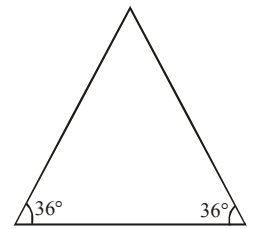
Q49: Which of the following best describes the given triangle?
1. What topics are covered in the Class 5 Maths Olympiad Model Test Paper - 3?
Ans. The Class 5 Maths Olympiad Model Test Paper - 3 typically covers topics such as Logical Reasoning, Mathematical Reasoning, and Everyday Mathematics. These areas are designed to enhance problem-solving skills and apply mathematical concepts in real-life situations.
2. How can I prepare my child for the Maths Olympiad?
Ans. To prepare your child for the Maths Olympiad, encourage regular practice of mathematical concepts, engage them in logical reasoning puzzles, and use model test papers for practice. Additionally, reviewing previous years' papers and understanding the exam pattern can be beneficial.
3. What is the importance of Logical Reasoning in the Maths Olympiad?
Ans. Logical Reasoning is essential in the Maths Olympiad as it helps students develop critical thinking and the ability to analyze problems effectively. This skill is crucial not just for the exam but also for overall academic success and everyday decision-making.
4. How are the questions structured in the Maths Olympiad Model Test Paper?
Ans. The questions in the Maths Olympiad Model Test Paper are structured to assess a variety of skills, including comprehension, application of mathematical concepts, and problem-solving abilities. They may include multiple-choice questions, fill-in-the-blanks, and short answer questions.
5. Where can I find additional practice materials for the Maths Olympiad?
Ans. Additional practice materials for the Maths Olympiad can be found in various resources including online educational platforms, maths Olympiad preparation books, and past year question papers available through educational websites. Many schools also provide resources and guidance for their students.
Free, practice quizzes, Sample Paper, Important questions, Maths Olympiad Model Test Paper - 3, Exam, video lectures, Objective type Questions, MCQs, Maths Olympiad Model Test Paper - 3, pdf , past year papers, mock tests for examination, Viva Questions, Semester Notes, Maths Olympiad Model Test Paper - 3, Extra Questions, Previous Year Questions with Solutions, shortcuts and tricks, ppt, study material, Summary;

 (a)
(a) 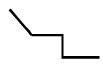


 (a) 35
  (a) 28
  (a) 4
(a) 4 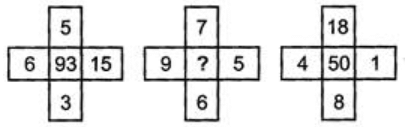
 (a)
(a) 


 (a) 16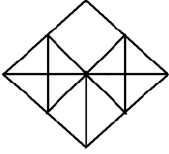
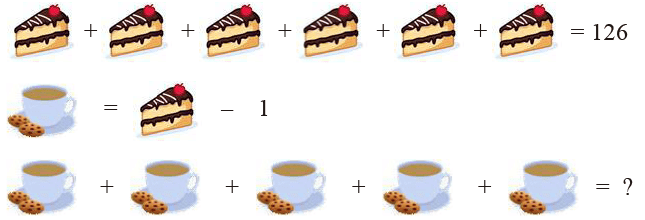 (a) 50
  (a) 9
(a) 9 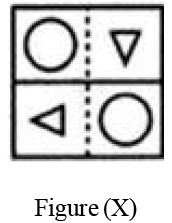 (a)
(a) 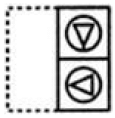



 (a) 500, 998, 889