Logarithm Chapter Notes | Quantitative Aptitude for CA Foundation PDF Download
| Table of contents |

|
| Unit Overview |
|
| Logarithm |
|
| Fundamental Laws of Logarithm |
|
| Change of Base |
|
Unit Overview
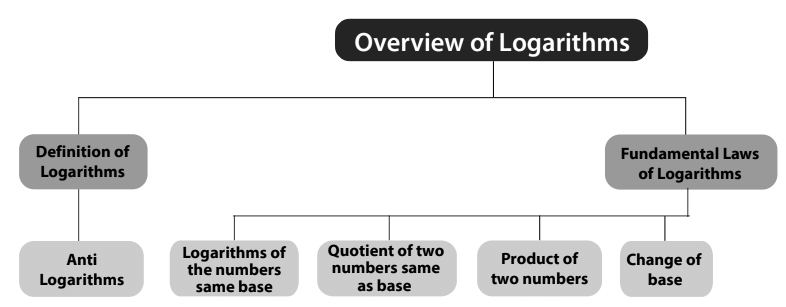

Logarithm
The logarithm of a number to a given base is the index or the power to which the base must be raised to produce the number, i.e. to make it equal to the given number. If there are three quantities indicated by say a, x and n, they are related as follows:If ax = n, where n > 0, a > 0 and a ≠ 1 then x is said to be the logarithm of the number n to the base ‘a’ symbolically it can be expressed as follows:
logan = x , where n > 0, a > 0 and a = 1 i.e. the logarithm of n to the base ‘a’ is x. We give some illustrations below:
(i) 24 = 16 ⇒ log216 = 4
i.e. the logarithm of 16 to the base 2 is equal to 4
(ii) 103 = 1000 ⇒ log101000 = 3
i.e. the logarithm of 1000 to the base 10 is 3
(iii) 5-3 =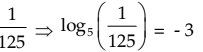
i.e. the logarithm of 1/125 to the base 5 is –3
(iv) 23 = 8 ⇒ log28 = 3
i.e. the logarithm of 8 to the base 2 is 3
Remarks:
1. The two equations ax = n and x = loga n are only transformations of each other and should be remembered to change one form of the relation into the other.
2. The logarithm of 1 to any base is zero. This is because any number raised to the power zero is one.
Since a0 = 1 , loga 1 = 0
3. The logarithm of any quantity to the same base is unity. This is because any quantity raised to the power 1 is that quantity only.
Since a1 = a , loga a = 1
ILLUSTRATIONS:
1. If  find the value of a.
We have 
2. Find the logarithm of 5832 to the base 3√2.
Let us take 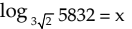
We may write, 
Hence, x = 6
Logarithms of numbers to the base 10 are known as common logarithm.
Fundamental Laws of Logarithm
1. Logarithm of the product of two numbers is equal to the sum of the logarithms of the numbers to the same base, i.e.
Proof:
Let loga m = x so that ax = m – (I)
Loga n = y so that ay = n – (II)
Multiplying (I) and (II), we get
m × n = ax × ay = ax+y
loga mn = x + y (by definition)
∴ loga mn = loga m + loga n
2. The logarithm of the quotient of two numbers is equal to the difference of their logarithms to the same base, i.e.
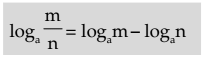
Proof:
Let loga m = x so that ax = m ————(I)
loga n = y so that ay = n ———————(II)
Dividing (I) by (II) we get
Then by the definition of logarithm, we get
Similarly,
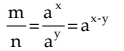
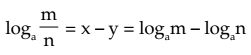

Illustration I: log ½ = log 1 – log 2 = –log 2
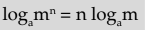
3. Logarithm of the number raised to the power is equal to the index of the power multiplied by the logarithm of the number to the same base i.e.
Proof:
Let loga m = x so that ax = m
Raising the power n on both sides we get
(ax)n = (m)n
axn = m n (by definition)
logamn = nx i.e.
logamn = n loga m
Illustration II:
1(a) Find the logarithm of 1728 to the base 2√3.
Solution: We have 1728 = 26 × 33 = 26 × (√3)6 = (2√3)6; and so, we may write
log2√3 1728 = 6
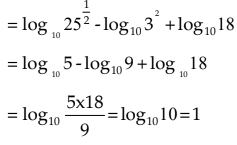
1(b) Solve 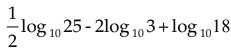
Solution: The given expression
 |
Download the notes
Chapter Notes: Logarithm
|
Download as PDF |
Change of Base
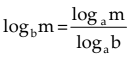
If the logarithm of a number to any base is given, then the logarithm of the same number to any other base can be determined from the following relation.
Proof:
Let loga m = x, logbm = y and loga b = z
Then by definition,
ax = m, by = m and az = b
Also ax = by = (az)y = ayz
Therefore, x = yz
⇒ loga m = logb m x logab
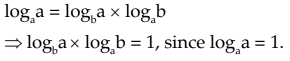
Putting m = a, we have
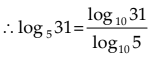
Example 1: Change the base of log531 into the common logarithmic base.
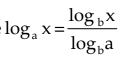
Solution: Since
Example Prove that 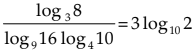 .
.
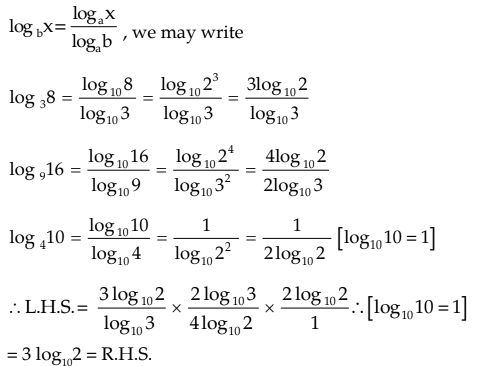
Solution: Change all the logarithms on L.H.S. to the base 10 by using the formula.
= R.H.S.
Logarithm Tables:
The logarithm of a number consists of two parts, the whole part or the integral part is called the characteristic and the decimal part is called the mantissa where the former can be known by mere inspection, the latter has to be obtained from the logarithm tables.
Characteristic:
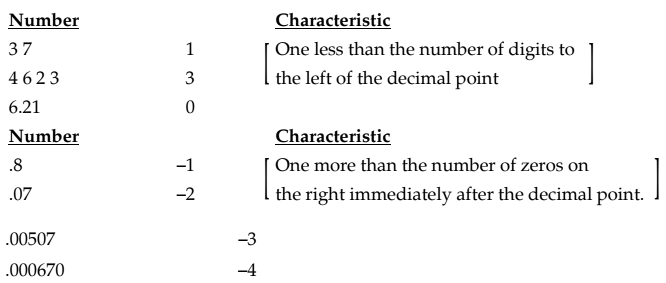
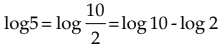
The characteristic of the logarithm of any number greater than 1 is positive and is one less than the number of digits to the left of the decimal point in the given number. The characteristic of the logarithm of any number less than one (1) is negative and numerically one more than the number of zeros to the right of the decimal point. If there is no zero then obviously it will be –1. The following table will illustrate it.
Zero on positive characteristic when the number under consideration is greater than unity:
Since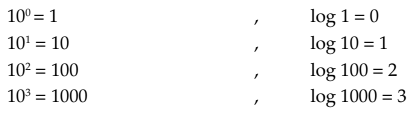 All numbers lying between 1 and 10 i.e. numbers with 1 digit in the integral part have their logarithms lying between 0 and 1. Therefore, their integral parts are zero only.
All numbers lying between 10 and 100 have two digits in their integral parts. Their logarithms lie between 1 and 2. Therefore, numbers with two digits have integral parts with 1 as characteristic.
In general, the logarithm of a number containing n digits only in its integral parts is (n – 1) + a decimal. For example, the characteristics of log 75, log 79326, log 1.76 are 1, 4 and 0 respectively.
Negative characteristics
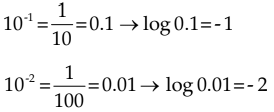
All numbers lying between 1 and 0.1 have logarithms lying between 0 and –1, i.e. greater than – 1 and less than 0. Since the decimal part is always written positive, the characteristic is –1.
All numbers lying between 0.1 and 0.01 have their logarithms lying between –1 and –2 as characteristic of their logarithms.
In general, the logarithm of a number having n zeros just after the decimal point is
(n + 1) + a decimal.–
Hence, we deduce that the characteristic of the logarithm of a number less than unity is one more than the number of zeros just after the decimal point and is negative.
Mantissa
The mantissa is the fractional part of the logarithm of a given number.
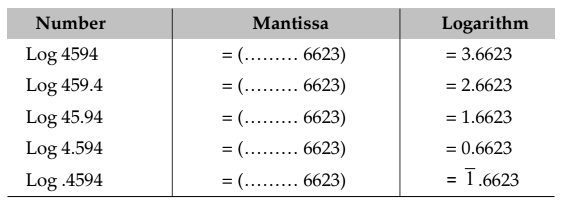
Thus with the same figures there will be difference in the characteristic only. It should be remembered, that the mantissa is – always a positive quantity. The other way to indicate this is

Negative mantissa must be converted into a positive mantissa before reference to a logarithm table. For example

It may be noted that  is different from – 4.3128 as – 4.3128 is a negative number whereas, in
  , 4 is negative while .3128 is positive.
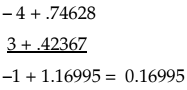
Illustration I: Add  and 3.42367
Antilogarithms
If x is the logarithm of a given number n with a given base then n is called the antilogarithm (antilog) of x to that base.
This can be expressed as follows:
If loga n = x then n = antilog x
For example, if log 61720 = 4.7904 then 61720 = antilog 4.7904
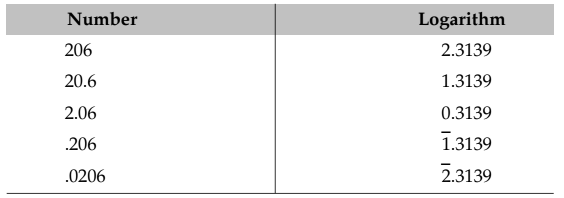
Example 1: Find the value of log 5 if log 2 is equal to .3010.
Solution:
1– .3010
= .6990
Example 2: Find the number whose logarithm is 2.4678.
Solution: From the antilog table, for mantissa .467,
the number = 2931 for mean difference 8, the number = 5
∴ for mantissa .4678, the number = 2936
The characteristic is 2, therefore, the number must have 3 digits in the integral part.
Hence, Antilog 2.4678 = 293.6
Example 3: Find the number whose logarithm is –2.4678.
Solution:
For mantissa .532, the number = 3404
For mean difference 2, the number = 2
∴ for mantissa .5322, the number = 3406
The characteristic is –3, therefore, the number is less than one and there must be two zeros just after the decimal point.
Thus, Antilog (–2.4678) = 0.003406

Relation between Indices and Logarithm
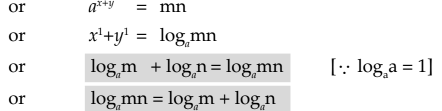
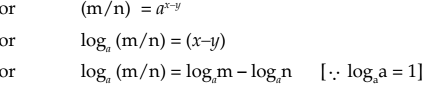
Let x = loga m and y = loga n
∴ax = m and ay = n
so ax . ay = mn
Also, (m/n) = ax/ay
Again mn = m.m.m. ———————— to n times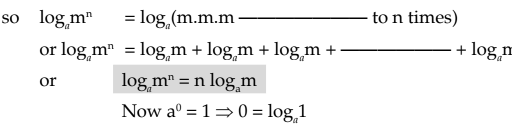
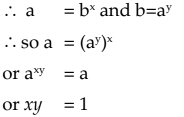
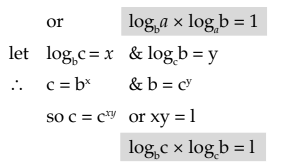
Let logb a = x and loga b =y
∴ a = bx and b = ay
Example 1: Find the logarithm of 64 to the base 2 √2
Solution:

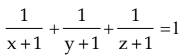
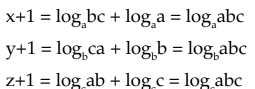
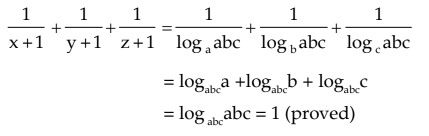
Example 2: If loga bc = x, logb ca = y, logc ab = z, prove that
Solution:
Therefore
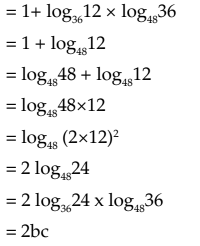
Example 3: If a = log2412, b = log3624, and c = log4836 then prove that
1+abc = 2bc
Solution: 1 + abc = 1+ log2412 × log3624 × log4836
|
114 videos|169 docs|98 tests
|



Viva Questions
,Logarithm Chapter Notes | Quantitative Aptitude for CA Foundation
,Previous Year Questions with Solutions
,Extra Questions
,MCQs
,Sample Paper
,Free
,Important questions
,Exam
,study material
,Semester Notes
,Summary
,ppt
,Logarithm Chapter Notes | Quantitative Aptitude for CA Foundation
,Objective type Questions
,practice quizzes
,mock tests for examination
,past year papers
,video lectures
,Logarithm Chapter Notes | Quantitative Aptitude for CA Foundation
,shortcuts and tricks
;



Chapter Notes: Logarithm Free PDF Download
Importance of Chapter Notes: Logarithm
Chapter Notes: Logarithm
Chapter Notes: Logarithm CA Foundation Questions
Study Chapter Notes: Logarithm on the App
|
© EduRev
|
Education Revolution
|


|




within 7 days!