CBSE Class 1 > Class 1 Notes > EVS > Mind Map: Our Body
Mind Map: Our Body

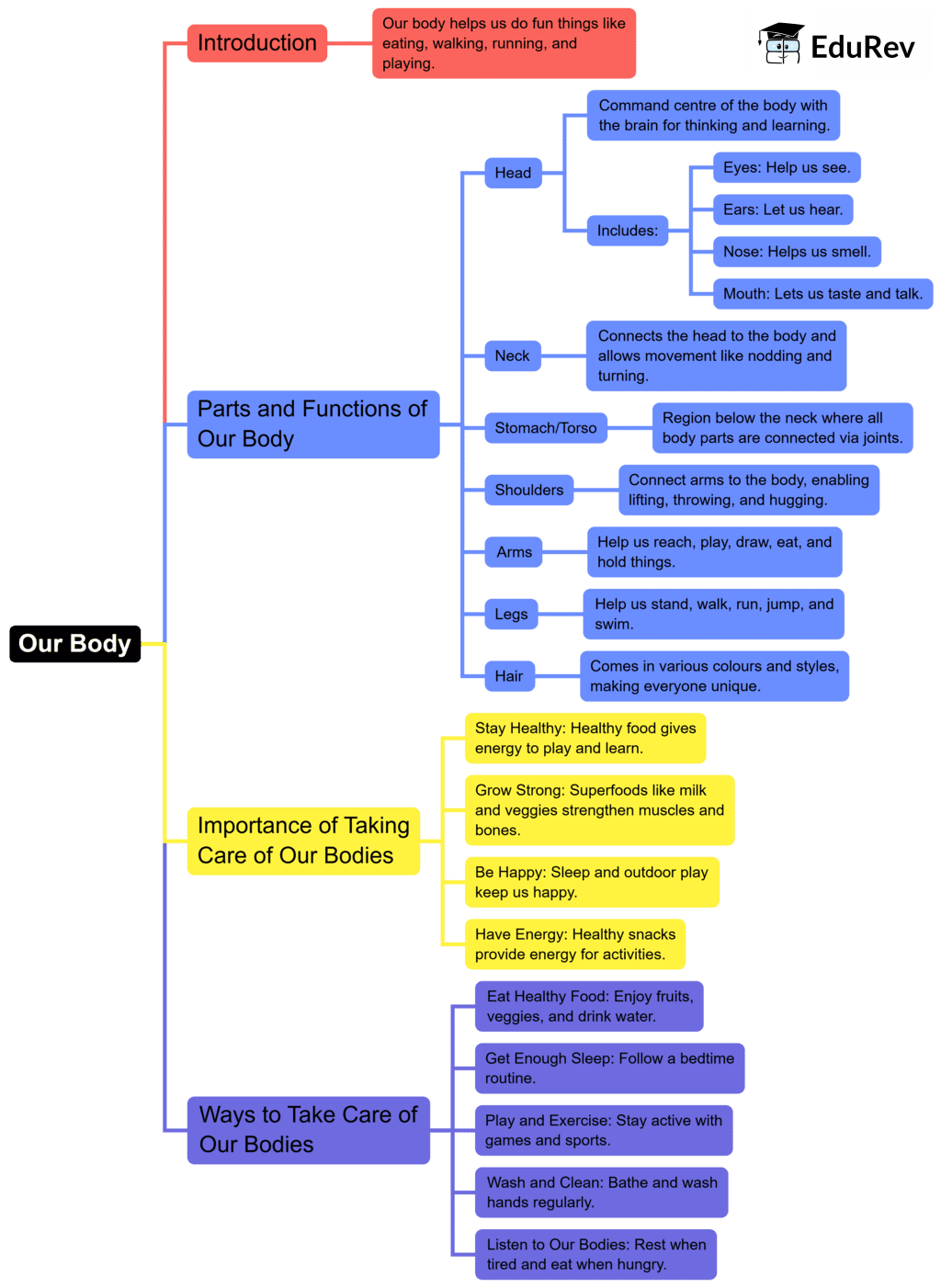
The document Mind Map: Our Body is a part of the Class 1 Course EVS for Class 1.
All you need of Class 1 at this link: Class 1
FAQs on Mind Map: Our Body
| 1. What are the main parts of the human body that Class 1 students need to know? |  |
Ans. The human body has five external parts students learn first: head, neck, trunk, arms, and legs. Each part serves different functions-the head contains eyes, ears, nose, and mouth for sensing; the trunk holds vital organs; arms and legs help movement. Understanding body structure helps children recognise their own physical features and builds awareness of how different body parts work together.
| 2. How do the five senses connect to different parts of our body? | |
Ans. The five senses-sight, hearing, smell, taste, and touch-are located in specific body areas. Eyes enable vision, ears detect sound, the nose identifies smells, the tongue experiences taste, and skin provides touch sensation across the entire body. Each sensory organ sends messages to the brain, helping students understand why different body parts have unique roles in perceiving their surroundings.
| 3. What are internal organs and why do Class 1 students learn about them? | |
Ans. Internal organs like the heart, lungs, stomach, and brain are hidden inside the body and perform essential functions. The heart pumps blood, lungs help breathing, the stomach digests food, and the brain controls all body activities. Learning about these organs helps young learners understand that their body has systems working invisibly to keep them healthy and active.
| 4. How can a mind map help understand the structure of our body better? | |
Ans. Mind maps visually organise body information into branches-showing how main body parts connect to smaller components and their functions. This structure helps Class 1 students see relationships between body systems at a glance. Using flashcards and visual mind maps available on EduRev makes learning body structure interactive and easier to remember for young learners.
| 5. What's the difference between external body parts and internal body systems? | |
Ans. External body parts-head, arms, legs, eyes, ears-are visible and can be touched directly. Internal systems-digestive, circulatory, respiratory-work invisibly inside to keep the body functioning. Understanding this distinction helps students recognise that the body operates on two levels: what they see and feel outside, and complex systems working silently within.
About this Document

4.93/5 Rating

Apr 19, 2026 Last updated
Document Description: Mind Map: Our Body for Class 1 2026 is part of EVS for Class 1 preparation. The notes and questions for Mind Map: Our Body have been prepared according to the Class 1 exam syllabus. Information about Mind Map: Our Body covers topics like and Mind Map: Our Body Example, for Class 1 2026 Exam. Find important definitions, questions, notes, meanings, examples, exercises and tests below for Mind Map: Our Body.
Introduction of Mind Map: Our Body in English is available as part of our EVS for Class 1 for Class 1 & Mind Map: Our Body in Hindi for EVS for Class 1 course. Download more important topics related with notes, lectures and mock test series for Class 1 Exam by signing up for free. Class 1: Mind Map: Our Body
Description
Mind Map: Our Body of EVS provides you one-page visual summary of the chapter covering all the important topics. Download the PDF from EduRev.
Information about Mind Map: Our Body
In this doc you can find the meaning of Mind Map: Our Body defined & explained in the simplest way possible. Besides explaining types of Mind Map: Our Body theory, EduRev gives you an ample number of questions to practice Mind Map: Our Body tests, examples and also practice Class 1 tests


Related Searches
Exam, Extra Questions, MCQs, Mind Map: Our Body, Mind Map: Our Body, pdf , study material, Objective type Questions, Semester Notes, ppt, Mind Map: Our Body, past year papers, Important questions, shortcuts and tricks, practice quizzes, Summary, Sample Paper, mock tests for examination, Free, Viva Questions, video lectures, Previous Year Questions with Solutions;