Detailed Summary: India at Play | English Reader New Gems Class 6 PDF Download
| Table of contents |

|
| Key Points |
|
| Detailed Summary |
|
| Theme/ Message |
|
| Difficult Words |
|

Key Points
- When we think about sports, we usually think of popular games like cricket, football, and tennis.
- However, India has many traditional games like kabaddi, gilli danda, and kith-kith that are also very important.
- Sports have been a part of human life for a long time, helping people stay fit and have fun.
- In ancient India, games were played by everyone, from kings to common people, even before cricket and football became popular.
- Kho-kho is a game that requires quick movements and teamwork. Players try to touch opponents to get them out.
- Kabaddi is a game that originated from a story in the Mahabharata, where players must hold their breath while trying to touch opponents.
- Wrestling, or kushti, is also an ancient sport in India, known for its strength and bravery.
- Kite-flying is a joyful sport during celebrations, especially during festivals like Makar Sankranti and Independence Day.
- Gilli danda is a fun game played with a small piece of wood and a stick, similar to cricket.
- Kith-kith, also known as hopscotch in other countries, is a game that tests balance and aiming skills.
- Chess, which is said to have originated in India, requires smart thinking and strategy to win.
- These traditional games are a big part of Indian culture and help keep the history alive.
- Even if they are not as famous as cricket, they are important for our identity and legacy.
Detailed Summary
When we think about sports, we often think of popular games like cricket, football, and tennis. However, there are many other games in India that are just as exciting and have been played for a very long time. Some of these games include kabaddi, gilli danda, and kith-kith. These games are not just fun; they are an important part of Indian culture and history. Let's explore them in detail to understand their significance and how they are played.
Sports have always been an important part of human life. They help us have fun and keep our bodies and minds healthy. In ancient India, people believed that it was not enough to just learn things; they also needed to be strong and fit. Long before cricket and football became popular, ancient Indian games like kite-flying, kabaddi, and kho-kho were played by everyone, including kings and common people. These games may not have famous players like Sachin Tendulkar or Mary Kom, but they are still very loved today. In fact, some of these games have been around since before the epic poem, the Mahabharata, was written.
One interesting game is kho-kho. This game is all about being quick and alert. In ancient times, kho-kho was played on chariots, which are like small cars pulled by horses, and it was called 'rathera.' Today, the game is played on a rectangular field. In kho-kho, one team has a chaser who tries to touch players from the other team to get them 'out.' If the chaser wants to pass the job to a teammate, they can do so by touching that teammate's back and shouting 'kho.' The team that can make the other team 'out' the fastest wins the game. It is a game that requires a lot of energy and quick thinking.
Another exciting game is kabaddi. This game has a fascinating story behind it. It is said that kabaddi originated from a story in the Mahabharata where a warrior named Abhimanyu got trapped in a dangerous formation made by his enemies. In kabaddi, players take turns to raid the opposite team. A raider goes into the other team's area, tries to touch one of the players, and must return to their side while holding their breath and chanting 'kabaddi-kabaddi.' This game tests a player’s breath control and agility. India has been very successful in kabaddi, winning gold medals at the Asian Games repeatedly.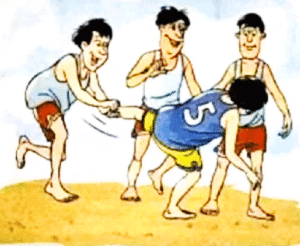
Wrestling is another traditional sport that has been important in India for many years. The Mahabharata mentions two characters, Duryodhana and Bhima, who were great wrestlers. The most famous style of wrestling in India is called kushti. This sport is about strength and bravery. Wrestlers, known as pehelwans, train in special places called akharas. They also compete in dangals, which are village competitions held every year to find new champions. Many Indian wrestlers like Sushil Kumar, Geeta Phogat, and Babita Kumari have made India proud by becoming famous wrestlers around the world.
Sports in India are not just about competition; they are also part of celebrations and festivals. One of the most popular activities is kite-flying, known as patangbazi. This activity was enjoyed by rich and noble people during medieval times, and now it is part of many joyous occasions in India. For instance, the International Kite Festival is celebrated in Gujarat every year during Makar Sankranti, a festival that marks the end of winter. On India's Independence Day, August 15, people fly kites in the sky to celebrate freedom. There are even kite battles, where kite flyers try to cut each other’s kites by tangling their strings. This adds to the fun and excitement of kite-flying.
Another traditional game that children enjoy is called gilli danda. This game is believed to have started during the Mauryan period, which was a long time ago. Gilli danda is similar to cricket but uses two pieces: the gilli, which is a small piece of wood, and the danda, which is a stick. Players hit the gilli with the danda, and if the other team catches the gilli after it is hit, the striker is out. If not, the distance is measured to see how far the gilli has gone. This game is very popular among children in rural India and is also played in other countries like Nepal and Iran under different names.
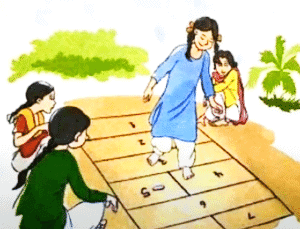
Another fun game that children play is kith-kith, also known as stapoo. This game is simple but requires good balance and aiming skills. A grid is drawn on the ground with numbers. A player tosses a stone or a marker onto one of the squares, and then hops on one foot from one end of the grid to the other, trying not to lose balance. The player continues this until they reach the last square and successfully complete the lap. Kith-kith is similar to hopscotch played in England and escargot in France.
While most of these games are physical and require movement, there is also a game that is played purely with the mind: chess. Chess is a game of strategy. It is said to have originated in India a long time ago. The ancient texts like the Ramayana and Mahabharata refer to it as 'chaturanga.' The game spread to other parts of the world after an Indian king sent a chaturanga board to the king of Persia. Today, India is proud of its chess champions like Viswanathan Anand and Koneru Humpy, who have made great achievements in the game.
All these traditional games are an important part of our cultural heritage. We play them not just to exercise and have fun, but also to connect with our history and identity. While games like cricket may draw large crowds and excitement, these traditional games hold a special place in our hearts, reminding us of our roots and the rich history of India.
In conclusion, sports and games in India are diverse and deeply rooted in our culture. They provide joy, promote fitness, and connect us to our past. From the lively games of kabaddi and kho-kho to the calm strategy of chess, each game tells a story and contributes to the colorful tapestry of Indian tradition. By playing these games, we not only enjoy ourselves but also celebrate the spirit of our heritage.
Theme/ Message
- The main theme of the chapter is the importance of traditional games in Indian culture.
- These games reflect our history and heritage, showing how sports have always been a part of our lives.
- Playing games helps us stay healthy and fit, both physically and mentally.
- Games like kabaddi, kho-kho, and wrestling teach us teamwork and strategy.
- Festivals and traditional games bring people together, creating joy and celebration in communities.
- Chess, as a game of strategy, shows that not all games are about physical strength; some are about thinking and planning.
Difficult Words
- Amusement: Fun or enjoyment.
- Agility: The ability to move quickly and easily.
- Chariot: A type of vehicle used in ancient times, usually pulled by horses.
- Raiding: Attacking an opponent to score points in a game.
- Dodging: Avoiding something by moving quickly.
- Symbolize: To represent something else.
- Akhara: A place where wrestlers train.
- Dangal: A wrestling competition held in villages.
- Patangbazi: The act of flying kites.
- Entangle: To get caught up in something.
- Balance: The ability to stay upright and steady.
- Strategy: A plan made to achieve a goal, especially in games.
- Heritage: Traditions and beliefs passed down through generations.
- Legacy: Something handed down from the past.
|
69 videos|283 docs|61 tests
|



Free
,mock tests for examination
,Exam
,Previous Year Questions with Solutions
,MCQs
,Viva Questions
,shortcuts and tricks
,Summary
,Detailed Summary: India at Play | English Reader New Gems Class 6
,Sample Paper
,past year papers
,Objective type Questions
,video lectures
,Detailed Summary: India at Play | English Reader New Gems Class 6
,Important questions
,study material
,ppt
,Extra Questions
,Semester Notes
,practice quizzes
,Detailed Summary: India at Play | English Reader New Gems Class 6
;



Detailed Summary: India at Play Free PDF Download
Importance of Detailed Summary: India at Play
Detailed Summary: India at Play Notes
Detailed Summary: India at Play Class 6 Questions
Study Detailed Summary: India at Play on the App
|
© EduRev
|
Education Revolution
|


|




