Class 2 Exam > Class 2 Notes > EVS for Class 2 > Poster: Seasons
Poster: Seasons | EVS for Class 2 PDF Download

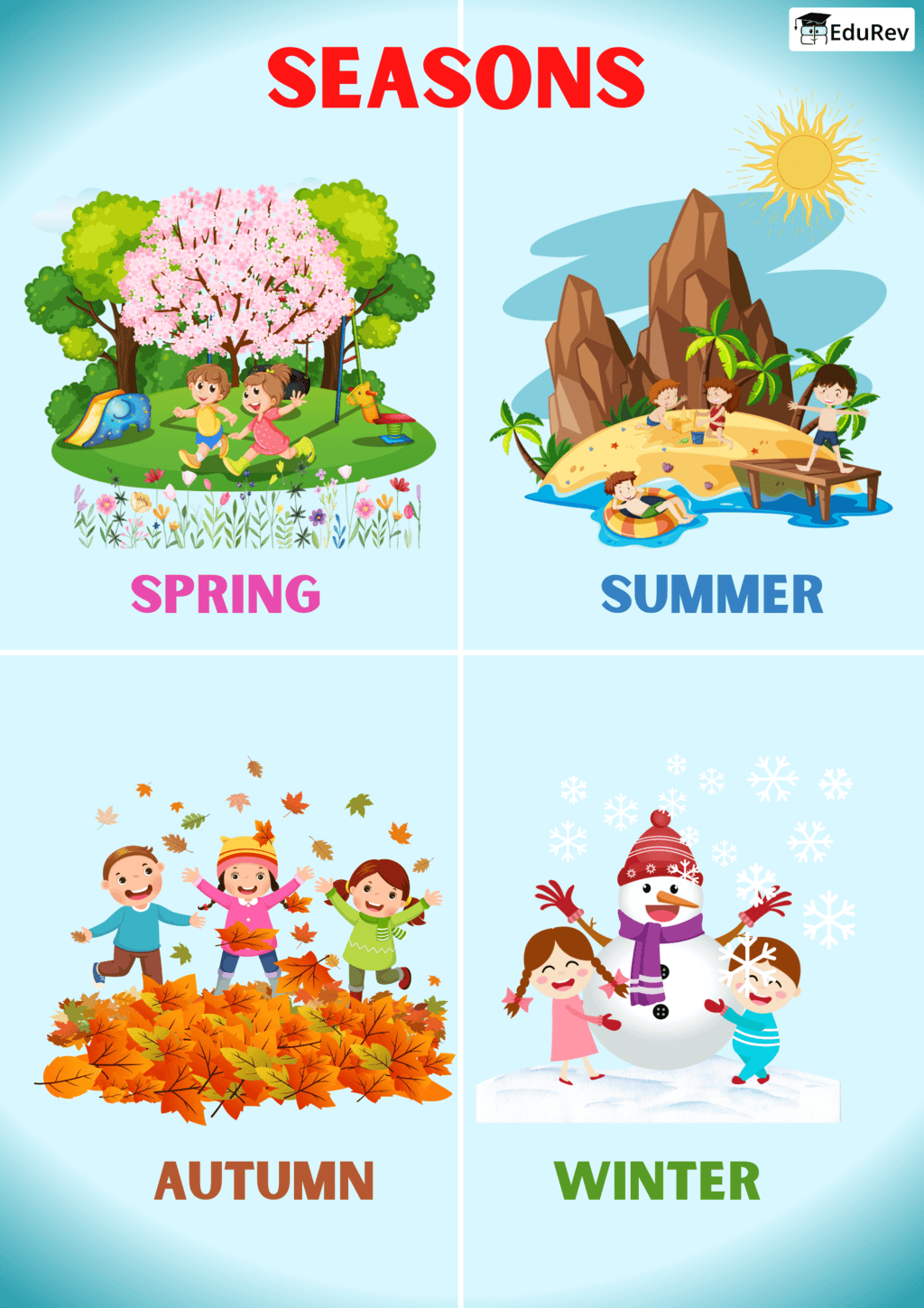
The document Poster: Seasons | EVS for Class 2 is a part of the Class 2 Course EVS for Class 2.
All you need of Class 2 at this link: Class 2
|
30 videos|304 docs|48 tests
|
FAQs on Poster: Seasons - EVS for Class 2
| 1. What are the four seasons and how do they differ from each other? |  |
Ans. The four seasons are spring, summer, autumn (or fall), and winter. Spring is characterized by blooming flowers and warmer temperatures as nature awakens from winter. Summer is the hottest season, marked by long days and outdoor activities. Autumn brings cooler temperatures and changes in leaf color as trees prepare for winter. Winter is the coldest season, often associated with snow and shorter days.
| 2. How do seasons affect climate and weather patterns? | |
Ans. Seasons significantly influence climate and weather patterns. For example, during summer, regions experience higher temperatures and increased humidity, leading to different weather phenomena like thunderstorms. In contrast, winter can bring cold temperatures, snow, and ice. The tilt of the Earth's axis and its orbit around the sun create these seasonal changes, affecting local climates worldwide.
| 3. Why do seasons occur at different times in different parts of the world? | |
Ans. Seasons occur at different times in various parts of the world due to the Earth's axial tilt and its orbit around the sun. For instance, when it is summer in the Northern Hemisphere, it is winter in the Southern Hemisphere. This is because the tilt causes different regions to receive varying amounts of sunlight throughout the year.
| 4. How do animals adapt to seasonal changes? | |
Ans. Animals adapt to seasonal changes through various behaviors and physiological changes. For example, many animals hibernate during winter to conserve energy when food is scarce. Others may migrate to warmer climates to find food and suitable living conditions. In spring, animals may reproduce as conditions become more favorable for raising young.
| 5. What activities are commonly associated with each season? | |
Ans. Each season has activities that are traditionally associated with it. In spring, people often engage in gardening and outdoor sports as the weather warms. Summer is popular for beach trips, barbecues, and vacations. Autumn is known for harvest festivals and enjoying the changing foliage. Winter often involves activities like skiing, snowboarding, and celebrating holiday festivities.
About this Document

4.77/5
Rating

Sep 24, 2025
Last updated
Document Description: Poster: Seasons for Class 2 2025 is part of EVS for Class 2 preparation.
The notes and questions for Poster: Seasons have been prepared according to the Class 2 exam syllabus. Information about Poster: Seasons covers topics
like and Poster: Seasons Example, for Class 2 2025 Exam. Find important definitions, questions, notes, meanings, examples, exercises and tests below for Poster: Seasons.
Introduction of Poster: Seasons in English is available as part of our EVS for Class 2
for Class 2 & Poster: Seasons in Hindi for EVS for Class 2 course.
Download more important topics related with notes, lectures and mock test series for Class 2
Exam by signing up for free. Class 2: Poster: Seasons | EVS for Class 2
Description
Full syllabus notes, lecture & questions for Poster: Seasons | EVS for Class 2 - Class 2 | Plus excerises question with solution to help you revise complete syllabus for EVS for Class 2 | Best notes, free PDF download
Information about Poster: Seasons
In this doc you can find the meaning of Poster: Seasons defined & explained in the simplest way possible. Besides explaining types of
Poster: Seasons theory, EduRev gives you an ample number of questions to practice Poster: Seasons tests, examples and also practice Class 2
tests


Related Searches
Poster: Seasons | EVS for Class 2
,Extra Questions
,Exam
,Summary
,Semester Notes
,Viva Questions
,Previous Year Questions with Solutions
,Objective type Questions
,practice quizzes
,Sample Paper
,past year papers
,Free
,Important questions
,Poster: Seasons | EVS for Class 2
,video lectures
,study material
,shortcuts and tricks
,Poster: Seasons | EVS for Class 2
,mock tests for examination
,ppt
,MCQs
;



Additional Information about Poster: Seasons for Class 2 Preparation
Poster: Seasons Free PDF Download
The Poster: Seasons is an invaluable resource that delves deep into the core of the Class 2 exam.
These study notes are curated by experts and cover all the essential topics and concepts, making your preparation more efficient and effective.
With the help of these notes, you can grasp complex subjects quickly, revise important points easily,
and reinforce your understanding of key concepts. The study notes are presented in a concise and easy-to-understand manner,
allowing you to optimize your learning process. Whether you're looking for best-recommended books, sample papers, study material,
or toppers' notes, this PDF has got you covered. Download the Poster: Seasons now and kickstart your journey towards success in the Class 2 exam.
Importance of Poster: Seasons
The importance of Poster: Seasons cannot be overstated, especially for Class 2 aspirants.
This document holds the key to success in the Class 2 exam.
It offers a detailed understanding of the concept, providing invaluable insights into the topic.
By knowing the concepts well in advance, students can plan their preparation effectively.
Utilize this indispensable guide for a well-rounded preparation and achieve your desired results.
Poster: Seasons Notes
Poster: Seasons Notes offer in-depth insights into the specific topic to help you master it with ease.
This comprehensive document covers all aspects related to Poster: Seasons.
It includes detailed information about the exam syllabus, recommended books, and study materials for a well-rounded preparation.
Practice papers and question papers enable you to assess your progress effectively.
Additionally, the paper analysis provides valuable tips for tackling the exam strategically.
Access to Toppers' notes gives you an edge in understanding complex concepts.
Whether you're a beginner or aiming for advanced proficiency, Poster: Seasons Notes on EduRev are your ultimate resource for success.
Poster: Seasons Class 2 Questions
The "Poster: Seasons Class 2 Questions" guide is a valuable resource for all aspiring students preparing for the
Class 2 exam. It focuses on providing a wide range of practice questions to help students gauge
their understanding of the exam topics. These questions cover the entire syllabus, ensuring comprehensive preparation.
The guide includes previous years' question papers for students to familiarize themselves with the exam's format and difficulty level.
Additionally, it offers subject-specific question banks, allowing students to focus on weak areas and improve their performance.
Study Poster: Seasons on the App
Students of Class 2 can study Poster: Seasons alongwith tests & analysis from the EduRev app,
which will help them while preparing for their exam. Apart from the Poster: Seasons,
students can also utilize the EduRev App for other study materials such as previous year question papers, syllabus, important questions, etc.
The EduRev App will make your learning easier as you can access it from anywhere you want.
The content of Poster: Seasons is prepared as per the latest Class 2 syllabus.
|
© EduRev
|
Education Revolution
|


|




Signup on EduRev and stay on top of your study goals
10M+ students crushing their study goals daily