Worksheet Solutions: Fractions - 2 | Worksheets with Solutions for Class 6 PDF Download

Q.1. Write the fraction representing the shaded portion.
(i) 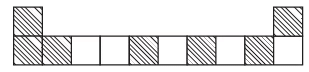
(ii)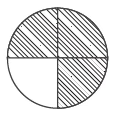
Ans.
(i) Total number of boxes = 12
Total number to shaded portion = 7
Therefore, fraction representing the shaded portion = 712
(ii) Total parts = 4
Total number to shaded parts = 3
Therefore, fraction representing the shaded portion = 34
Q.2. Colour the part according to the given fraction :
(i)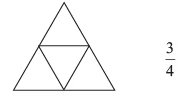
(ii)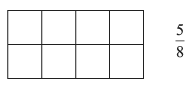
Ans.
(i)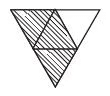
(ii) 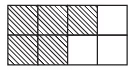
Q.3. Which of the following represents 12 ?
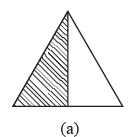
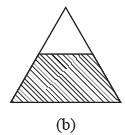
(i) Only figure (a)
(ii) Only figure (b)
(iii) Both figures (a) and (b)
(iv) Neither figure (a) nor figure (b)
Ans. (i) Only figure (a) as other figure doesn't divide the triangle equally.
Q.4. Write natural numbers from 1 to 15 :________________________
(i) What fraction of them are prime numbers?
(ii) What fraction of them are composite numbers?
Ans. The natural numbers from 1 to 15 are: 1, 2, 3, 4, 5, 6, 7, 8, 9, 10, 11, 12, 13, 14, 15
(i) The prime numbers are: 2, 3, 5, 7, 11, 13.
So, there are 6 prime numbers.
= 615 = 25
(ii) The composite numbers are:4, 6, 8, 9, 10, 12, 14, 15.
So, there are 8 composite numbers.
= 815
Q.5. Identify the following fractions :
(i) 6 hours of a day.
(ii) 750 gms of a kilogram.
Ans.
(i)A day has 24 hours.
Fraction = 624 = 14
(ii) A kilogram is equal to 1000 grams.
Fraction = 7501000 = 34
Q.6. Fill the following blanks with <, > or =
(i) 12 ______ 15
(ii) 33 ______ 36
(iii) 14 ______ 28
Ans. (i) >
12 = 0.5 and 15 = 0.2, so 0.5 > 0.2.
(ii) >
Explanation: 33 = 1 and 36 = 0.5, so 1 > 0.5.
(iii) =
Explanation: 14 = 0.25 and 28 = 0.25, so 0.25 = 0.25.
Q.7. Put the following set of fractions in descending order :
(i) 15, 35, 135, 95, 125
(ii) 37, 311, 32, 35, 310
Ans.
(i) Since the denominators are the same we will compare the numerators, then the order becomes :
135 > 125 > 95 > 35 > 15
(ii) The smaller the denominator, the larger the fraction:
32 > 35 > 37 > 310 > 311
Q.8. Represent 58 and 38on the number line.
Ans. 
Q.9. Rita has a pizza with 8 slices. She ate 3 pieces out of it. Sita eats  of the same pizza. Who eats more and by how much?
Ans. Rita eats more pizza than Sita.
Rita eats 38 - 28 = 18 more pizza than Sita.
Q.10. Is it true or false for the following? If not then mention the correct options (<, > or =)
(i) 14 = 1
(ii) 55 = 1
(iii) 06 < 1
(iv) 78 < 1
Ans.
(i) False, <
14 means 1 divided by 4, which equals 0.25.
So, 14 ≠ 1, and this statement is false.
(ii) True
55 means 5 divided by 5, which equals 1.
So, 55 = 1, and this statement is true.
(iii) False, <
06 means 0 divided by 6, which equals 0.
Since 0 is less than 1, the statement is true.
(iv) True
78 is 0.875, which is less than 1.
So, 78 < 1, and the statement is true.
Q.11. Find the equivalent fraction of 35, with
(i) Numerator 27
(ii) Denominator 25
Ans.
(i)We need to find a number to multiply 3 by to get 27.
So,
Now, we multiply the denominator by the same number, 9, to maintain the equality of the fraction:
(i) 35 × 99 = 2745
So, the equivalent fraction with numerator 27 is 2745.
(ii) We need to find a number to multiply 5 by to get 25.
So,
Q.12. Reduce to the simplest form :
(i) 15060
(ii) 3672
(iii) 5125
Ans.
(i) The prime factorization of 150 is 2 × 3 × 52,
and the prime factorization of 60 is 22 × 3 × 5.
The common factors are 2 × 3 × 5 = 30.
Now, divide both the numerator and denominator by 30:
15060 = 150 ÷ 3060 ÷ 30 = 52.
The simplest form of 15060 is 52.
(ii) The prime factorization of 36 is 22 × 32,
and the prime factorization of 72 is 23 × 32.
The common factors are 22 × 32 = 36.
Now, divide both the numerator and denominator by 36:
3672 = 36 ÷ 3672 ÷ 36 = 12.
The simplest form of 3672 is 12.
(iii) The prime factorization of 5 is 5,
and the prime factorization of 125 is 53.
The common factor is 5.
Now, divide both the numerator and denominator by 5:
5125 = 5 ÷ 5125 ÷ 5 = 125.
The simplest form of 5125 is 125.
Q.13. Match the following :
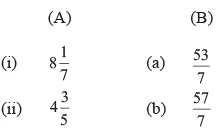
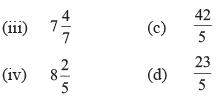
Ans. (i) ↔ (b)
(ii) ↔ (d)
(iii) ↔ (a)
(iv) ↔ (c)
Sol:
1. 8 17 = 8 × 7 + 17 = 577
2. 4 35 = 4 × 5 + 35 = 235
3. 7 47 = 7 × 7 + 47 = 537
4. 8 25 = 8 × 5 + 25 = 425
Now we can match the pairs:
(i) 8 17 = 577 → (b)
(ii) 4 35 = 235 → (d)
(iii) 7 47 = 537 → (a)
(iv) 8 25 = 425 → (c)
Q.14. Complete the addition subtraction box.
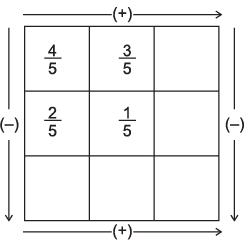
Ans.
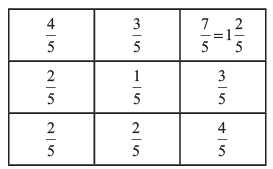
Q.15. Fill in the boxes :
(i)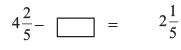
(ii)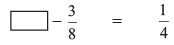
(iii) 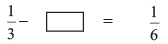
Ans.
(i) 2 15
(ii) 58
(iii) 16
FAQs on Worksheet Solutions: Fractions - 2 - Worksheets with Solutions for Class 6
| 1. What are fractions and how are they used in everyday life? |  |
| 2. How do you add and subtract fractions with different denominators? | |
| 3. What is the difference between proper and improper fractions? | |
| 4. How can I simplify fractions? | |
| 5. Why is it important to learn about fractions in class 6? | |





video lectures
,mock tests for examination
,Important questions
,Objective type Questions
,practice quizzes
,Summary
,past year papers
,shortcuts and tricks
,ppt
,Worksheet Solutions: Fractions - 2 | Worksheets with Solutions for Class 6
,Free
,Previous Year Questions with Solutions
,Viva Questions
,Worksheet Solutions: Fractions - 2 | Worksheets with Solutions for Class 6
,Sample Paper
,MCQs
,Worksheet Solutions: Fractions - 2 | Worksheets with Solutions for Class 6
,Exam
,Semester Notes
,study material
,Extra Questions
;




Worksheet Solutions: Fractions - 2 Free PDF Download
Importance of Worksheet Solutions: Fractions - 2
Worksheet Solutions: Fractions - 2 Notes
Worksheet Solutions: Fractions - 2 Class 6 Questions
Study Worksheet Solutions: Fractions - 2 on the App
|
© EduRev
|
Education Revolution
|


|




