Worksheet Solutions: Diversity in the Living World - 2 | Worksheets with Solutions for Class 6 PDF Download
| Table of contents |

|
| Fill in the Blanks |
|
| True or False |
|
| Short Questions Answers |
|
| Assertion and Reason Questions |
|

Fill in the Blanks
(i) Aquatic habitats are places like __________, __________, and __________ where water-based organisms live.
Ans: lakes, rivers, and oceans
(i) The __________ of plants and animals are the living components of a habitat.
Ans: biotic components
(iii) Major parts of plants are the , , , and .
Ans: Stem, fruit, roots, leaves, flowers
(iv) Plants can be classified into three categories: , and .
Ans: herbs, shrubs, trees
(v) The pattern of veins on a leaf is called __________.
Ans: venation
True or False
(i) All organisms living in a habitat are referred to as abiotic components.
Ans: False - Biotic components refer to all living organisms in a habitat.
(ii) All plants are of the same size.
Ans: False -Plants come in various sizes, from tiny mosses to towering trees.
(iii) Roots hold the plant above the soil.
Ans: False - Roots anchor the plant in the soil and absorb water and nutrients. Stems and branches provide structural support.
(iv) Pistil is the female part of the flower.
Ans: True - The pistil is the female reproductive part of a flower, consisting of the stigma, style, and ovary.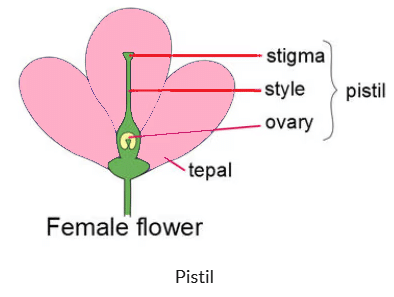
(v) Whale is an aquatic animal.
Ans: True
Short Questions Answers
Q1: What are herbs? Give one example.
Ans: Herbs are small plants with soft and green stems. Example: Tomato.
Q2: What is biodiversity?
Ans: Biodiversity is the variety of different plants, animals, and other living organisms found in a particular region or environment.
Q3: Give one example of a plant adapted to desert conditions.
Ans: Cactus is adapted to desert conditions with thick stems that store water and spines to reduce water loss.
Q4: Name one animal that can live both on land and in water.
Ans: Frog is an amphibian that can live both on land and in water.
Q5: What is the function of tendrils in climbers?
Ans: Tendrils help climbers attach to a support and grow vertically.
Q6: The following picture shows two types of roots. Write the type of roots for the following figures.
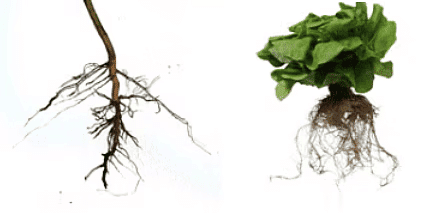
Ans:
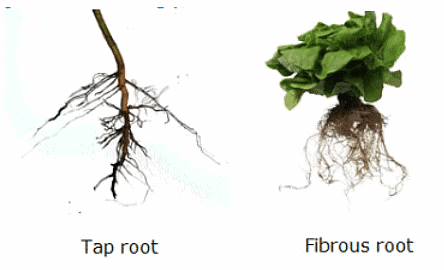
Q7: What type of roots the plants with parallel venation in the leaves likely to have?
Ans: Plants exhibiting parallel venation in their leaves are likely to have fibrous roots. Examples include grass, wheat, and maize, where the fibrous root system complements the leaf structure.
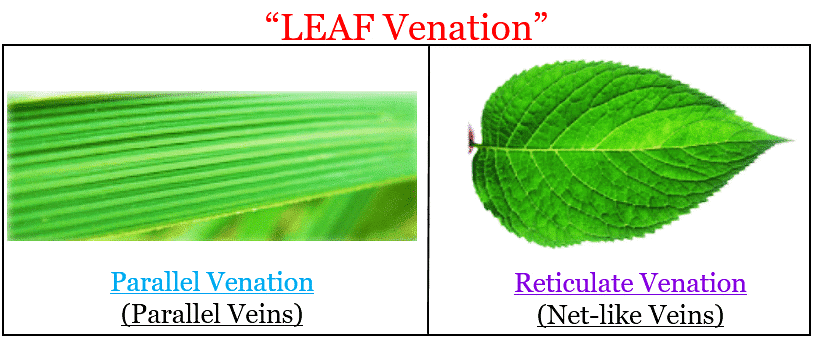 Leaf Venation
Q8: What is adaptation? Give one example.
Ans: Adaptation is a special feature that helps an organism survive in its environment. Example: Camels have long legs and store fat in humps to survive in deserts.
Assertion and Reason Questions
Q1: Assertion (A): Rhododendrons found in windy mountain areas have small leaves.Reason (R): Small leaves help reduce water loss and resist strong winds.
(a) Both A and R are true, and R is the correct explanation of A
(b) Both A and R are true, but R is not the correct explanation of A
(c) A is true but R is false
(d) A is false but R is true
Correct Option: (a) Both A and R are true, and R is the correct explanation of A
Q2: Assertion (A): Lions live in oceans.
Reason (R): Lions are aquatic animals that swim using fins.
(a) Both A and R are true, and R is the correct explanation of A
(b) Both A and R are true, but R is not the correct explanation of A
(c) A is true but R is false
(d) Both A and R are false
Correct Option: (d) Both A and R are false
Q3: Assertion (A): Sacred groves are important for protecting biodiversity.
Reason (R): Local communities do not allow cutting trees or harming animals in sacred groves.
(a) Both A and R are true, and R is the correct explanation of A
(b) Both A and R are true, but R is not the correct explanation of A
(c) A is true but R is false
(d) A is false but R is true
Correct Option: (a) Both A and R are true, and R is the correct explanation of A
Q4: Assertion (A): Fish cannot survive without air.
Reason (R): Fish take in dissolved oxygen from water using gills.
(a) Both A and R are true, and R is the correct explanation of A
(b) Both A and R are true, but R is not the correct explanation of A
(c) A is true but R is false
(d) A is false but R is true
Correct Option: (d) A is false but R is true
Q5: Assertion (A): Grouping animals helps in understanding their behaviour and characteristics.
Reason (R): Grouping is useful to organise and study biodiversity more easily.
(a) Both A and R are true, and R is the correct explanation of A
(b) Both A and R are true, but R is not the correct explanation of A
(c) A is true but R is false
(d) A is false but R is true
Correct Option: (a) Both A and R are true, and R is the correct explanation of A
FAQs on Worksheet Solutions: Diversity in the Living World - 2 - Worksheets with Solutions for Class 6
| 1. What is biodiversity and why is it important? |  |
| 2. How do living organisms adapt to their environment? | |
| 3. What are the main classifications of living organisms? | |
| 4. How do humans impact biodiversity? | |
| 5. What can be done to conserve biodiversity? | |




Free
,Worksheet Solutions: Diversity in the Living World - 2 | Worksheets with Solutions for Class 6
,video lectures
,Important questions
,Viva Questions
,shortcuts and tricks
,Previous Year Questions with Solutions
,MCQs
,study material
,Summary
,ppt
,past year papers
,Sample Paper
,Exam
,practice quizzes
,Worksheet Solutions: Diversity in the Living World - 2 | Worksheets with Solutions for Class 6
,Extra Questions
,Worksheet Solutions: Diversity in the Living World - 2 | Worksheets with Solutions for Class 6
,mock tests for examination
,Objective type Questions
,Semester Notes
;



Worksheet Solutions: Diversity in the Living World - 2 Free PDF Download
Importance of Worksheet Solutions: Diversity in the Living World - 2
Worksheet Solutions: Diversity in the Living World - 2 Notes
Worksheet Solutions: Diversity in the Living World - 2 Class 6 Questions
Study Worksheet Solutions: Diversity in the Living World - 2 on the App
|
© EduRev
|
Education Revolution
|


|




