Mnemonics: Electromagnetic Induction

1. Key Laws of Electromagnetic Induction
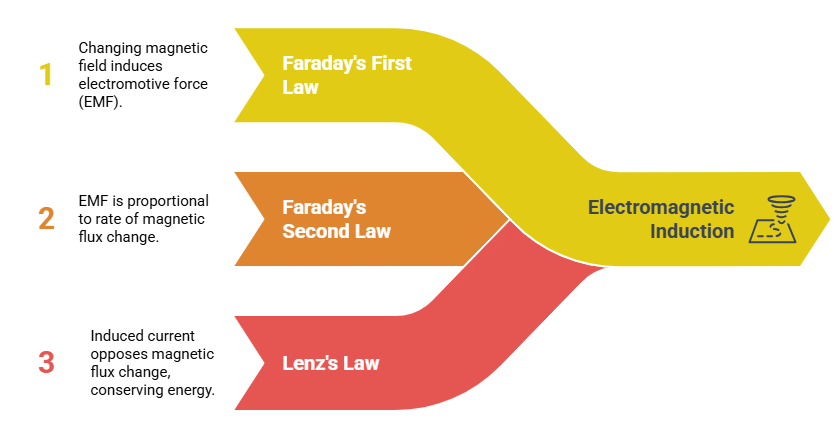
Types: Faraday's First Law, Faraday's Second Law, Lenz's Law
Mnemonic: "Funny Friends Love-magnets"
- Funny - Faraday's First Law
- Friends - Faraday's Second Law
- Love-magnets - Lenz's Law
This mnemonic helps you remember the three main laws in electromagnetic induction:
1. Faraday's First Law of Electromagnetic Induction
Statement:
Whenever there is a change in the magnetic flux linked with a closed circuit, an EMF is induced in the circuit. If the circuit is closed, an induced current flows in it.Explanation:
This law states the condition for electromagnetic induction. A magnetic field by itself does not induce EMF unless the magnetic flux changes. The change in flux may occur due to the motion of a magnet, motion of the conductor, change in magnetic field strength, or change in the area or orientation of the coil.Conclusion:
Faraday's First Law tells us when EMF is induced but does not give its magnitude.
2. Faraday's Second Law of Electromagnetic Induction
Statement:
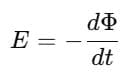
The magnitude of the induced EMF in a circuit is directly proportional to the rate of change of magnetic flux linked with the circuit.Mathematical Expression:
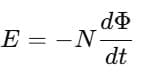
For a coil of N turns:
Explanation:
This law gives the quantitative measure of induced EMF. A faster change in magnetic flux produces a larger EMF. Also, increasing the number of turns in the coil increases the induced EMF.Conclusion:
Faraday's Second Law explains how much EMF is induced in the circuit.3. Lenz's Law
Statement:
The direction of the induced current is such that it opposes the change in magnetic flux that produces it.Explanation:
When the magnetic flux through a coil changes, the induced current produces its own magnetic field. This magnetic field always acts in a direction that opposes the cause of the change in flux. This opposition is represented by the negative sign in Faraday's formula.Energy Conservation:
Lenz's Law ensures the law of conservation of energy. If the induced current did not oppose the change, energy would be created without any external work, which is not possible.Conclusion:
Lenz's Law determines the direction of induced current.
2. Types of Induction
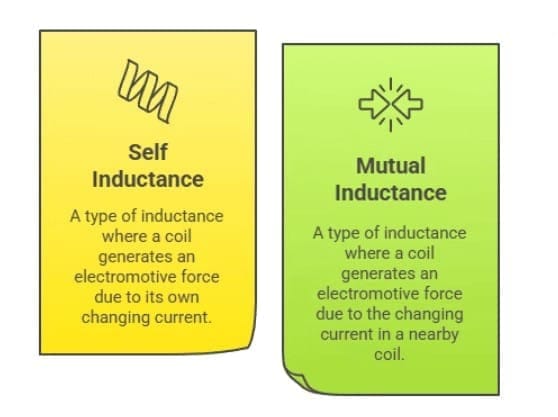
Types: Self Induction, Mutual Induction
Mnemonic: "Selfie Mode"
Selfie - Self Induction
Mode - Mutual Induction
This mnemonic helps you easily remember the two main types of electromagnetic induction:
1. Self Induction
Definition:
Self induction is the phenomenon in which a changing current in a coil induces an EMF in the same coil.Explanation:
When the current flowing through a coil changes, the magnetic flux linked with the coil also changes. This change in flux induces an EMF in the same coil, which opposes the change in current according to Lenz's Law.Example:
When current in a solenoid is switched on or off, an induced EMF is produced in the same solenoid.2. Mutual Induction
Definition:
Mutual induction is the phenomenon in which a changing current in one coil induces an EMF in a nearby coil.Explanation:
When the current in the primary coil changes, the magnetic flux linked with the secondary coil changes. This change in magnetic flux induces an EMF in the secondary coil.Example:
The working principle of a transformer is based on mutual induction.
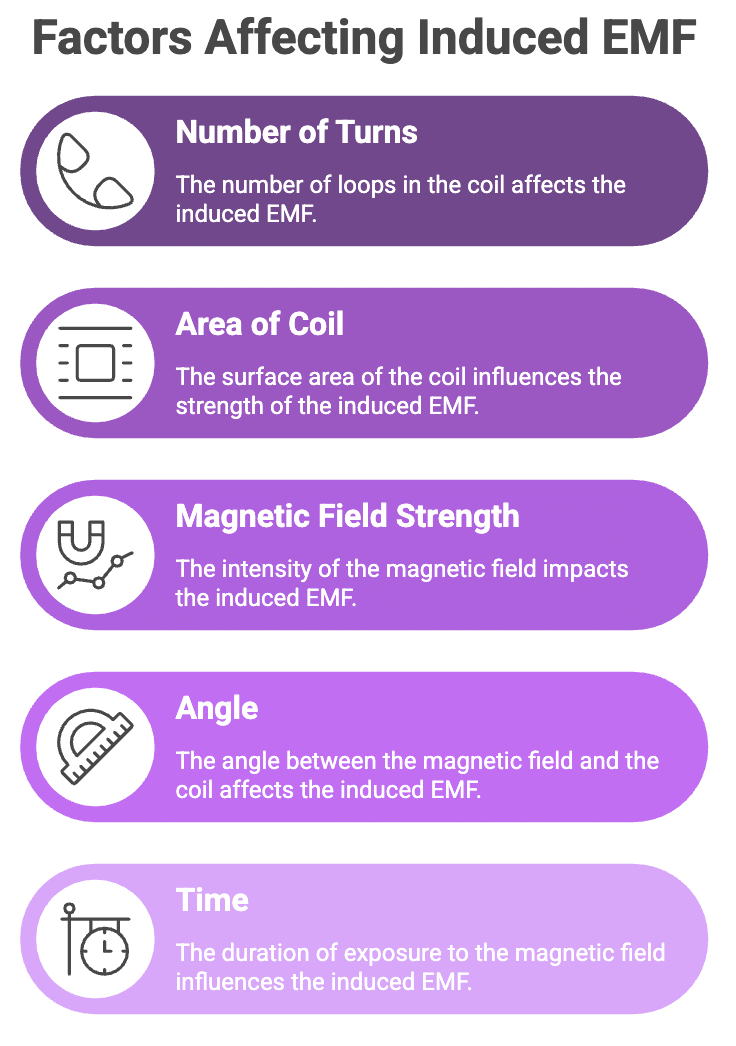
3. Factors Affecting Induced EMF
Types: Number of Turns, Area of Coil, Magnetic Field Strength, Angle, Time
Mnemonic: "Nina Always Makes Amazing Tea"
- Nina - Number of Turns
- Always - Area of Coil
- Makes - Magnetic Field Strength
- Amazing - Angle (between field and area vector)
- Tea - Time (rate of change)
This mnemonic helps recall all key factors that influence the induced EMF in a coil:
Number of Turns: More turns → more EMF
Area of Coil: Larger area → greater flux
Magnetic Field Strength: Stronger field → higher EMF
Angle: EMF depends on the angle between magnetic field and area vector
Time: Faster change → greater EMF
4. Applications of Electromagnetic Induction
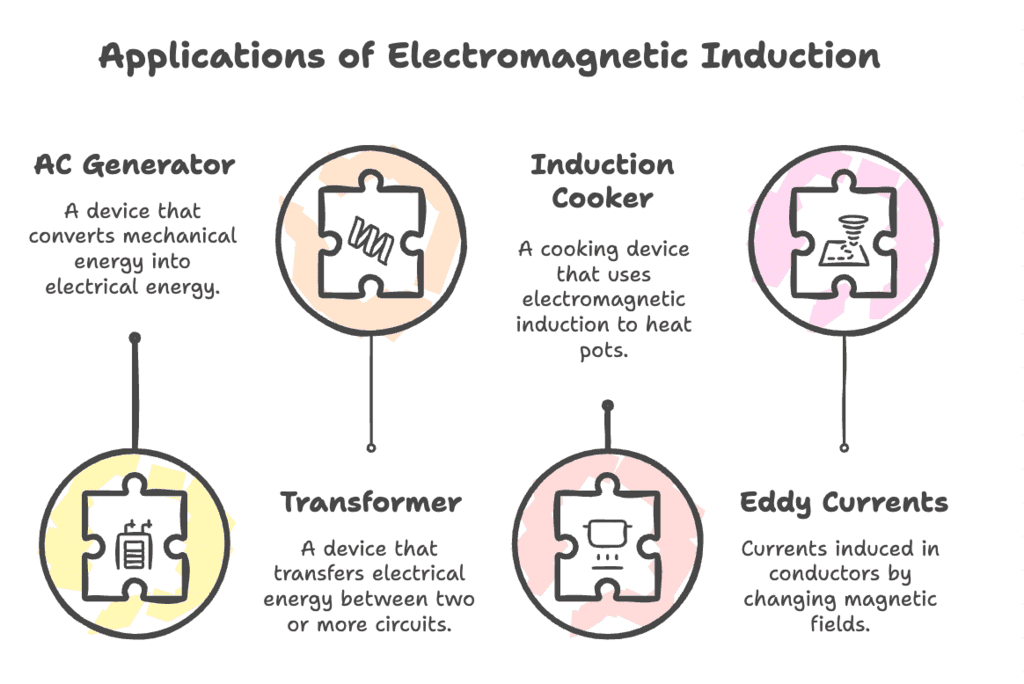
Types: AC Generator, Transformer, Induction Cooker, Eddy Currents
Mnemonic: "Aman Took Icecream Eagerly"
- Aman - AC Generator
- Took - Transformer
- Icecream - Induction Cooker
- Eagerly - Eddy Currents
This mnemonic helps you quickly recall devices and effects related to electromagnetic induction:
AC Generator - Produces alternating current using magnetic induction
Transformer - Steps voltage up or down in AC circuits
Induction Cooker - Uses changing magnetic fields to heat metal vessels
Eddy Currents - Circular currents induced in conductors, useful or wasteful based on application
FAQs on Mnemonics: Electromagnetic Induction
| 1. What is electromagnetic induction? |  |
| 2. What are the applications of electromagnetic induction in daily life? | |
| 3. How does Faraday's law relate to electromagnetic induction? | |
| 4. What is Lenz's law and how does it apply to electromagnetic induction? | |
| 5. What are some common misconceptions about electromagnetic induction? | |




