ICSE Class 9 > Class 9 Notes > Mathematics > Revision Notes: Distance Formula
Revision Notes: Distance Formula

- The distance between P(x1, y1) and Q(x2, y2) is

This is known as the distance formula. - The distance of a point P(x, y) from origin is

- The points A, B and C are collinear if AB + BC = AC.
- Three points A, B and C are the vertices of an equilateral triangle if AB = BC = CA.
- The points A, B and C are the vertices of an isosceles triangle if AB = BC or BC = CA or CA = AB.
- Three points A, B and C are the vertices of a right triangle if sum of squares of any two sides is equal to the square of the third side.
- For the given four points A, B, C and D:
(i) AB = BC = CD = DA; AC = BD ⇒ ABCD is a square.
(ii) AB = BC = CD = DA; AC ≠ BD ⇒ ABCD is a rhombus.
(iii) AB = CD, BC = DA; AC = BD ⇒ ABCD is a rectangle.
(iv) AB = CD, BC = DA; AC ≠ BD ⇒ ABCD is a parallelogram. - Circumcentre is the point of intersection of the perpendicular bisectors of the sides of the triangle.
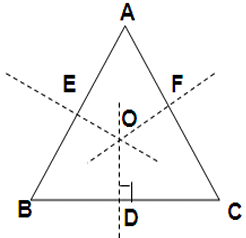 O is the circumcentre of the triangle ABC.
The document Revision Notes: Distance Formula is a part of the Class 9 Course Mathematics Class 9 ICSE.
All you need of Class 9 at this link: Class 9
FAQs on Revision Notes: Distance Formula
| 1. What is the distance formula in coordinate geometry? |  |
Ans. The distance formula is used to determine the distance between two points in a coordinate plane. If you have two points, A(x₁, y₁) and B(x₂, y₂), the distance (d) between them can be calculated using the formula: \[ d = \sqrt{(x₂ - x₁)² + (y₂ - y₁)²} \]
| 2. How can the distance formula be derived using the Pythagorean theorem? | |
Ans. The distance formula can be derived from the Pythagorean theorem, which states that in a right triangle, the square of the hypotenuse (d) is equal to the sum of the squares of the other two sides. When finding the distance between two points (x₁, y₁) and (x₂, y₂), the horizontal distance is (x₂ - x₁) and the vertical distance is (y₂ - y₁). Therefore, applying the theorem gives: \[ d² = (x₂ - x₁)² + (y₂ - y₁)² \] Taking the square root of both sides leads to the distance formula.
| 3. Can the distance formula be used in three-dimensional space? | |
Ans. Yes, the distance formula can be extended to three-dimensional space. For two points A(x₁, y₁, z₁) and B(x₂, y₂, z₂), the distance (d) is calculated using the formula: \[ d = \sqrt{(x₂ - x₁)² + (y₂ - y₁)² + (z₂ - z₁)²} \]
| 4. How do you find the distance between points with negative coordinates using the distance formula? | |
Ans. The distance formula works the same way regardless of whether the coordinates are positive or negative. Simply plug the coordinates into the formula. For example, for points A(-3, -4) and B(1, 2), the distance is calculated as follows: \[ d = \sqrt{(1 - (-3))² + (2 - (-4))²} = \sqrt{(1 + 3)² + (2 + 4)²} = \sqrt{4² + 6²} = \sqrt{16 + 36} = \sqrt{52} = 2\sqrt{13} \]
| 5. What are some practical applications of the distance formula in real life? | |
Ans. The distance formula has various practical applications, such as in navigation systems for calculating distances between locations, in computer graphics for measuring distances between points in a digital image, and in physics for determining the displacement between two objects in motion. It is also used in fields such as architecture and engineering to calculate distances when designing structures.
About this Document

4.64/5 Rating

Apr 29, 2026 Last updated
Document Description: Revision Notes: Distance Formula for Class 9 2026 is part of Mathematics Class 9 ICSE preparation. The notes and questions for Revision Notes: Distance Formula have been prepared according to the Class 9 exam syllabus. Information about Revision Notes: Distance Formula covers topics like and Revision Notes: Distance Formula Example, for Class 9 2026 Exam. Find important definitions, questions, notes, meanings, examples, exercises and tests below for Revision Notes: Distance Formula.
Introduction of Revision Notes: Distance Formula in English is available as part of our Mathematics Class 9 ICSE for Class 9 & Revision Notes: Distance Formula in Hindi for Mathematics Class 9 ICSE course. Download more important topics related with notes, lectures and mock test series for Class 9 Exam by signing up for free. Class 9: Revision Notes: Distance Formula
Description
Revision Notes: Distance Formula of Mathematics Class 9 ICSE on EduRev - covers all the formulas compiled in a single place. Download free PDF for last-minute revision.
Information about Revision Notes: Distance Formula
In this doc you can find the meaning of Revision Notes: Distance Formula defined & explained in the simplest way possible. Besides explaining types of Revision Notes: Distance Formula theory, EduRev gives you an ample number of questions to practice Revision Notes: Distance Formula tests, examples and also practice Class 9 tests



Related Searches
MCQs, study material, Revision Notes: Distance Formula, Revision Notes: Distance Formula, Sample Paper, practice quizzes, Extra Questions, Summary, past year papers, Important questions, shortcuts and tricks, Revision Notes: Distance Formula, Objective type Questions, Semester Notes, Previous Year Questions with Solutions, pdf , video lectures, Free, ppt, Exam, mock tests for examination, Viva Questions;