New Beginnings: Cities and States Class 7 Notes Social Science Chapter 4 Free PDF


Introduction: India's Second Urbanisation
After the decline of the Indus or Harappan civilization around the early 2nd millennium BCE, urban life in India disappeared for nearly a thousand years.
 Ruins of a major structure at Rajagriha
- Cities were abandoned or people reverted to village life as the elaborate urban systems—like markets, administration, specialized occupations, sanitation, and writing—vanished. This marked the end of India’s ‘First Urbanisation.’
- However, in the 1st millennium BCE, a new phase of urban growth began in the fertile Gangetic plains, parts of the Indus basin, and surrounding regions.
- This resurgence of towns and cities, known as India’s ‘Second Urbanisation,’ gradually spread across the subcontinent and laid the foundation for new political and social systems.
- Archaeological findings and ancient texts from the late Vedic, Buddhist, and Jain traditions help us understand this important transformation.
In this chapter, we will explore the emergence of janapadas and mahājanapadas, their governance systems, and their crucial role in India’s early history of cities and states.
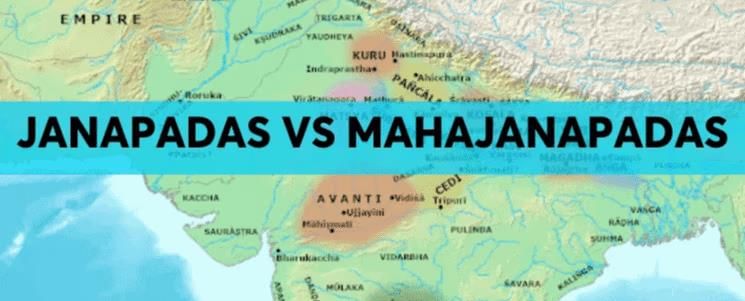
What are Janapadas and Mahājanapadas?
Towards the end of the 2nd millennium BCE, people in north India formed groups or clans with shared language and customs, settling in areas called janapadas (meaning 'where people set foot'). By the 6th century BCE, some janapadas merged to form larger states called maha janapadas.
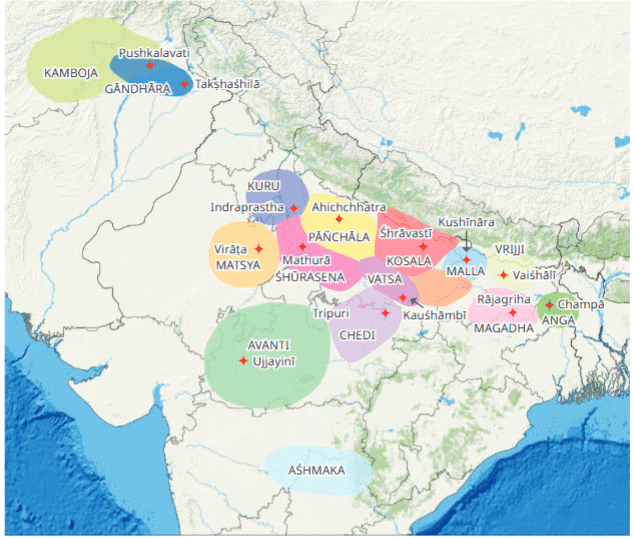 Map of 16 Mahajanpadas
- Each janapada was led by a raja (ruler) and tied to a specific territory.
- Ancient texts list 16 mahajanapadas, stretching from Gandhāra (northwest) to Anga (east) and Aśhmaka (central India near the Godavari River).
- Some smaller janapadas continued independently, and there may have been more mahajanapadas.
- Powerful mahajanapadas included Magadha (Bihar), Kosala (Uttar Pradesh), Vatsa, and Avanti (Madhya Pradesh).
- Their capitals, like Rajagriha (Magadha) and Kauśhāmbī (Vatsa), were large, fortified cities with moats and narrow gateways for defense.
- Many of these ancient capitals, about 2500 years old, are still cities today.Question for Chapter Notes: New Beginnings: Cities and StatesTry yourself:What does the term 'janapada' mean?View Solution
- The land was fertile for agriculture.
- Iron ore in nearby mountains helped make tools and weapons.
- New trade networks connected regions.
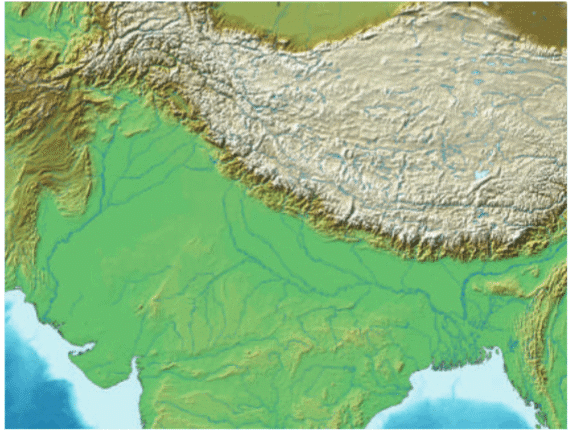 Fertile Ganga Plains helped Mahajanpadas to grow
Early Democratic Traditions
Each janapada had a council called sabhā or samiti, where elders discussed clan matters. The raja was expected to follow the council’s advice, not rule alone. Some texts say an unfit ruler could be removed by the assembly, though this wasn’t a fixed rule.
- Monarchies: The raja was the main authority, supported by ministers and an assembly. His role was passed to his son (hereditary). He collected taxes, maintained law, built fortifications, and kept an army. Examples: Magadha, Kosala, Avanti.
- Ganas or Sanghas: In some, like Vajji and Malla, the sabhā or samiti had more power, making decisions through discussion or voting among elites, sometimes choosing the raja. These were called early republics, functioning as oligarchic or republican systems rather than fully democratic ones
More Innovations
The janapadas and mahajanapadas brought big changes to Indian society:
New Schools of Thought:
- Late Vedic, Buddhist, and Jain teachings spread through scholars, monks, and nuns traveling across India or people on pilgrimages.
Art:
- Indian art improved and grew, setting the stage for more growth during later empires.
- By the late 2nd millennium BCE, iron tools became common, improving farming on a larger scale.
- Iron made better, lighter, and sharper weapons (swords, spears, arrows) than bronze.
- Some mahajanapadas fought wars, though how often or intense is unclear. Wars and alliances led to new kingdoms and empires.
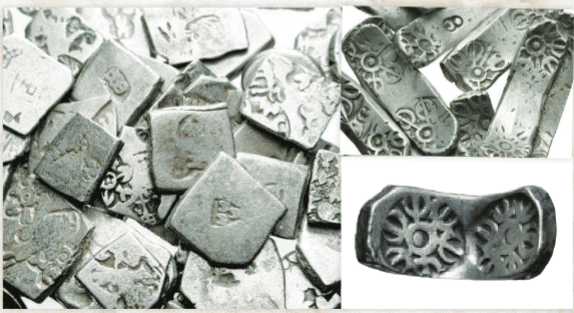 Punch Marked Coins
- Growing trade led to the first use of coins in India.
- Early coins, called punch-marked coins, were made of silver with symbols stamped on them. Later, coins used copper, gold, and other metals.
- Each mahajanapada issued its own coins, but coins were also traded between regions and with other countries.
The Varna–Jāti System
As societies grew complex, they divided into groups based on jobs or class to organize work. In India, society was organized by two systems: jāti and varna.
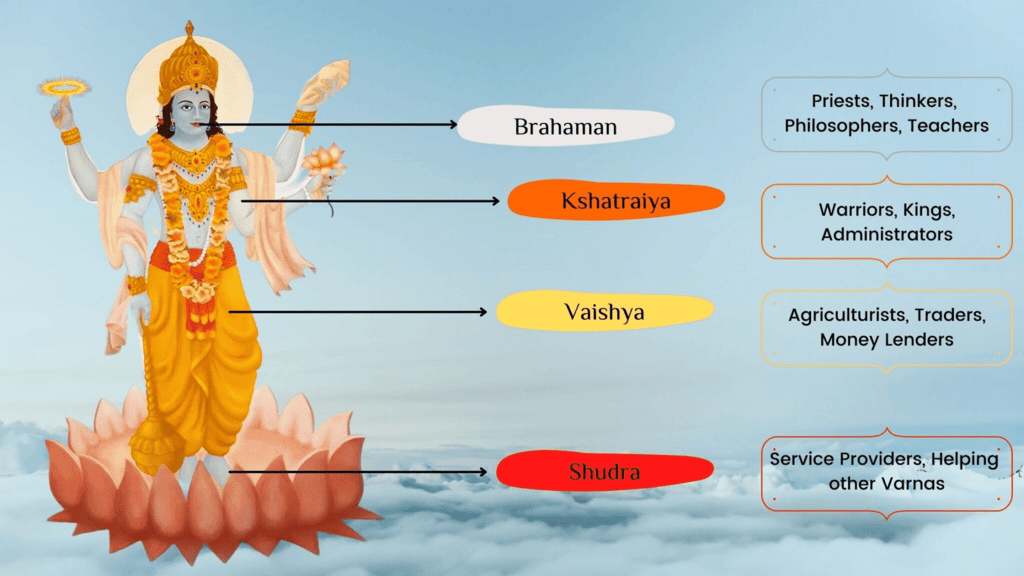 Varna System
- The English word caste (from Portuguese “casta”) is used for jātis, varnas, or the whole system, depending on scholars.
- Early on, people could change jobs if needed (e.g., farmers becoming traders due to drought). This flexibility helped society stay stable.
- Over time, the system became strict, leading to inequalities and unfair treatment of lower jātis or excluded groups, especially during British rule.
- The Varna-jāti system shaped Indian society but wasn’t the only way it was organized. Other systems will be studied later.Question for Chapter Notes: New Beginnings: Cities and StatesTry yourself:What were the four varnas mentioned in Vedic texts?View Solution
 Metal Workshop depicted at Sanchi StupaJāti:
- A group of people with a specific job, like farming, metalwork, or trade, passed down through families.
- Jātis had their own customs for marriage, rituals, or food.
- Some jātis split into smaller sub-jātis with unique traditions.
- Brahmins: Teachers and priests who spread knowledge and performed rituals.
- Kshatriyas: Warriors who protected society and fought wars.
- Vaishyas: Traders, farmers, and businesspeople who created wealth.
- Shudras: Artisans, workers, or servants who made goods or served others.
Developments Elsewhere in India
In the 1st millennium BCE, trade, pilgrimage, and military campaigns opened major routes:
- Uttarapatha: Connected northwest India to the Ganga plains and eastern India.
- Dakshinapatha: Ran from Kauśhāmbī (near Prayagraj) through the Vindhya Range to south India.
- Other roads linked to ports on the western and eastern coasts, which were busy trade centers.
- In eastern India, cities like Śhiśhupalgarh (near Bhubaneswar) grew as the capital of Kalinga, with a square layout, strong fortifications, and wide streets.
- In South India, cities emerged around 400 BCE, with some evidence of earlier trade.
- Three southern kingdoms formed: Cholas, Cheras, and Pandyas.
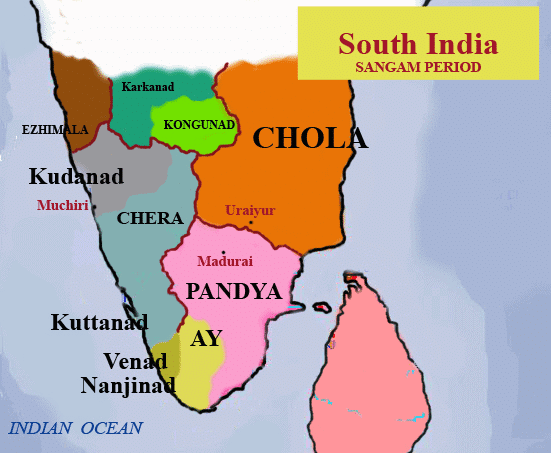 Cholas, Cheras, and Pandyas.
 - South India was rich in precious stones, gold, and spices, traded within India and with foreign kingdoms.
- Ancient Tamil literature mentions these kingdoms and their kings.
- By 300–200 BCE, the entire Indian Subcontinent, including the Northeast, was connected, with goods, ideas, and culture moving across regions and to Central and Southeast Asia.
- Around this time, the mahajanapadas ended, leading to new developments in India.
Points to Remember
- From the late 2nd millennium BCE, janapadas formed in north and central India, led by a raja advised by an assembly of elders.
- The 16 mahajanapadas were the first organized states in the 1st millennium BCE, marking India’s Second Urbanisation, which spread from the Ganga plains to south India.
- By 300 BCE, the mahajanapadas ended, giving way to new developments.
- A network of roads connected north, south, east, and west, allowing people, goods, ideas, and teachings to travel across the Subcontinent.
Difficult Words
- Second Urbanisation: The growth of new cities in India starting in the 1st millennium BCE after the Harappan Civilisation.
- Janapada: A territory where a clan or group settled, led by a raja.
- Mahajanapada: A larger state formed by merging janapadas, with fortified cities.
- Raja: A ruler or king of a janapada or mahajanapada.
- Sabha/Samiti: A council of elders that advised the raja or made decisions.
- Monarchy: A system where a raja or king has the main power, passed to his son.
- Gana/Sangha: A democratic system where the council chose the raja and made decisions.
- Iron Metallurgy: The technique of making tools and weapons from iron.
- Punch-marked Coins: Early silver coins with symbols stamped on them, used for trade.
- Jati: A group of people with a specific job, passed down through families.
- Varna: Four groups in Vedic society: Brahmins, Kshatriyas, Vaishyas, and Shudras.
- Caste: A term for jātis, varṇas, or the whole social system, from Portuguese “casta.”
- Uttarapatha: A trade route connecting northwest to eastern India.
- Dakshinapatha: A route from central India to the south.
FAQs on New Beginnings: Cities and States Class 7 Notes Social Science Chapter 4 Free PDF
| 1. What are Janapadas and Mahājanapadas in ancient India? |  |
| 2. How did early democratic traditions manifest in ancient Indian societies? | |
| 3. What innovations emerged during the period of Janapadas and Mahājanapadas? | |
| 4. What is the Varṇa–Jāti system, and how did it influence society? | |
| 5. What were some of the developments in other parts of India during this period? | |




New Beginnings: Cities and States Class 7 Notes Social Science Chapter 4 Free PDF
,practice quizzes
,MCQs
,New Beginnings: Cities and States Class 7 Notes Social Science Chapter 4 Free PDF
,Important questions
,New Beginnings: Cities and States Class 7 Notes Social Science Chapter 4 Free PDF
,video lectures
,Viva Questions
,Semester Notes
,Sample Paper
,past year papers
,Extra Questions
,mock tests for examination
,Previous Year Questions with Solutions
,Objective type Questions
,Exam
,shortcuts and tricks
,study material
,Free
,Summary
,ppt
;




Chapter Notes: New Beginnings: Cities and States Free PDF Download
Importance of Chapter Notes: New Beginnings: Cities and States
Chapter Notes: New Beginnings: Cities and States
Chapter Notes: New Beginnings: Cities and States Class 7 Questions
Study Chapter Notes: New Beginnings: Cities and States on the App
|
© EduRev
|
Education Revolution
|


|




