CBSE Class 4 > Class 4 Notes > Mathematics Olympiad > Mind Map: Patterns Around Us
Mind Map: Patterns Around Us

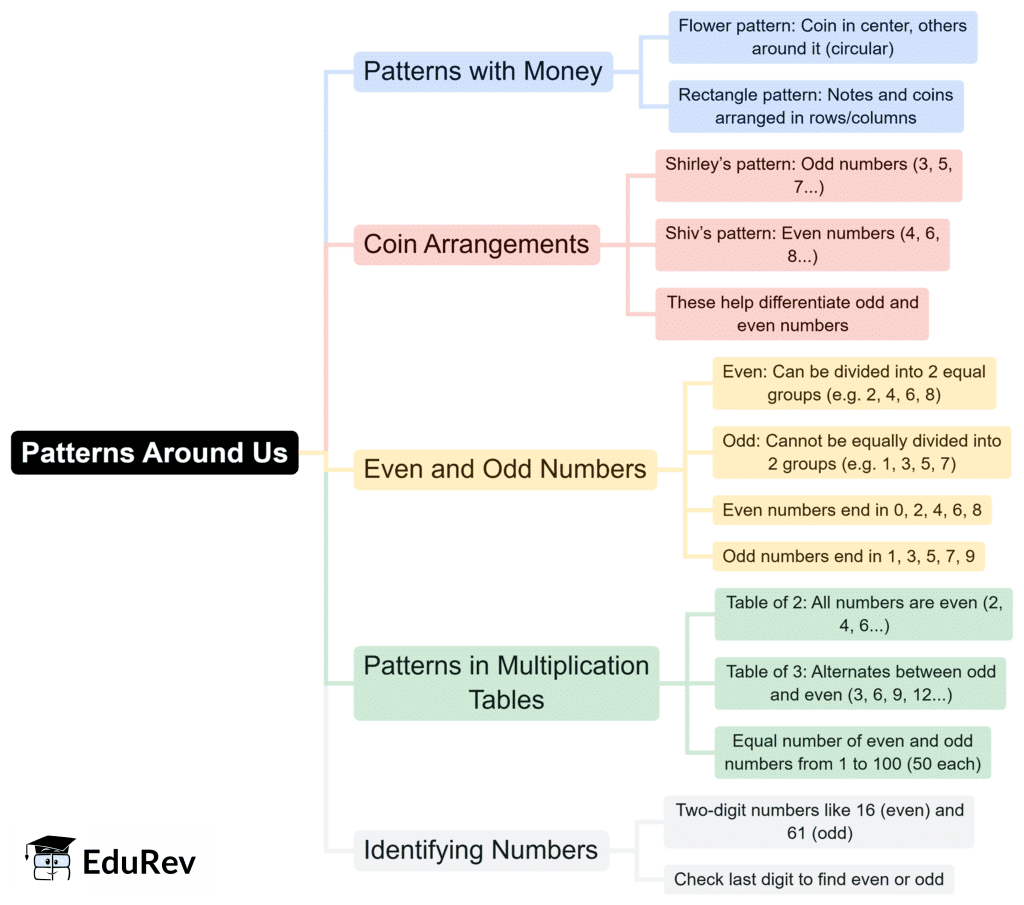
The document Mind Map: Patterns Around Us is a part of the Class 4 Course Mathematics Olympiad Class 4.
All you need of Class 4 at this link: Class 4
FAQs on Mind Map: Patterns Around Us
| 1. What are the different types of patterns we see in everyday life for Class 4 Maths Olympiad? |  |
Ans. Patterns are repeating arrangements of shapes, numbers, or objects following a specific rule or sequence. Everyday patterns include striped clothing, floor tiles, wallpaper designs, plant leaves, and number sequences. Understanding these visual and numerical patterns helps students recognise logical sequences and predict what comes next, strengthening problem-solving skills essential for Olympiad success.
| 2. How do I identify the pattern rule when I'm given a sequence of numbers or shapes? | |
Ans. To identify a pattern rule, students should examine the relationship between consecutive elements by checking if numbers are increasing, decreasing, or repeating. Look for differences between terms, multiplication factors, or alternating sequences. Drawing the shapes or writing numbers helps visualise the rule. Practice with mind maps and visual worksheets available on EduRev to master pattern recognition across different problem types.
| 3. Why do we study patterns around us in Mathematics Olympiad for Class 4? | |
Ans. Studying patterns develops logical reasoning and sequential thinking-core skills tested in Mathematics Olympiad competitions. Recognising patterns trains students to spot mathematical relationships, make predictions, and solve complex problems efficiently. Pattern-based questions frequently appear in Olympiad exams, making pattern mastery crucial for scoring well. These skills also apply to real-world problem-solving beyond academics.
| 4. What's the difference between repeating patterns and growing patterns in Class 4 Mathematics? | |
Ans. Repeating patterns cycle the same sequence indefinitely, like colours in a striped design. Growing patterns increase or decrease progressively, such as 2, 4, 6, 8 or pyramid shapes getting larger. Recognising this distinction helps students apply the correct logic when extending sequences. Olympiad questions test both types, requiring students to identify which pattern type they're facing before solving.
| 5. Can patterns help me solve harder Olympiad questions faster? | |
Ans. Yes, recognising patterns significantly reduces solving time by allowing students to predict answers without calculating every step. Strong pattern identification skills enable quick spotting of shortcuts and underlying mathematical structures. Refer to flashcards and MCQ tests on EduRev covering pattern-based problems to build speed and accuracy. Regular practice with varied pattern types strengthens intuition and boosts Olympiad performance.
About this Document

2.3K Views

4.73/5 Rating

Apr 29, 2026 Last updated
Related Exams
Document Description: Mind Map: Patterns Around Us for Class 4 2026 is part of Mathematics Olympiad Class 4 preparation. The notes and questions for Mind Map: Patterns Around Us have been prepared according to the Class 4 exam syllabus. Information about Mind Map: Patterns Around Us covers topics like and Mind Map: Patterns Around Us Example, for Class 4 2026 Exam. Find important definitions, questions, notes, meanings, examples, exercises and tests below for Mind Map: Patterns Around Us.
Introduction of Mind Map: Patterns Around Us in English is available as part of our Mathematics Olympiad Class 4 for Class 4 & Mind Map: Patterns Around Us in Hindi for Mathematics Olympiad Class 4 course. Download more important topics related with notes, lectures and mock test series for Class 4 Exam by signing up for free. Class 4: Mind Map: Patterns Around Us
Description
Mind Map: Patterns Around Us of Mathematics Olympiad Class 4 provides you one-page visual summary of the chapter covering all the important topics. Download the PDF from EduRev.
Information about Mind Map: Patterns Around Us
In this doc you can find the meaning of Mind Map: Patterns Around Us defined & explained in the simplest way possible. Besides explaining types of Mind Map: Patterns Around Us theory, EduRev gives you an ample number of questions to practice Mind Map: Patterns Around Us tests, examples and also practice Class 4 tests



Related Searches
Mind Map: Patterns Around Us, video lectures, Semester Notes, past year papers, ppt, mock tests for examination, MCQs, Sample Paper, Summary, study material, Exam, Previous Year Questions with Solutions, Mind Map: Patterns Around Us, Free, Mind Map: Patterns Around Us, Extra Questions, Important questions, shortcuts and tricks, practice quizzes, pdf , Viva Questions, Objective type Questions;