Short & Long Answer Questions: Sexual Reproduction in Flowering Plants | Biology Class 12 - NEET PDF Download

Short Answer Questions
Q1: What is the function of the anther in a flower?
Ans: The anther produces and releases pollen grains, which contain the male gametes, essential for fertilization in flowering plants.
Q2: Define microsporogenesis and name the cell where it occurs.
Ans: Microsporogenesis is the process of formation of microspores (pollen grains) from microspore mother cells through meiosis. It occurs in the microsporangium of the anther.
Q3: What is the role of synergids in the embryo sac?
Ans: Synergids, located at the micropylar end of the embryo sac, possess a filiform apparatus that guides the pollen tube to the egg cell for fertilization.
Q4: Differentiate between autogamy and geitonogamy.
Ans: Autogamy is self-pollination within the same flower, while geitonogamy is self-pollination between different flowers on the same plant. Both involve genetically similar pollen.
Q5: Why is sporopollenin significant in pollen grains?
Ans: Sporopollenin forms the tough outer wall (exine) of pollen grains, protecting them from environmental damage and enabling fossilization.
Q6: Comment on viability of pollen grains.
Ans: The period for which pollen grains remain viable is highly variable and to some extent depends on the prevailing temperature and humidity. In some cereals such as rice and wheat, pollen grains lose viability within 30 minutes of their release, and in some members of Rosaceae, Leguminoseae and Solanaceae, they maintain viability for months.
Q7: Explain the role of 2 male gametes during double fertilization.
Ans: After entering one of the synergids, the pollen tube releases the two male gametes into the cytoplasm of the synergid. One of the male gametes moves towards the egg cell and fuses with its nucleus thus completing the syngamy. This results in the formation of a diploid cell, the zygote. The other male gamete moves towards the two polar nuclei located in the central cell and fuses with them to produce a triploid primary endosperm nucleus.
Q8: What is the fate of antipodal cells in the embryo sac?
Ans: Antipodal cells, located at the chalazal end of the embryo sac, typically degenerate after fertilization, having no specific role in embryo development.
Q9: Define apomixis and give one example.
Ans: Apomixis is seed formation without fertilization, producing genetically identical offspring. Example: Citrus.
Q10: What is the significance of the seed coat in a seed?
Ans: The seed coat, derived from ovule integuments, protects the embryo from mechanical damage, desiccation, and pathogens during dormancy and germination.
Long Answer Questions
Q1: Describe the structure of a mature anther and the process of microsporogenesis.
Ans:
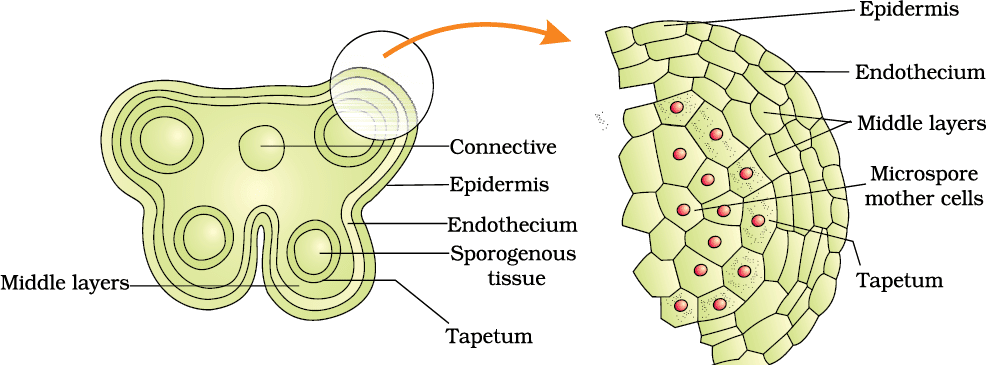
Structure of a mature anther
A mature anther is bilobed with four microsporangia, each forming a pollen sac. It has four wall layers: epidermis, endothecium, middle layers, and tapetum. The tapetum nourishes pollen grains, while the endothecium aids dehiscence.
Process of Microsporogenesis
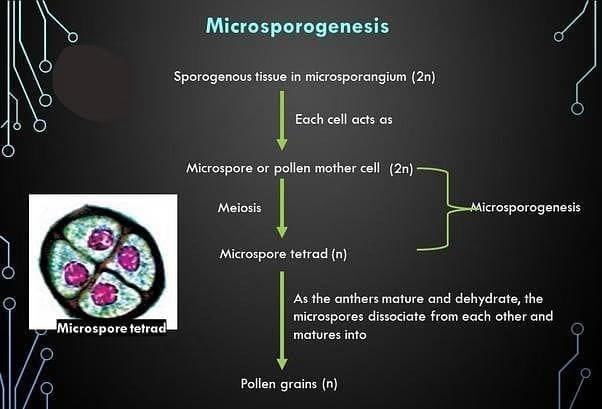
Microsporogenesis begins in the microsporangium, where microspore mother cells undergo meiosis to form tetrads of microspores. Each microspore develops into a pollen grain with a vegetative and generative cell, enclosed by a sporopollenin-rich exine and intine. The pollen grains are released upon anther dehiscence.
Q2: Give a detailed account of the structure of the embryo sac and the process of megasporogenesis.
Ans:
Structure of Embryo Sac
The embryo sac (female gametophyte) is typically a 7-celled, 8-nucleate structure within the ovule. It has:
- Egg apparatus at the micropylar end: one egg cell and two synergids with filiform apparatus.
- Three antipodal cells at the chalazal end.
- A central cell with two polar nuclei.
Process of Megasporogenesis
Megasporogenesis begins in the ovule’s nucellus, where a megaspore mother cell undergoes meiosis to form a linear tetrad of megaspores. Usually, only the chalazal megaspore survives, developing into the embryo sac through three mitotic divisions. The first division forms a 2-nucleate sac, followed by divisions to form a 4-nucleate, then 8-nucleate sac, which organizes into the mature embryo sac.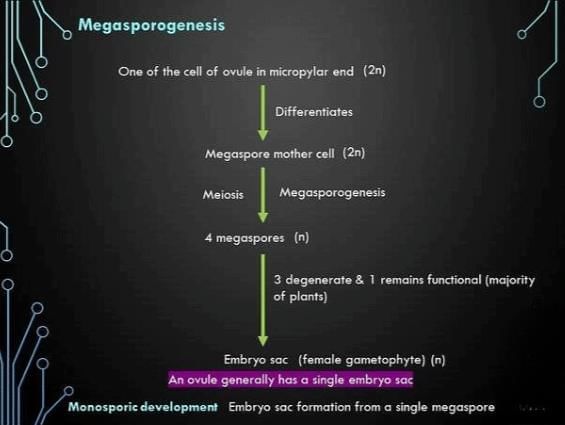
Q3: Discuss the process of double fertilization and its significance in angiosperms.
Ans: Double fertilization in angiosperms involves two sperm cells from a pollen tube. After pollination, the pollen grain germinates on the stigma, forming a pollen tube that grows through the style to the ovary. The generative cell divides to form two sperm cells. One sperm fuses with the egg cell to form a diploid zygote (syngamy), which develops into the embryo. The second sperm fuses with the two polar nuclei in the central cell to form a triploid primary endosperm nucleus (PEN), which develops into the endosperm. This dual process ensures the embryo has a nutrient supply (endosperm) and promotes genetic diversity via sexual reproduction. It is unique to angiosperms and enhances seed viability.
Q4: Explain the development of the embryo and endosperm in a dicot seed.
Ans: After double fertilization, the zygote divides transversely to form a proembryo with a basal and terminal cell. The terminal cell forms the embryo proper, developing into globular, heart-shaped, and mature stages with cotyledons, plumule, and radicle. The basal cell forms the suspensor, anchoring the embryo. The primary endosperm nucleus (PEN) undergoes free nuclear divisions, followed by cell wall formation, to form the endosperm, which nourishes the embryo. In dicots (e.g., pea), the endosperm may be consumed during embryo development, with nutrients stored in cotyledons, or persist in some species. The ovule develops into the seed, with integuments forming the seed coat.
Q5: Describe the structure of a mature seed and the role of its components in germination.
Ans: A mature dicot seed (e.g., bean) consists of a seed coat (from integuments), two cotyledons, an embryo (with plumule, radicle, and hypocotyl), and sometimes endosperm. The seed coat protects the embryo and regulates water uptake. Cotyledons store nutrients (or absorb them from endosperm) for germination. The plumule develops into the shoot, the radicle into the root, and the hypocotyl connects them. The endosperm, if present, provides additional nourishment. During germination, the seed coat ruptures, the radicle emerges to anchor the plant, and the plumule grows upward, using stored nutrients until photosynthesis begins.
Q6: Discuss apomixis and polyembryony, highlighting their significance in plant breeding.
Ans: Apomixis is the production of seeds without fertilization, where the embryo develops from diploid cells (e.g., nucellus or integument) without meiosis or gamete fusion, producing genetically identical offspring. It occurs in species like Citrus and grasses. Polyembryony is the formation of multiple embryos in one ovule, either from multiple egg cells or nucellar cells, as in Citrus. Both are significant in plant breeding: apomixis allows the propagation of hybrid vigour without segregation, maintaining desirable traits, while polyembryony enables the production of multiple uniform seedlings from one seed, aiding clonal propagation and disease-free stock production.
Q7: Explain the role of pollinators and the adaptations in flowers that attract them.
Ans: Pollinators (e.g., bees, birds, bats, wind) transfer pollen from anther to stigma, ensuring cross-pollination and genetic diversity. Flower adaptations include:
Colour and scent: Bright petals (e.g., red in hibiscus) and fragrances attract insects or birds.
Nectar: Sweet secretions in nectaries reward pollinators (e.g., bees in sunflower).
Pollen structure: Sticky or spiny pollen adheres to pollinators (e.g., insect-pollinated plants).
Flower shape: Specific shapes suit pollinators, like tubular flowers for hummingbirds or flat platforms for bees.
Special mechanisms: Yucca and moth show co-evolution, where the moth pollinates while laying eggs. Wind-pollinated flowers (e.g., grasses) have feathery stigmas and abundant, light pollen. These adaptations enhance pollination efficiency and reproductive success.
|
59 videos|290 docs|168 tests
|




Free
,Sample Paper
,MCQs
,Important questions
,practice quizzes
,study material
,past year papers
,Extra Questions
,Previous Year Questions with Solutions
,Exam
,Viva Questions
,Short & Long Answer Questions: Sexual Reproduction in Flowering Plants | Biology Class 12 - NEET
,Semester Notes
,ppt
,Objective type Questions
,video lectures
,Short & Long Answer Questions: Sexual Reproduction in Flowering Plants | Biology Class 12 - NEET
,Short & Long Answer Questions: Sexual Reproduction in Flowering Plants | Biology Class 12 - NEET
,shortcuts and tricks
,Summary
,mock tests for examination
,



Short & Long Answer Questions: Sexual Reproduction in Flowering Plants Free PDF Download
Importance of Short & Long Answer Questions: Sexual Reproduction in Flowering Plants
Short & Long Answer Questions: Sexual Reproduction in Flowering Plants Notes
Short & Long Answer Questions: Sexual Reproduction in Flowering Plants NEET
Study Short & Long Answer Questions: Sexual Reproduction in Flowering Plants on the App
|
© EduRev
|
Education Revolution
|


|




