CBSE Class 5  >  Class 5 Notes  >  Our Wondrous World - New NCERT  >  Worksheet: The Mystery of Food


Worksheet: The Mystery of Food

Worksheet: The Mystery of FoodQ1: Choose the correct option for each question.
(i) What causes the coloured patches on Disha's uttapam?
(a) Dust
(b) Mould
(c) Oil
(d) Sugar

(ii) Which method keeps air away from pickles?
(a) Drying
(b) Pickling
(c) Eating
(d) Freezing

(iii) What is the role of microbes in food?
(a) Spoiling food
(b) Making food rise
(c) Preparing food
(d) All of the above

(iv) Which fruit did Disha's father bring home?
(a) Mango
(b) Lychee
(c) Banana
(d) Apple

(v) What does refrigeration do to microbes?
(a) It speeds them up
(b) It kills them
(c) It slows them down
(d) It has no effect

Q2: Fill in the blanks with the correct words from the chapter.
(i) Microbes can be found in __________, water, air, and inside us.
(ii) Drying food removes __________ from it.
(iii) Good microbes help the idli batter __________.
(iv) Eating bad food can cause __________.
(v) Seasonal fruits taste better when they are __________.

Q3: State whether the following statements are True or False. Correct the false statements.
(i) Microbes are only found in soil and water.
(ii) Oil prevents air from reaching pickles.
(iii) Refrigeration is not useful for preserving food.
(iv) Chewing food properly releases saliva.
(v) Eating quickly is safe and doesn't lead to choking.

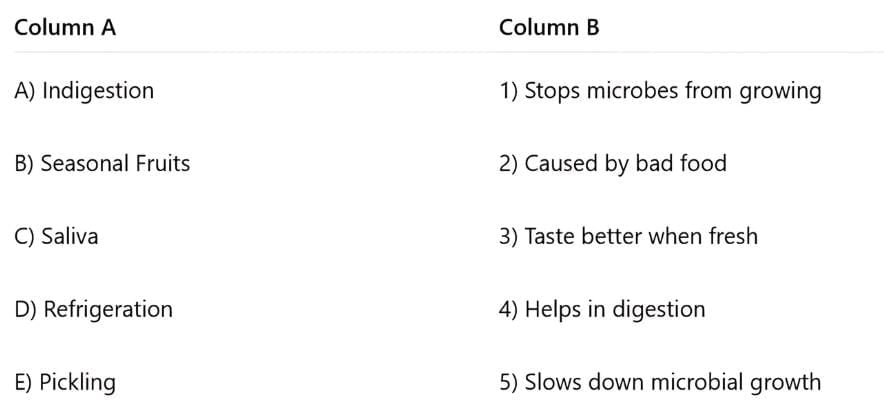
Q4: Match the items in Column A with the correct descriptions in Column B.
Worksheet: The Mystery of Food

Q5: Answer the following questions in 2-3 sentences each.
(i) What causes food to spoil?
(ii) How can we stop food from spoiling?
(iii) Why is it important to chew our food well?
(iv) What should we do to keep our teeth healthy?
(v) What are some foods that help with digestion?

Q6: Answer the following questions in 4-6 sentences each. Use examples from the chapter to support your answers.
(i) Explain how microbes affect our food. Describe both harmful and helpful effects.
(ii) Describe four methods of food preservation and how they work.
(iii) Why is proper chewing important? Explain the role of different teeth and saliva.
(iv) What would happen without food preservation methods? Discuss the problems.

You can find Worksheet Solutions here: Worksheet Solutions: Mystery of Food

The document Worksheet: The Mystery of Food is a part of the Class 5 Course Our Wondrous World Class 5 - New NCERT.
All you need of Class 5 at this link: Class 5

FAQs on Worksheet: The Mystery of Food

1. What does "food mystery" mean and why do we need to understand where our food comes from?
Ans. Understanding food sources reveals how meals reach our tables through farming, processing, and distribution networks. For Class 5 students, this knowledge builds awareness about agriculture, nutrition, and sustainability. Recognising the journey of food-from soil to plate-develops appreciation for farmers' work and teaches responsibility towards natural resources essential for survival.
2. How can I identify which foods are healthy and which are unhealthy in my daily diet?
Ans. Healthy foods include fruits, vegetables, whole grains, and proteins that provide energy and nutrients for growth. Unhealthy foods high in sugar, salt, and fat offer limited nutritional value. A balanced diet combines carbohydrates, proteins, fats, vitamins, and minerals in appropriate portions. Reading food labels and understanding nutritional content helps Class 5 students make informed choices supporting physical development and mental wellbeing.
3. What are the main food groups and why does each group matter for our body?
Ans. The five food groups-fruits, vegetables, grains, proteins, and dairy-each serve distinct purposes. Grains provide energy; proteins build muscles; fruits and vegetables supply vitamins and minerals; dairy strengthens bones. Together, these groups ensure complete nutrition for growth and immunity. Understanding food group functions helps students plan balanced meals and recognise how different foods work together to keep bodies healthy and active throughout the day.
4. Why do some foods spoil quickly while others last longer, and how does this connect to food safety?
Ans. Perishable foods like milk and meat spoil quickly due to bacterial growth; non-perishable foods like grains resist decay longer. Storage methods-refrigeration, drying, salting-slow spoilage by controlling temperature and moisture. Understanding food preservation teaches Class 5 students about safe eating practices, preventing foodborne illness, and reducing waste. Proper storage protects family health while extending food availability during emergencies.
5. How does farming and where our vegetables grow affect the food we eat every day?
Ans. Farming practices-crop selection, soil quality, water availability, and seasonal cycles-directly impact food nutrition, cost, and availability. Local farming produces fresh vegetables requiring less transport; sustainable methods preserve soil health. Understanding agricultural connections helps Class 5 learners appreciate regional cuisine, seasonal eating patterns, and environmental responsibility. Students can explore these concepts through mind maps and visual worksheets on EduRev to deepen comprehension of food production systems.
Explore Courses for Class 5 exam
Get EduRev Notes directly in your Google search
Related Searches
Semester Notes, Sample Paper, Worksheet: The Mystery of Food, shortcuts and tricks, ppt, study material, MCQs, Exam, Objective type Questions, Worksheet: The Mystery of Food, Important questions, video lectures, Extra Questions, Previous Year Questions with Solutions, pdf , Worksheet: The Mystery of Food, Free, mock tests for examination, Summary, past year papers, practice quizzes, Viva Questions;