CBSE Class 5  >  Class 5 Notes  >  Our Wondrous World - New NCERT  >  Worksheet: Energy-How Things Work

Worksheet: Energy-How Things Work

Worksheet: Energy-How Things Work

Q1: Choose the correct option for each question.
(i) What is the primary source of energy for life on Earth?
(a) Oil
(b) The Sun
(c) Coal
(d) Natural Gas

(ii) Which of the following is a non-renewable energy source?
(a) Solar
(b) Wind
(c) Coal
(d) Water

(iii) What type of energy do solar panels convert?
(a) Thermal Energy
(b) Mechanical Energy
(c) Solar Energy
(d) Kinetic Energy

(iv) Which energy source is used in cooking gas?
(a) Electricity
(b) Natural Gas
(c) Coal
(d) Wood

(v) What do windmills generate?
(a) Heat
(b) Light
(c) Electricity
(d) Sound

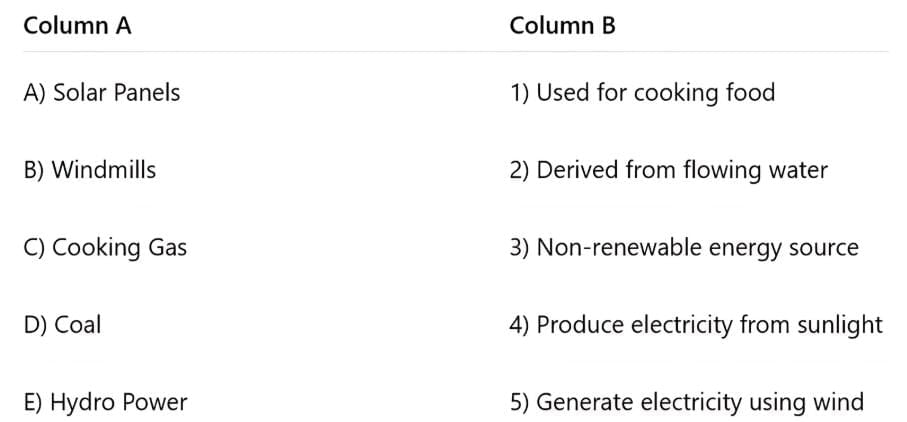
Q2: Match the items in Column A with the correct descriptions in Column B.
Worksheet: Energy-How Things Work

Q3: Fill in the blanks with the correct words from the chapter.
(i) The process of converting sunlight into electricity is called __________.
(ii) __________ is a common fuel used in vehicles.
(iii) The __________ is responsible for warming our homes during winter in some regions.
(iv) __________ is a renewable source of energy that can be harnessed by using solar panels.
(v) Electricity is used in homes for lighting, heating, and __________.

Q4: State whether the following statements are True or False. Correct the false statements.
(i) The Sun provides energy only in the form of light.
(ii) Animals do not require energy to move.
(iii) Burning wood produces less pollution than burning coal.
(iv) Solar power is a clean source of energy.
(v) All electricity comes from renewable sources.

Q5: Answer the following questions in 2-3 sentences each.
(i) What is energy?
(ii) How do we get energy from food?
(iii) What are some sources of energy?
(iv) Why is electricity important?
(v) What is clean energy?

Q6: Answer the following questions in 4-6 sentences each. Use examples from the chapter to support your answers.
(i) What is energy, and how do we use it in our daily lives? Give examples.
(ii) Why should we use clean energy sources like solar and wind power instead of coal?
(iii) How do different sources provide energy to make things work? Explain with examples.
(iv) What safety rules should we follow while using electricity, and why is energy efficiency important?

You can find Worksheet Solutions here: Worksheet Solutions: Energy-How Things Work

The document Worksheet: Energy-How Things Work is a part of the Class 5 Course Our Wondrous World Class 5 - New NCERT.
All you need of Class 5 at this link: Class 5

FAQs on Worksheet: Energy-How Things Work

1. What are the different types of energy that do work in our everyday life?
Ans. Energy exists in multiple forms-mechanical, heat, light, sound, and electrical-each capable of doing work differently. Mechanical energy moves objects, heat warms things, light enables vision, sound travels through vibrations, and electrical energy powers devices. Understanding these energy transformations helps explain how everyday tools and appliances function in the real world.
2. How does energy transfer happen when a ball bounces or a fan rotates?
Ans. Energy transfer occurs when one object passes its energy to another through motion or contact. When a ball bounces, kinetic energy converts to potential energy at the peak, then back to kinetic energy downward. A fan's electrical energy transforms into mechanical motion of blades, demonstrating how energy changes form but never disappears, following the law of energy conservation.
3. Why do some machines need more energy than others to do the same job?
Ans. Machines differ in efficiency-their ability to convert input energy into useful work. A simple lever requires less effort than lifting by hand because it distributes force better. Friction, design, and mechanism type determine how much energy is wasted as heat. More efficient machines achieve results using less total energy input, making them practical for daily tasks.
4. What's the difference between potential energy stored in objects and kinetic energy of moving things?
Ans. Potential energy is stored energy based on an object's position or state-like water held behind a dam or a stretched rubber band. Kinetic energy is the energy of motion possessed by moving objects. A raised ball has potential energy; when dropped, it gains kinetic energy. Both forms constantly interchange in mechanical systems and everyday activities.
5. How can we identify energy transformations happening inside common household appliances?
Ans. Energy transformations occur invisibly within appliances: a microwave converts electrical energy into heat radiation; a light bulb transforms electricity into light and heat; a blender converts electrical energy into mechanical motion. Observing these changes helps students recognize that all devices work by converting one energy form into another, making abstract energy concepts tangible and observable.
Explore Courses for Class 5 exam
Get EduRev Notes directly in your Google search
Related Searches
past year papers, Sample Paper, ppt, Free, Previous Year Questions with Solutions, Objective type Questions, pdf , mock tests for examination, Exam, practice quizzes, Extra Questions, study material, Worksheet: Energy-How Things Work, Worksheet: Energy-How Things Work, MCQs, Summary, Important questions, Viva Questions, Worksheet: Energy-How Things Work, shortcuts and tricks, Semester Notes, video lectures;