Every day, our ears are greeted with a multitude of sounds produced by humans, birds, bells, machines, vehicles, televisions, radios, and more.
Sound is very important in our life. It is the sound that helps us to communicate with each other. In the school's music room, instruments like flute and tabla create a melodic atmosphere.
In this Science Class 8 chapter, we will unravel sound's mysteries – its creation, travel, how we hear, and why some sounds are louder while others are not.
Sound
What is Sound?
Sound is a form of energy that is produced by the vibration of an object.
We can say that sound is produced because of the vibration of an object. But How exactly can it be produced.
When an object vibrates, it disturbs the air around it and creates sound waves. These sound waves travel through the air and reach our ears. Our ears then convert these sound waves into signals that our brain can understand. This is how we hear sound.
Let us see some real life examples :
When a table is beaten, it starts vibrating and produces sound.
When a drum is beaten, it starts vibrating and produces sound.
When a stretched rubber band is struck, it starts vibrating and produces sound.
Production of Sound
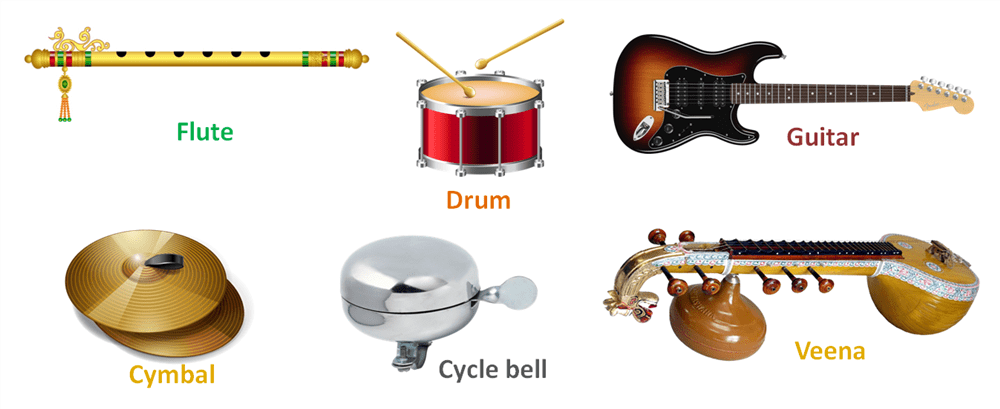
Musical instruments produce different types of sound because of vibration. For example; a flute produces sound because of vibration in its air column, a guitar produces sound because of vibration of its string, and a drum produces sound because of vibration of its diaphragm.
Question for Chapter Notes - Sound
Try yourself:What happens to an object when it produces sound?
Explanation
When an object produces sound, it means that the object is vibrating. Vibrating means that the object is shaking or moving back and forth very quickly. This movement creates waves in the air, which we perceive as sound. So, the correct answer is c) It starts vibrating.
For example, if you take a table and hit it with your hand, the table starts vibrating. The vibrations travel through the table, and as a result, sound is produced. Similarly, when you beat a drum or strike a stretched rubber band, they start vibrating, and that vibration creates sound.
Report a problem
View Solution
Sound is Produced by a Vibrating Body
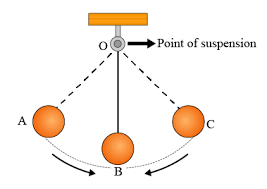
Vibration is the to and fro or back and forth motion of an object.
Vibration is to and fro motion
A vibrating object produces sound, while a non-vibrating one doesn't. Vibrations are sometimes visible but often too small to see, although we can feel them.
But not all objects vibrate in the same way. Some objects vibrate faster, some slower. Some objects vibrate more, some less.
Examples of Activities Demonstrating Sound and Vibration
1. School Bell Test:
When Not in Use: Touch the school bell. It feels stationary.
When Ringing: Touch the bell while it’s producing sound. You will feel it vibrating.
2. Metal Plate Vibration:
Initial Observation: Strike a metal plate (or shallow pan) with a stick and then gently touch it with your finger to feel the vibrations.
Post-Striking: Strike the plate again and hold it tightly with your hands right after striking. You will still hear the sound, but if you touch the plate after it stops producing sound, you will no longer feel the vibrations.
3. Rubber Band Sound:
Setup: Place a rubber band around the longer side of a pencil box, and insert two pencils between the box and the stretched rubber band.
Plucking: Pluck the rubber band in the middle. You will hear a sound and feel the band vibrating.
4. Metal Dish and Water:
Striking: Pour water into a metal dish and strike it at its edge with a spoon. You will hear a sound.
Feeling Vibrations: After striking, touch the dish to feel the vibrations. Strike the dish again and observe the surface of the water for any waves. Holding the dish will change the appearance of the water surface, which indicates the connection between sound and vibrations.
5. Making a Musical Instrument:
Creating: Take a hollow coconut shell or an earthen pot to create an ektara or similar instrument.
Playing: Play the instrument and identify the vibrating part, which is responsible for producing sound.
6. Water Bowl Instrument (Jaltrang):
Setup: Fill 6-8 bowls or tumblers with water to different levels, gradually increasing from one end to the other.
Playing: Gently strike each bowl with a pencil. Striking them in succession produces pleasant sounds, creating your own jaltrang.
Musical instruments like the sitar, mridangam, manjira (cymbals), ghatam, noot (mudpots), and kartal produce sound by vibrating their entire structure, not just individual parts.
Sound Produced by Human
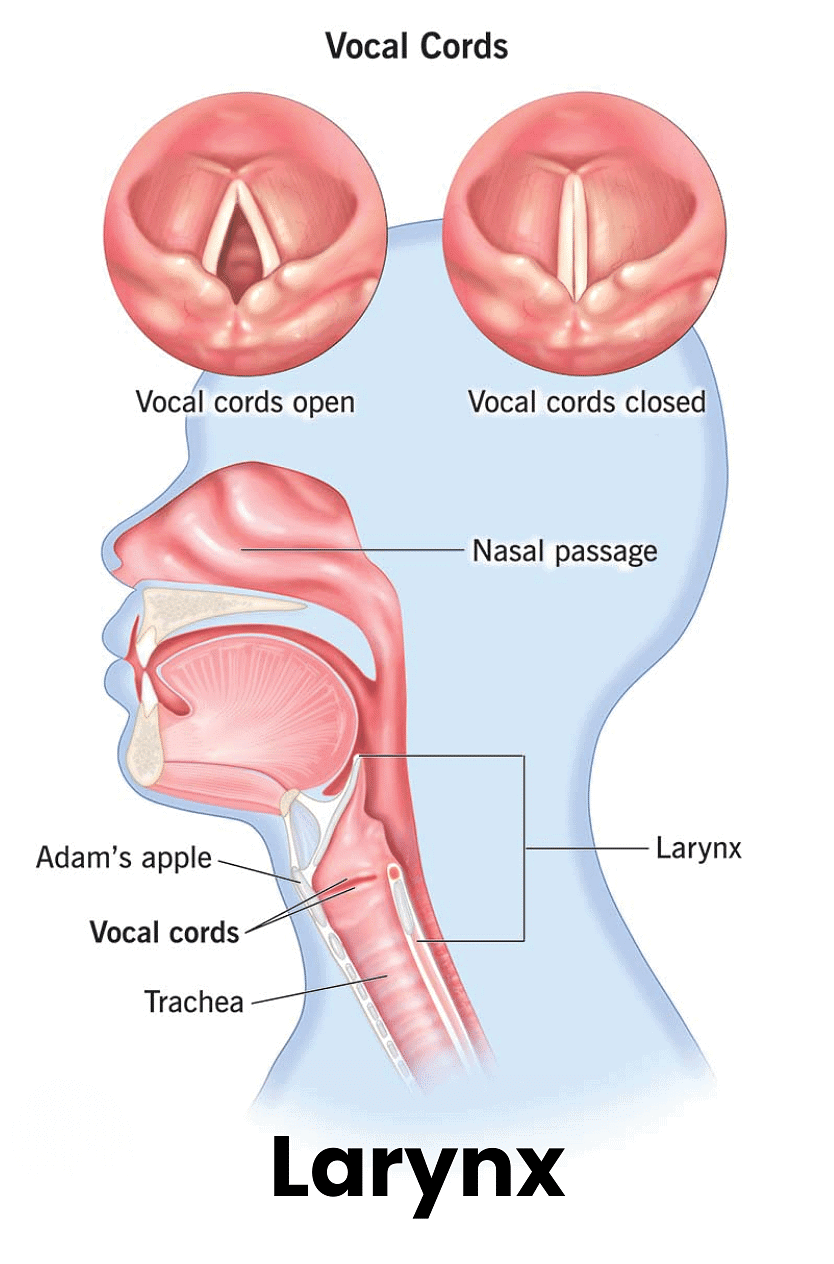
A human being produces sound because of the vibration of his voice box. The voice box is also known as larynx.
Larynx is situated at the upper end of the windpipe. There are two stretched membranes called vocal cords attached in larynx; with a narrow slit between them.
When air passes through those stretched membranes they produce different types of sound with different combinations of stretching.
The muscles attached to the vocal cords can control their tightness and thickness.
The type and quality of voice vary based on the tightness and thickness of the vocal cords.
When Vocal chords are tight and thin, a high pitched sound is produced.
Human Voice Box
Question for Chapter Notes - Sound
Try yourself:How does the tightness and thickness of the vocal cords affect the human voice?
Explanation
The tightness and thickness of vocal cords affect the type and quality of a person's voice. Tighter vocal cords produce higher pitches, while looser vocal cords produce lower pitches. Thicker vocal cords create deeper, richer sounds, while thinner vocal cords result in lighter, thinner sounds.
Report a problem
View Solution
Activities Demonstrating Sound Production
Blowing Air Through Rubber Strips:
Setup: Take two rubber strips of the same size, place them one on top of the other, and stretch them tightly.
Action: Blow air through the gap between the stretched rubber strips.
Observation: As the air passes through, it produces a sound.
Blowing Air Through a Paper Slit:
Setup: Take a piece of paper with a narrow slit and hold it between your fingers.
Action: Blow air through the slit.
Observation: You will hear a sound produced by the air passing through the narrow slit.
Note: These activities demonstrate how sound can be produced by the vibration of air or materials, similar to how our vocal cords produce sound.
Sound needs a medium for Propagation
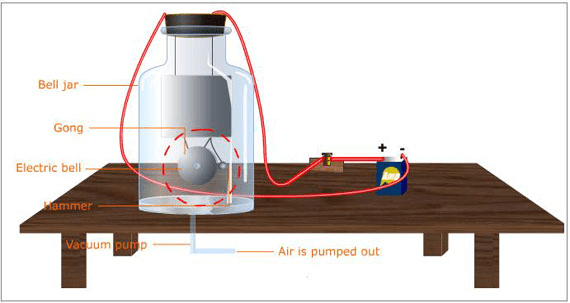
The traveling of sound is called propagation of sound. Sound cannot propagate in the absence of a medium.
The place where there is no air or air is removed, is called a vacuum.
Sound does not propagate (travels) through a vacuum. Sound travels through solids, liquids, and gas.We usually hear a sound that comes to us through the air.
Sound needs a medium to travel
Aquatic animals communicate as sound travels through water also.
Aquatic animals communicate through waterActivities Demonstrating Sound Travel Through Different Mediums
1. Sound in a Metal or Glass Tumbler:
Setup: Place a dry metal or glass tumbler with a cell phone inside it (ensure the phone is not in water).
Action: Have a friend call the cell phone. Listen to the ringtone.
Observation: Surround the rim of the tumbler with your hands and put your mouth over the opening. Have your friend call the phone again while you suck air from the tumbler.
Results: Notice that the sound becomes fainter as you remove air from the tumbler. Removing the tumbler from your mouth will make the sound loud again. This demonstrates that sound needs a medium (air) to travel. In the absence of air (a vacuum), sound cannot travel.
2. Sound in Water:
Setup: Fill a bucket or bathtub with clean water. Take a small bell and shake it inside the water, ensuring it doesn’t touch the bucket or tub.
Action: Place your ear gently on the water surface (avoid water entering your ear).
Observation: Listen for the sound of the bell. This shows that sound can travel through liquids
3. Sound Through Solids:
Setup: Take a meter scale or a long metal rod and hold one end to your ear. Have a friend gently scratch or tap the other end of the scale.
Action: Listen for the sound of the scratching.
Observation: Confirm that you can hear the sound through the solid. Check with others if they hear the same sound when standing away from the scale. This demonstrates that sound travels through solids. You can also test this by placing your ear on a wooden or metal table and having someone scratch the other end.
4. Sound Through Strings:
Setup: Create a toy telephone using two cans or cups connected by a string (or use another string-based setup).
Action: Speak into one can while the other can is held by a friend.
Observation: The sound travels through the string, showing that sound can travel through strings.
Conclusion: These activities demonstrate that sound travels through different mediums such as air, water, and solids. Vibrating objects produce sound, which is carried through a medium in all directions.
We Hear Sound through Our Ears
We hear the sound through ear. The external ear works like a funnel.
Due to its unique shape, sound waves are concentrated once they enter through the external ears. Then the sound waves reach the ear drum or tympanic membrane.
The eardrum is like a stretched membrane; which vibrates when sound waves strike it. From the ear drum, sound waves reach inner ear; through middle ear.
From inner ear, sound waves are sent to the brain via auditory nerve. The brain interprets these signals and we hear the sound.
Activity: Observing Sound Vibrations with a Can
Setup:
Take a plastic or tin can and cut off both ends.
Stretch a piece of a rubber balloon across one end of the can and secure it with a rubber band.
Place four or five grains of dry cereal on the stretched rubber surface.
Action:
Ask your friend to speak “Hurrey, Hurrey” into the open end of the can.
Observation:
Watch what happens to the grains of cereal on the stretched rubber.
Explanation:
The grains of cereal jump up and down because the sound waves produced by your friend’s voice cause the rubber surface to vibrate. These vibrations are transferred to the cereal grains, making them move. This demonstrates how sound waves can create vibrations in a surface and affect objects placed on it.
Amplitude, Time Period, and Frequency of a Vibration
The to and fro motion of an object is known as vibration and this motion is also called oscillatory motion.
Sound travels in the form of waves. When a pebble is dropped in pond water, it produces ripples in water. The ripple is called a wave. Sound travels producing similar waves.
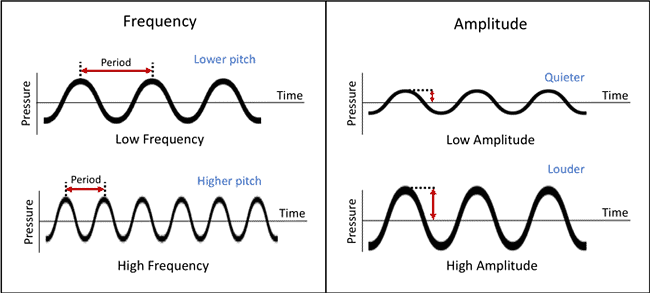
Amplitude and frequency are two important characteristics of sound. Sounds produced by different object are differentiated by amplitude and frequency of sound.
Every wave can have a different amplitude or frequency
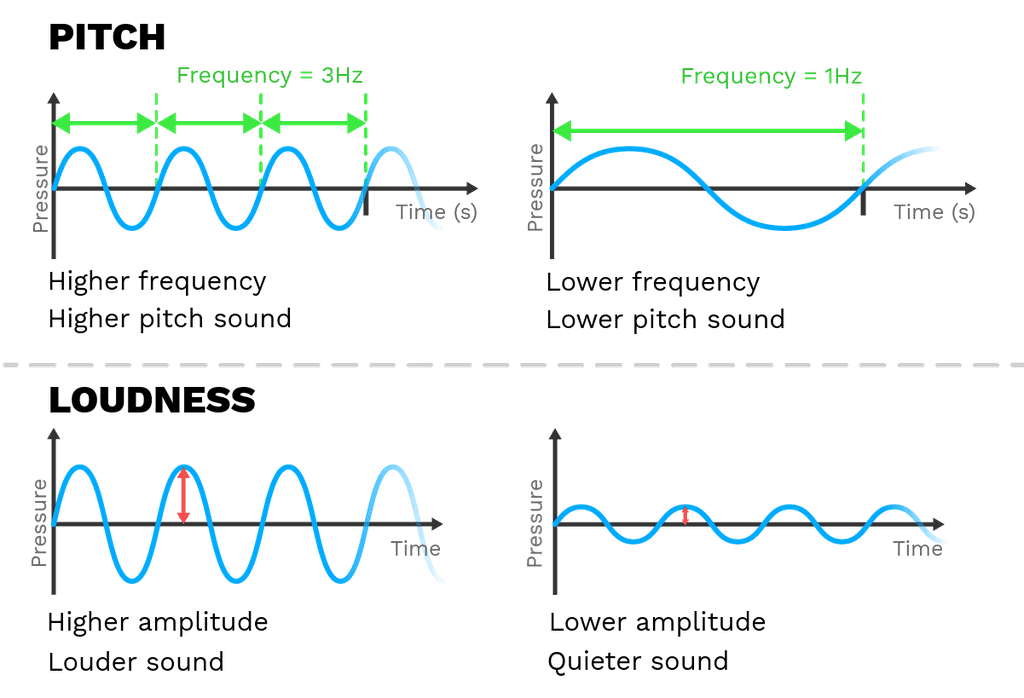
Amplitude: The distance from normal to peak is called amplitude. Since, sound travels in the form of wave, so sound has amplitude.
Frequency: The number of vibrations or oscillations per second is called frequency. Frequency is expressed in hertz. Its symbol is Hz.
A frequency of 1 Hz is one oscillation per second.
Frequency Formula
If an object oscillates or vibrates 40 times in 1 second, then its frequency will be equal to 40 hertz.
Time period: Time required to produce one complete oscillation is called time period.
Loudness
Activity: Exploring Sound Intensity and Vibration
Initial Sound Test:
Setup: Take a metallic tumbler and a tablespoon.
Action: Strike the brim of the tumbler gently with the spoon and listen to the sound produced.
Action: Bang the spoon on the tumbler with more force and listen to the sound again.
Observation: Notice that the sound is louder when the tumbler is struck harder. This is because the force increases the amplitude of the vibrations, resulting in a louder sound.
Measuring Vibration Amplitude:
Setup: Suspend a small thermocole ball so that it touches the rim of the tumbler.
Action: Strike the tumbler to make it vibrate.
Observation: Observe how far the thermocole ball is displaced by the vibrations. The displacement indicates the amplitude of the tumbler’s vibrations.
Comparison of Vibration Amplitudes:
Action: Strike the tumbler gently and observe the thermocole ball's displacement.
Action: Strike the tumbler with greater force and observe the ball's displacement again.
Comparison: Compare the amplitudes of vibration in the two cases. The amplitude is larger when the tumbler is struck with more force, as indicated by a greater displacement of the ball.
Conclusion: The louder sound produced by striking the tumbler harder is due to the increased amplitude of the vibrations. The thermocole ball's displacement provides a visual measure of these vibrations, showing that more force leads to larger vibrations and thus a louder sound.
Loudness of sound is proportional to the square of the amplitude of the vibration producing the sound. For example, if the amplitude becomes twice, the loudness increases by a factor of 4.
Loudness of some types of sound is given here in decibels.
Sound wave - High pitch and Low pitch
Above 80 dB the noise becomes physically painful.
Loudness of sound
Normal breathing
10 dB
Soft whisper
30 dB
Normal Conversation
60 dB
Busy traffic (Inside car)
70 dB
Telephone dial tone
80 dB
Train whistle
90 dB
Hand drill
98 dB
Jet Engine
140 dB
Question for Chapter Notes - Sound
Try yourself:
What determines the loudness of a sound?
Explanation
- The loudness of a sound is determined by the amplitude of the sound wave. - Greater amplitude produces a louder sound, while smaller amplitude produces a feeble sound. - Loudness is measured in decibels (dB). - The amplitude of the sound wave directly affects the intensity and volume of the sound. - Therefore, option B is the correct answer as it accurately reflects the relationship between amplitude and loudness.
Report a problem
View Solution
Shrillness or Pitch
Frequency of a sound determines the shrillness or pitch of the sound. Shrillness or pitch increases with increase in frequency of sound. Sound with greater frequency is shriller and has higher pitch. Sound with lower frequency is less shrill and of lower pitch.
Examples:
Children and women produce sound of high frequency and their sound is shriller and of higher pitch. On the other hand, an adult male produces sound of lower frequency and his sound is less shrill and has lower pitch.
A drum produces sound of lower frequency which is less shrill and has lower pitch, while a whistle produces sound of higher frequency which is shriller and is of higher pitch.
A lion produces a sound of lower frequency which is less shrill and has lower pitch, while a bird produces sound of high frequency which is shriller and has higher pitch. However, sound of lion is louder than the sound of a bird.
Shrillness and Loudness
Audible and Inaudible Sound
Audible Sound: Sounds with frequency between 20 Hz to 20,000 Hz are called audible sound. The hearing range of human beings is between 20 hertz to 20,000 hertz.
Inaudible Sound: Sound with frequency below 20 hertz and above 20,000 hertz is called sound of inaudible range. Humans cannot hear the sound of inaudible range. Many animals, such as dogs, cats, etc. can hear the sound with frequency above 20,000 hertz.
Audible and Inaudible Sound
Uses of Inaudible sounds:
Some animals can hear sounds of frequencies higher than 20,000 Hz. Dogs have this ability. The police use high frequency whistles which dogs can hear but humans cannot.
The ultrasound equipment, familiar to us for investigating and tracking many medical problems, works at frequencies higher than 20,000 Hz.
Question for Chapter Notes - Sound
Try yourself:Which of the following is an example of audible sound?
Explanation
Step 1: Audible sounds:
The human ear can detect sounds in the 20Hz-20KHz range.
These are known as audible sounds. For example, music, instruments, and crackers.
Step 2: Non-Audible sounds:
The human ear cannot hear frequencies lower than 20Hz or higher than 20KHz.
These are sounds with wave frequencies less than 20Hz, which is the normal lower human hearing limit.
Communication sounds are made by animals such as whales, elephants, giraffes, and rhinos.
Audible sound waves: The frequency range of this wave is 20Hz - 20000Hz. Humans can easily detect these types of waves.
Example: Sound produced by Vocal cords.
Infrasonic waves: The frequency range of these types of waves is below 20Hz. Humans cannot detect it.
Example: Sound produced by Earthquake, Volcanic eruption and ocean waves, Weather, Lee waves, Avalanche, Waterfalls, Meteors, Lightening, etc.
Report a problem
View Solution
Noise and Music
Noise: Sound that appears unpleasant to us is called noise, such as sound of horn, sound near the site of construction work, sound of aeroplane, etc.
Music: Sound that appears pleasant to our ear is called musical sound, such as sound of musical instrument, song of a good singer, etc.
Difference Between Noise and Music
Noise Pollution
Loud and excessive sound is unbearable to our ears and is called noise. Unwanted and excessive sound in our environment creates noise pollution. Sounds of crackers, factories, vehicles, desert coolers, air conditioners, airplanes, transistors, or televisions with high volume, loudspeakers, etc. create sound pollution.
Unbearable Sound is Noise Pollution
What are the Harms of Noise Pollution?
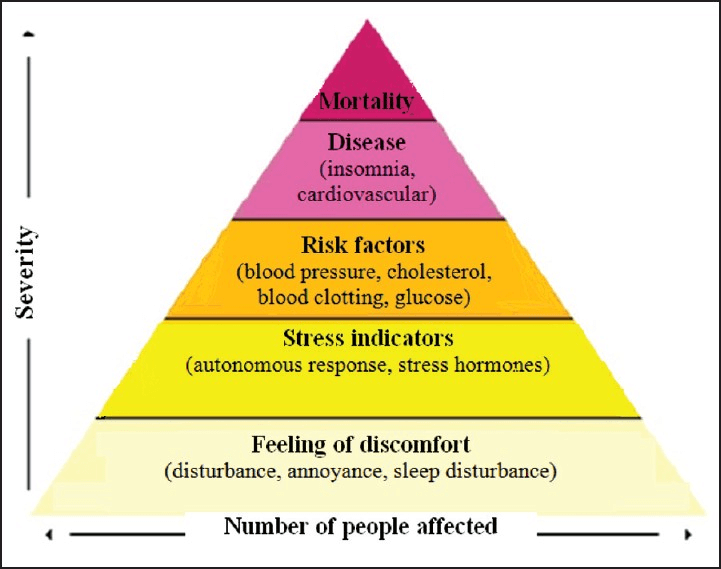
Noise pollution can create many types of health-related problems, such as lack of sleep (insomnia), hypertension, loss of hearing, anxiety, etc. Sound above 80 dB is very painful to hear.
A person who is exposed to loud sound continuously may get permanent or temporary loss of hearing (impairment of hearing).
Problems due to Noise Pollution Hierarchy
Measure to Limit Noise Pollution
Noise pollution can be limited or controlled by controlling the noise coming from the source.
Noise pollution can be limited by taking the following measures:
TV or radio should be played at low volume.
By installing high-quality silencer in vehicles.
Minimum use of vehicle horns.
Plantation of trees along the roadsides and around buildings. Trees absorb sound.
Awareness campaign to make people aware; about the harmful effects of noise pollution and measures to control noise pollution.
Hearing Impairment
Total hearing impairment, which is rare, is usually from birth itself. Partial disability is generally the result of a disease, injury or age. Children with impaired hearing need special care. By learning sign language, such children can communicate effectively. Because speech develops as the direct result of hearing, a child with a hearing loss may have defective speech also. Technological devices for the hearing-impaired have made it possible for such persons to improve their quality of life. Society can do much to improve the living environment for the hearing-impaired and help them live normal lives.
Frequently Asked Questions (FAQs) Related to Sound
1. What is sound and how is it produced?
Ans. Sound is a form of energy that results from the vibration of matter. It is produced when an object vibrates, causing air molecules to vibrate and create sound waves that travel through the air. The frequency of the waves determines the pitch of the sound, while the amplitude determines the loudness.
2. How does sound travel through different mediums?
Ans. Sound travels differently through different mediums. In solids, sound travels faster because the molecules are closely packed together. In liquids, sound travels slower than in solids because the molecules are further apart. In gases like air, sound travels slower than in solids and liquids because the molecules are even further apart.
3. What is the difference between noise and music?
Ans. Noise is an unpleasant sound that is often unwanted and can cause discomfort or harm to the ears. It has no specific pattern or rhythm and is usually caused by random vibrations. Music, on the other hand, is a pleasing sound that is created through specific patterns and rhythms. It is often intentional and is meant to be enjoyed.
4. What are the applications of sound technology?
Ans. Sound technology has many applications in various fields such as entertainment, communication, and medical sciences. In entertainment, sound technology is used in music production, film, and television. In communication, sound technology is used in telephones, public address systems, and hearing aids. In medical sciences, sound technology is used in ultrasound machines, stethoscopes, and hearing tests.
5. How can sound be harmful to human health?
Ans. Sound can be harmful to human health when it exceeds a certain level. Prolonged exposure to loud noise can cause hearing loss and damage to the ears. It can also cause stress, anxiety, and other health problems. Noise pollution in urban areas can also lead to sleep disturbances, hypertension, and other health issues. It is important to protect our ears from loud noises and avoid exposure to excessive noise levels.
The document Sound Class 8 Notes Science Chapter 11 is a part of the Class 8 Course Science Class 8.
1. What is the process through which sound is produced by humans?
Ans. Sound is produced by humans primarily through the vibration of vocal cords located in the larynx. When air from the lungs passes through the vocal cords, they vibrate, creating sound waves. The pitch and volume of the sound can be modified by changing the tension of the vocal cords, the shape of the mouth, and the position of the tongue.
2. Why does sound require a medium for propagation?
Ans. Sound requires a medium, such as air, water, or solids, to propagate because it travels in the form of mechanical waves. These waves are created by the vibration of particles in the medium. Without a medium, there are no particles to transmit the vibrations, meaning sound cannot travel through a vacuum.
3. How do we hear sound through our ears?
Ans. Sound waves enter the ear through the outer ear and travel down the ear canal to the eardrum, causing it to vibrate. These vibrations are transmitted to the tiny bones in the middle ear, known as the ossicles, which amplify the sound. The vibrations then reach the cochlea in the inner ear, where they are converted into electrical signals that are sent to the brain, allowing us to perceive sound.
4. What is the difference between audible and inaudible sound?
Ans. Audible sound refers to sound waves that can be heard by the human ear, typically in the frequency range of 20 Hz to 20,000 Hz (20 kHz). Inaudible sound, on the other hand, includes sounds below 20 Hz (infrasound) and above 20 kHz (ultrasound), which cannot be detected by human hearing but may be sensed by other animals or used in various technologies.
5. What are the effects of noise pollution on human health?
Ans. Noise pollution can have several adverse effects on human health, including stress, hearing loss, sleep disturbances, and increased risk of cardiovascular diseases. Prolonged exposure to high levels of noise can also impair cognitive function and lead to a decline in overall well-being. It is important to minimize noise pollution to maintain a healthier living environment.






 2. Sound in Water: