NCERT Solutions for Class 9 Science Chapter 11 - Sound
| Table of contents |

|
| Page No. 129 |
|
| Page No. 132 |
|
| Page No. 133 |
|
| Page No. 134 |
|
| Page No. 135 |
|
| Page No. 136 |
|
| Page No. 138 |
|
| Page No. 139 |
|

Page No. 129
Q1. How does the sound produced by a vibrating object in a medium reach your ear?
Ans: When the object vibrates, it sets the neighbouring particles to vibrate. These particles exert force on other particles and pass on the energy to other parts of the medium. The particles do not get transported, but only the disturbance or energy is transferred. In this way, sound reaches our ears.
Q2. Explain how sound is produced by your school bell.
Ans: When the hammer hits the gong of the bell, it starts vibrating. These vibrations set the particles of surrounding air vibrating. The disturbance travels in all directions and the sound propagates.
Q3. Why are sound waves called mechanical waves?
Ans: Sound waves are produced by oscillations of particles of the medium. So they require a material medium for their propagation. Thus they are called mechanical waves.
Q4. Suppose you and your friends are on the moon. Will you be able to hear any sound produced by your friend?
Ans: No, it is not possible to hear any sound on the moon. There is no medium such as air on the moon to carry sound waves. Sound cannot travel through a vacuum as it is a mechanical wave.
Page No. 132
Q1. Which wave property determines
(a) loudness, (b) pitch?
Ans: (a) Loudness is determined by the intensity or amplitude of sound waves.
(b) Pitch is determined by the frequency of the sound wave.
Q2. Guess which sound has a higher pitch: guitar or car horn?
Ans: Guitar, because it has a higher frequency.
Q3. What are the wavelength, frequency, time period and amplitude of a sound wave?
Ans: Wavelength: The distance between two consecutive compressions or two consecutive rarefactions is called the wavelength. It is devoted to A.
Frequency: The number of complete waves produced per second is called the frequency of the wave.
Time Period: The time taken to complete one complete vibration is called time period.
Amplitude: The maximum displacement of the particles of the medium from their mean positions during the propagation of a wave is called the amplitude of the wave.
Q4. How are the wavelength and frequency of a sound wave related to its speed?
Ans: Speed of sound = Frequency × Wavelength
Q5. Calculate the wavelength of a sound wave whose frequency is 220 Hz and speed is 440 m/s in a given medium.
Ans: Given that,
Frequency of sound wave = 220 Hz
Speed of sound wave = 440 m/s
Calculate wavelength.
We know that
Speed = Wavelength × Frequency
v = λ ν
440 = Wavelength × 220
Wavelength = 440/220
Wavelength = 2
Therefore, the wavelength of the sound wave = 2 metres
Q6. A person is listening to a tone of 500 Hz, sitting at a distance of 450 m from the source of the sound. What is the time interval between successive compressions from the source?
Ans: The time interval between successive compressions from the source is equal to the time period, and the time period is reciprocal to the frequency. Therefore, it can be calculated as follows:
T= 1/F
T= 1/500
T = 0.002 s
Page No. 133
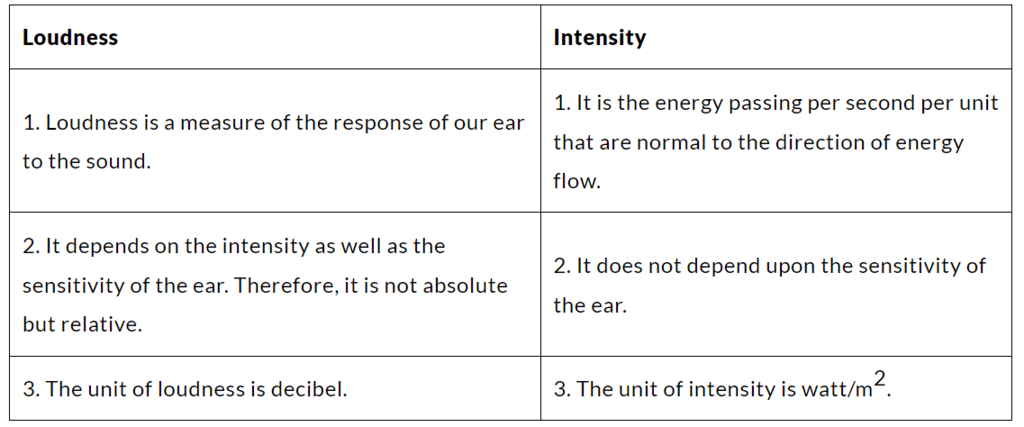
Q1. Distinguish between loudness and intensity of sound.
Ans:
Q2. In which of the three media, air, water or iron, does sound travel the fastest at a particular temperature?
Ans: Sound travels fastest in solids due to their high elasticity, so out of given media sound travels fastest in iron.
Page No. 134
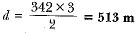
Q1. An echo is returned in 3s. What is the distance of the reflecting surface from the source, given that the speed of sound is 342 ms-1?
Ans: If d is the distance of the reflecting surface from the source and t is the time interval of echo-return, then
2d = vt ⇒ d = vt/2
Here, v - 342 ms-1, t = 3 s
∴ 
Page No. 135
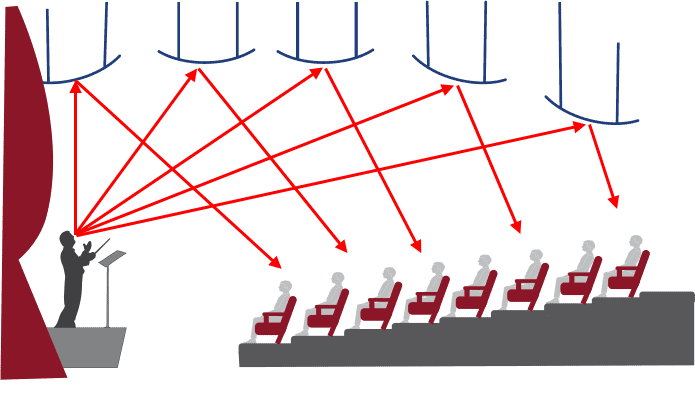
Q1. Why are the ceilings of concert halls curved?
Ans: The ceilings of concert halls are curved so that sound after reflection reaches all corners of the hall.
Page No. 136
Q1. What is the audible range of the average human ear?
Ans: Audible range for human ear = 20 Hz - 20 kHz
Q2. What is the range of frequencies associated with:
(a) Infrasound
(b) Ultrasound?
Ans: (a) Infrasound: Sound waves between the frequencies 1 to 20 Hz.
(b) Ultrasound: Sound waves of frequencies above 20,000 Hz.
Page No. 138
Q1. What is sound and how is it produced?
Ans: A sound is a form of energy that produces the sensation of hearing. It is produced by oscillation/ vibration of particles of a material medium.
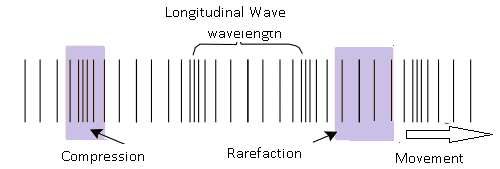
Q2. Describe with the help of a diagram, how compressions and rarefactions are produced in the air near a source of the sound.
Ans:
Q3. Why is sound wave called a longitudinal wave?
Ans: In sound waves, the vibration of the particles of the medium is along the direction of wave propagation, so sound waves in the air are longitudinal.
Q4. Which characteristic of the sound helps you to identify your friend by his voice while sitting with Miens in a dark room?
Ans: It is the quality of sound (or waveform) that helps us to identify the voice of our friend without seeing him.
Q5. Flash and thunder are produced simultaneously. But thunder is heard a few seconds after the flash is seen, why?
Ans: The speed of light is 3 x 10⁸ m/s while that of sound in air is only 330 m/s.
We know that time = distance/speed.
Since sound travels slower than light, thunder is heard after the flash is seen.
Q6. A person has a hearing range from 20 Hz to 20 kHz. what are the typical wavelengths of sound waves in air corresponding to these two frequencies? Take the speed of sound in air as 344 ms1.
Ans: For sound waves,
Speed = Wavelength × frequency
v = λ × v
Speed of sound wave in air = 344 m/s
(a) For v = 20 Hz
λ1 = v/v1 = 344/20 = 17.2 m
(b) For v2 = 20,000 Hz
λ2 = v/v2 = 344/20,000 = 0.0172 m
Therefore, for human beings, the hearing wavelength is in the range of 0.0172 m to 17.2 m.
Q7. Two children are at opposite ends of an aluminium rod. One strikes the end of the rod with a stone. Find the ratio of times taken by the sound wave in air and in aluminium to reach the second child.
Ans: Consider the length of the aluminium rod = d
Speed of sound wave at 25° C, V Al = 6420 ms-1
Time taken to reach the other end is,
T Al = d/ (V Al) = d/6420
Speed of sound in air, V air = 346 ms-1
Time taken by sound to each other end is,
T air = d/ (V air) = d/346
Therefore, the ratio of time taken by sound in aluminium and air is,
T air / t Al = 6420 / 346 = 18.55
Q8. The frequency of a source of sound is 100 Hz. How many times does it vibrate in a minute
Ans: Frequency = (Number of oscillations) / Total time
Number of oscillations = Frequency × Total time
Given,
∵ 1 minute = 60 s
Vibrations in 1 s = frequency = 100.
Vibrations in 60 s = 60 x 100 = 6000 times
The source vibrates 6000 times in a minute and produces a frequency of 100 Hz.
Q9. Does sound follow the same laws of reflection as light does? Explain.
Ans: Yes, sound and light follow the same laws of reflection given below :
- The angle of incidence at the point of incidence = The angle of reflection.
- At the point of incidence the incident sound wave, the normal and the reflected sound wave lie in the same plane.
Q10. When a sound is reflected from a distant object, an echo is produced. Let the distance between the reflecting surface and the source of sound production remains the same. Do you hear echo sound on a hotter day?
Ans: An echo is heard when the time interval between the reflected sound and the original sound is at least 0.1 seconds. As the temperature increases, the speed of sound in a medium also increases. On a hotter day, the time interval between the reflected and original sound will decrease, and an echo is audible only if the time interval between the reflected sound and the original sound is greater than 0.1 s.
Q11. Give two practical applications of reflection of sound waves.
Ans: Applications of reflection of sound waves are
- to locate underwater hidden objects such as rocks and icebergs through SONAR.
- to detect any undesired objects in the sky near airports and borders of the country.
Q12. A stone is dropped from the top of a tower 500 m high into a pond of water at the base of the tower. When is the splash heard at the top? Given, g = 10 ms-2 and speed of sound = 340 ms-1.
Ans: Height (s) of tower = 500 m
Velocity (v) of sound = 340 m s−1
Acceleration (g) due to gravity = 10 m s−1
Initial velocity (u) of the stone = 0
Time (t1) taken by the stone to fall to the tower base
As per second equation of motion:
s= ut1 + (½) g (t1)2
500 = 0 x t1 + (½) 10 (t1)2
(t1)2 = 100
t1 = 10 s
Time (t2) taken by sound to reach the top from the tower base = 500/340 = 1.47 s.
t = t1 + t2
t = 10 + 1.47
t = 11.47 s.
The time for the splash to be heard is 11.47 seconds from the time the stone is dropped.
Page No. 139
Q13. A sound wave travels at a speed of 339 ms-1. If its wavelength is 1.5 cm, what is the frequency of the wave? Will it be audible?
Ans: Given: Velocity of sound, v = 339 ms-1
Wavelength, λ = 1.5 cm - 0.015 m
Frequency, v = 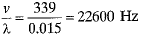
= 22.6 kHz
This sound is not audible to human beings as its frequency is higher than the audible range.
Q14. What is reverberation? How can it be reduced?
Ans: The time from generation of sound until its loudness reduces to zero is called reverberation time. The process due to which the persistence of sound is caused is called reverberation. This is reduced in an auditorium using sound-absorbent materials and good absorbers of sound.
Q15. What is loudness of sound? What factors does it depend on?
Ans: The loudness of sound is a measure of the response of sound to our ears. The loudness of sound is not simply the energy reaching the human ear, but it also tells about the sensitivity of the human ear detecting this energy. The loudness of sound is measured in decibels (dB). As energy reaching the ear depends on the square of the amplitude, the loudness of sound depends on two factors:
(i) Amplitude of sound waves and (ii) Sensitivity of ear.
Q16. How is ultrasound used for cleaning?
Ans: Ultrasound is used to clean the hard-to-reach places such as spiral tubes, electronic components etc. The object to be cleaned is placed in the cleaning solution and ultrasonic waves are sent into it. The high frequency of ultrasound detaches the dust, grease and dirt from the object and it gets thoroughly cleaned.
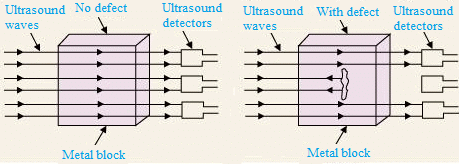
Q17. Explain how defects in a metal block can be detected using ultrasound.
Ans: Ultrasonic waves are allowed to pass through the metal. If the block is flawless, it will pass through it. If there is a crack or deformity, the wave gets reflected. The time taken by the wave to return is measured and helps to locate the flaw. If the wave is not reflected, it means the metal has no deformity.
|
84 videos|478 docs|60 tests
|
FAQs on NCERT Solutions for Class 9 Science Chapter 11 - Sound
| 1. What is sound and how is it produced? |  |
| 2. What are the different types of sound waves? | |
| 3. How does the speed of sound vary in different mediums? | |
| 4. What is the relationship between frequency and pitch of sound? | |
| 5. What is the significance of the Doppler effect in sound? | |




Exam
,Semester Notes
,mock tests for examination
,Important questions
,Free
,past year papers
,Viva Questions
,NCERT Solutions for Class 9 Science Chapter 11 - Sound
,MCQs
,practice quizzes
,study material
,shortcuts and tricks
,Extra Questions
,Sample Paper
,Objective type Questions
,video lectures
,NCERT Solutions for Class 9 Science Chapter 11 - Sound
,Previous Year Questions with Solutions
,Summary
,NCERT Solutions for Class 9 Science Chapter 11 - Sound
,ppt
;




NCERT Solutions: Sound Free PDF Download
Importance of NCERT Solutions: Sound
NCERT Solutions: Sound Notes
NCERT Solutions: Sound Class 9 Questions
Study NCERT Solutions: Sound on the App
|
© EduRev
|
Education Revolution
|


|




