NCERT Solutions Class 11 Physics Chapter 2 - Motion in a Straight Line

Q2.1: In which of the following examples of motion, can the body be considered approximately a point object:
(a) a railway carriage moving without jerks between two stations.
(b) a monkey sitting on top of a man cycling smoothly on a circular track.
(c) a spinning cricket ball that turns sharply on hitting the ground.
(d) a tumbling beaker that has slipped off the edge of a table.
Ans: (a), (b)
(a) The size of a carriage is very small as compared to the distance between two stations. Therefore, the carriage can be treated as a point sized object.
(b) The size of a monkey is very small as compared to the size of a circular track. Therefore, the monkey can be considered as a point sized object on the track.
(c) The size of a spinning cricket ball is comparable to the distance through which it turns sharply on hitting the ground. Hence, the cricket ball cannot be considered as a point object.
(d) The size of a beaker is comparable to the height of the table from which it slipped. Hence, the beaker cannot be considered as a point object.
Q2.2:
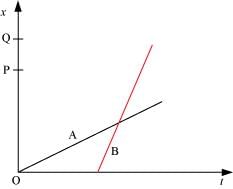 Fig 2.9
The position-time (x-t) graphs for two children A and B returning from their school O to their homes P and Q respectively are shown in Fig. 2.19. Choose the correct entries in the brackets below;
(a) (A/B) lives closer to the school than (B/A)
(b) (A/B) starts from the school earlier than (B/A)
(c) (A/B) walks faster than (B/A)
(d) A and B reach home at the (same/different) time
(e) (A/B) overtakes (B/A) on the road (once/twice).
Ans: (a) A lives closer to school than B.
(b) A starts from school earlier than B.
(c) B walks faster than A.
(d) A and B reach home at the same time.
(e) B overtakes A once on the road.
Explanation:
(a) In the given x–t graph, it can be observed that distance OP < OQ. Hence, the distance of school from the A’s home is less than that from B’s home.
(b) In the given graph, it can be observed that for x = 0, t = 0 for A, whereas for x = 0, t has some finite value for B. Thus, A starts his journey from school earlier than B.
(c) In the given x–t graph, it can be observed that the slope of B is greater than that of A. Since the slope of the x–t graph gives the speed, a greater slope means that the speed of B is greater than the speed A.
(d) It is clear from the given graph that both A and B reach their respective homes at the same time.
(e) B moves later than A and his/her speed is greater than that of A. From the graph, it is clear that B overtakes A only once on the road.
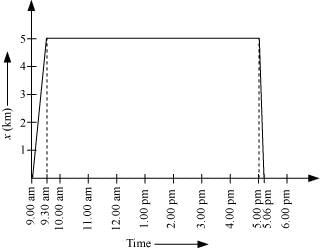
Q2.3: A woman starts from her home at 9.00 am, walks with a speed of 5 km h–1 on a straight road up to her office 2.5 km away, stays at the office up to 5.00 pm, and returns home by an auto with a speed of 25 km h–1. Choose suitable scales and plot the x-t graph of her motion.
Ans: Speed of the woman = 5 km/h
Distance between her office and home = 2.5 km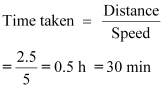
It is given that she covers the same distance in the evening by an auto.
Now, speed of the auto = 25 km/h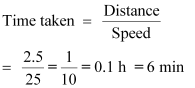
The suitable x-t graph of the motion of the woman is shown in the given figure.
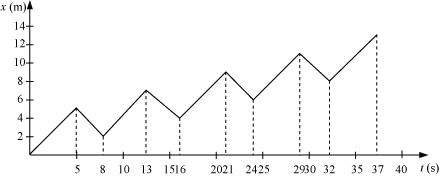
Q2.4: A drunkard walking in a narrow lane takes 5 steps forward and 3 steps backward, followed again by 5 steps forward and 3 steps backward, and so on. Each step is 1 m long and requires 1 s. Plot the x-t graph of his motion. Determine graphically and otherwise how long the drunkard takes to fall in a pit 13 m away from the start.
Ans: Distance covered with 1 step = 1 m
Time taken = 1 s
Time taken to move first 5 m forward = 5 s
Time taken to move 3 m backward = 3 s
Net distance covered = 5 – 3 = 2 m
Net time taken to cover 2 m = 8 s
Drunkard covers 2 m in 8 s.
Drunkard covered 4 m in 16 s.
Drunkard covered 6 m in 24 s.
Drunkard covered 8 m in 32 s.
In the next 5 s, the drunkard will cover a distance of 5 m and a total distance of 13 m and falls into the pit.
Net time taken by the drunkard to cover 13 m = 32 + 5 = 37 s
The x-t graph of the drunkard’s motion can be shown as:
Q2.5: A car moving along a straight highway with a speed of 126 km h–1 is brought to a stop within a distance of 200 m. What is the retardation of the car (assumed uniform), and how long does it take for the car to stop?
Ans: Initial velocity of the car, u = 126 km/h = 35 m/s
Final velocity of the car, v = 0
Distance covered by the car before coming to rest, s = 200 m
Retardation produced in the car = a
From third equation of motion, a can be calculated as: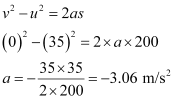
From first equation of motion, time (t) taken by the car to stop can be obtained as: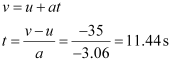
Q2.6: A player throws a ball upwards with an initial speed of 29.4 m s–1.
(a) What is the direction of acceleration during the upward motion of the ball?
(b) What are the velocity and acceleration of the ball at the highest point of its motion?
(c) Choose the x = 0 m and t = 0 s to be the location and time of the ball at its highest point, vertically downward direction to be the positive direction of x-axis, and give the signs of position, velocity and acceleration of the ball during its upward, and downward motion.
(d) To what height does the ball rise and after how long does the ball return to the player’s hands? (Take g = 9.8 m s–2 and neglect air resistance).
Ans: (a) Downward
(b) Velocity = 0, acceleration = 9.8 m/s2
(c) x > 0 for both up and down motions, v < 0 for up and v > 0 for down motion, a > 0 throughout the motion
(d) 44.1 m, 6 s
Explanation:
(a) Irrespective of the direction of the motion of the ball, acceleration (which is actually acceleration due to gravity) always acts in the downward direction towards the centre of the Earth.
(b) At maximum height, velocity of the ball becomes zero. Acceleration due to gravity at a given place is constant and acts on the ball at all points (including the highest point) with a constant value i.e., 9.8 m/s2.
(c) During upward motion, the sign of position is positive, sign of velocity is negative, and sign of acceleration is positive. During downward motion, the signs of position, velocity, and acceleration are all positive.
(d) Initial velocity of the ball, u = 29.4 m/s
Final velocity of the ball, v = 0 (At maximum height, the velocity of the ball becomes zero)
Acceleration, a = – g = – 9.8 m/s2
From third equation of motion, height (s) can be calculated as: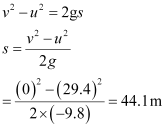
From first equation of motion, time of ascent (t) is given as: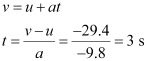
Time of ascent = Time of descent
Hence, the total time taken by the ball to return to the player’s hands = 3 + 3 = 6 s.
Q2.7: Read each statement below carefully and state with reasons and examples, if it is true or false;
A particle in one-dimensional motion
(a) with zero speed at an instant may have non-zero acceleration at that instant
(b) with zero speed may have non-zero velocity,
(c) with constant speed must have zero acceleration,
(d) with positive value of acceleration must be speeding up.
Ans: (a) True
(b) False
(c) True
(d) False
Explanation:
(a) When an object is thrown vertically up in the air, its speed becomes zero at maximum height. However, it has acceleration equal to the acceleration due to gravity (g) that acts in the downward direction at that point.
(b) Speed is the magnitude of velocity. When speed is zero, the magnitude of velocity along with the velocity is zero.
(c) A car moving on a straight highway with constant speed will have constant velocity. Since acceleration is defined as the rate of change of velocity, acceleration of the car is also zero.
(d) This statement is false in the situation when acceleration is positive and velocity is negative at the instant time taken as origin. Then, for all the time before velocity becomes zero, there is slowing down of the particle. Such a case happens when a particle is projected upwards.
This statement is true when both velocity and acceleration are positive, at the instant time taken as origin. Such a case happens when a particle is moving with positive acceleration or falling vertically downwards from a height.
Q2.8: A ball is dropped from a height of 90 m on a floor. At each collision with the floor, the ball loses one tenth of its speed. Plot the speed-time graph of its motion between t = 0 to 12 s.
Ans: Ball is dropped from a height, s = 90 m
Initial velocity of the ball, u = 0
Acceleration, a = g = 9.8 m/s2
Final velocity of the ball = v
From second equation of motion, time (t) taken by the ball to hit the ground can be obtained as:
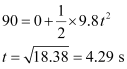
From first equation of motion, final velocity is given as:
v = u + at
= 0 9.8 × 4.29 = 42.04 m/s
Rebound velocity of the ball, ur = 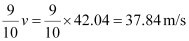
Time (t) taken by the ball to reach maximum height is obtained with the help of first equation of motion as:
v = ur + at′
0 = 37.84 (– 9.8) t′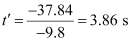
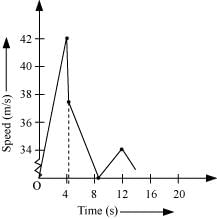
Total time taken by the ball = t +t′ = 4.29 + 3.86 = 8.15 s
As the time of ascent is equal to the time of descent, the ball takes 3.86 s to strike back on the floor for the second time.
The velocity with which the ball rebounds from the floor 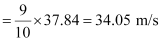
Total time taken by the ball for second rebound = 8.15 + 3.86 = 12.01 s
The speed-time graph of the ball is represented in the given figure as:
Q2.9: Explain clearly, with examples, the distinction between:
(a) magnitude of displacement (sometimes called distance) over an interval of time, and the total length of path covered by a particle over the same interval;
(b) magnitude of average velocity over an interval of time, and the average speed over the same interval. [Average speed of a particle over an interval of time is defined as the total path length divided by the time interval]. Show in both (a) and (b) that the second quantity is either greater than or equal to the first.
When is the equality sign true? [For simplicity, consider one-dimensional motion only].
Ans: (a) The magnitude of displacement over an interval of time is the shortest distance (which is a straight line) between the initial and final positions of the particle.
The total path length of a particle is the actual path length covered by the particle in a given interval of time.
For example, suppose a particle moves from point A to point B and then, comes back to a point, C taking a total time t, as shown below. Then, the magnitude of displacement of the particle = AC.

Whereas, total path length = AB + BC
It is also important to note that the magnitude of displacement can never be greater than the total path length. However, in some cases, both quantities are equal to each other.
(b) 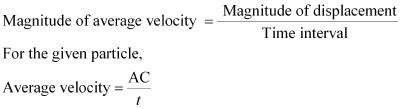
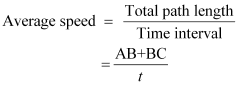
Since (AB + BC) > AC, average speed is greater than the magnitude of average velocity. The two quantities will be equal if the particle continues to move along a straight line.
Q2.10: A man walks on a straight road from his home to a market 2.5 km away with a speed of 5 km h –1. Finding the market closed, he instantly turns and walks back home with a speed of 7.5 km h–1. What is the
(a) magnitude of average velocity, and
(b) average speed of the man over the interval of time (i) 0 to 30 min, (ii) 0 to 50 min, (iii) 0 to 40 min? [Note: You will appreciate from this exercise why it is better to define average speed as total path length divided by time, and not as magnitude of average velocity. You would not like to tell the tired man on his return home that his average speed was zero!]
Ans: Time taken by the man to reach the market from home, 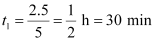
Time taken by the man to reach home from the market, 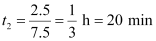
Total time taken in the whole journey = 30 + 20 = 50 min

Time = 50 min = 
Net displacement = 0
Total distance = 2.5 + 2.5 = 5 km

Speed of the man = 7.5 km
Distance travelled in first 30 min = 2.5 km
Distance travelled by the man (from market to home) in the next 10 min
= 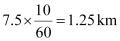
Net displacement = 2.5 – 1.25 = 1.25 km
Total distance travelled = 2.5 +1.25 = 3.75 km

Q2.11: In Exercises 2.9 and 2.10, we have carefully distinguished between average speed and magnitude of average velocity. No such distinction is necessary when we consider instantaneous speed and magnitude of velocity. The instantaneous speed is always equal to the magnitude of instantaneous velocity. Why?
Ans: Instantaneous velocity is given by the first derivative of distance with respect to time i.e.,
Here, the time interval dt is so small that it is assumed that the particle does not change its direction of motion. As a result, both the total path length and magnitude of displacement become equal is this interval of time.
Therefore, instantaneous speed is always equal to instantaneous velocity.
Q2.12: Look at the graphs (a) to (d) carefully and state, with reasons, which of these cannot possibly represent one-dimensional motion of a particle.
(a) 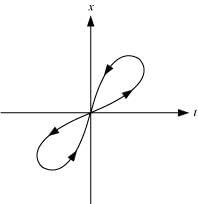
(b)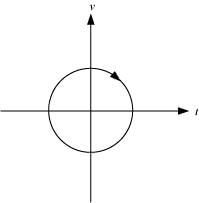
(c)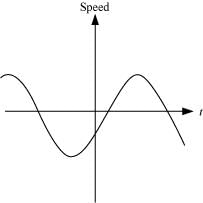
(d) 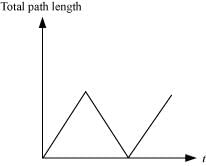
Ans: (a) The given x-t graph, shown in (a), does not represent one-dimensional motion of the particle. This is because a particle cannot have two positions at the same instant of time.
(b) The given v-t graph, shown in (b), does not represent one-dimensional motion of the particle. This is because a particle can never have two values of velocity at the same instant of time.
(c) The given v-t graph, shown in (c), does not represent one-dimensional motion of the particle. This is because speed being a scalar quantity cannot be negative.
(d) The given v-t graph, shown in (d), does not represent one-dimensional motion of the particle. This is because the total path length travelled by the particle cannot decrease with time.
Q2.13: Figure 2.11 shows the x-t plot of one-dimensional motion of a particle. Is it correct to say from the graph that the particle moves in a straight line for t < 0 and on a parabolic path for t > 0? If not, suggest a suitable physical context for this graph.
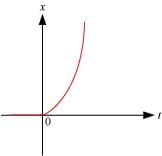 (Fig 2.11)Ans: No
The x-t graph of a particle moving in a straight line for t < 0 and on a parabolic path for t > 0 cannot be shown as the given graph. This is because, the given particle does not follow the trajectory of path followed by the particle as t = 0, x = 0. A physical situation that resembles the above graph is of a freely falling body held for sometime at a height.
Q2.14: A police van moving on a highway with a speed of 30 km h–1 fires a bullet at a thief’s car speeding away in the same direction with a speed of 192 km h–1. If the muzzle speed of the bullet is 150 m s–1, with what speed does the bullet hit the thief’s car ? (Note: Obtain that speed which is relevant for damaging the thief’s car).
Ans: Speed of the police van, vp = 30 km/h = 8.33 m/s
Muzzle speed of the bullet, vb = 150 m/s
Speed of the thief’s car, vt = 192 km/h = 53.33 m/s
Since the bullet is fired from a moving van, its resultant speed can be obtained as:
= 150 8.33 = 158.33 m/s
Since both the vehicles are moving in the same direction, the velocity with which the bullet hits the thief’s car can be obtained as:
vbt = vb – vt
= 158.33 – 53.33 = 105 m/s
Q2.15: Suggest a suitable physical situation for each of the following graphs (Fig 2.12):
(a) 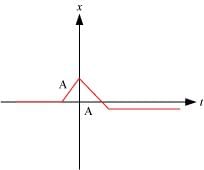
(b)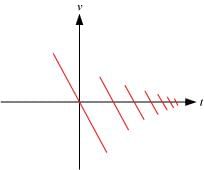
(c)
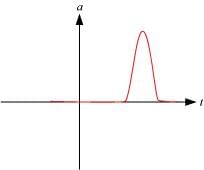
(Fig: 3.22)
Ans: (a)The given x-t graph shows that initially a body was at rest. Then, its velocity increases with time and attains an instantaneous constant value. The velocity then reduces to zero with an increase in time. Then, its velocity increases with time in the opposite direction and acquires a constant value. A similar physical situation arises when a football (initially kept at rest) is kicked and gets rebound from a rigid wall so that its speed gets reduced. Then, it passes from the player who has kicked it and ultimately gets stopped after sometime.
(b) In the given v-tgraph, the sign of velocity changes and its magnitude decreases with a passage of time. A similar situation arises when a ball is dropped on the hard floor from a height. It strikes the floor with some velocity and upon rebound, its velocity decreases by a factor. This continues till the velocity of the ball eventually becomes zero.
(c) The given a-t graph reveals that initially the body is moving with a certain uniform velocity. Its acceleration increases for a short interval of time, which again drops to zero. This indicates that the body again starts moving with the same constant velocity. A similar physical situation arises when a hammer moving with a uniform velocity strikes a nail.
Q2.16: Figure 2.13 gives the x-t plot of a particle executing one-dimensional simple harmonic motion. (You will learn about this motion in more detail in Chapter 13). Give the signs of position, velocity and acceleration variables of the particle at t = 0.3 s, 1.2 s, – 1.2 s.
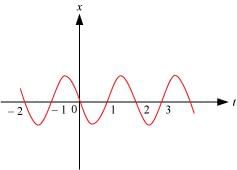 (Fig: 2.13)
Ans: Negative, Negative, Positive (at t = 0.3 s)
Positive, Positive, Negative (at t = 1.2 s)
Negative, Positive, Positive (at t = –1.2 s)
For simple harmonic motion (SHM) of a particle, acceleration (a) is given by the relation:
a = – ω2x ω → angular frequency … (i)
t = 0.3 s
In this time interval, x is negative. Thus, the slope of the x-t plot will also be negative. Therefore, both position and velocity are negative. However, using equation (i), acceleration of the particle will be positive.
t = 1.2 s
In this time interval, x is positive. Thus, the slope of the x-t plot will also be positive. Therefore, both position and velocity are positive. However, using equation (i), acceleration of the particle comes to be negative.
t = – 1.2 s
In this time interval, x is negative. Thus, the slope of the x-t plot will also be negative. Since both x and t are negative, the velocity comes to be positive. From equation (i), it can be inferred that the acceleration of the particle will be positive.
Q2.17: Figure 2.14 gives the x-t plot of a particle in one-dimensional motion. Three different equal intervals of time are shown. In which interval is the average speed greatest, and in which is it the least? Give the sign of average velocity for each interval.
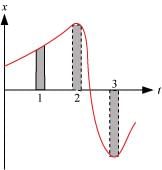 (Fig: 2.14)
Ans: Interval 3 (Greatest), Interval 2 (Least)
Positive (Intervals 1 & 2), Negative (Interval 3)
The average speed of a particle shown in the x-t graph is obtained from the slope of the graph in a particular interval of time.
It is clear from the graph that the slope is maximum and minimum restively in intervals 3 and 2 respectively. Therefore, the average speed of the particle is the greatest in interval 3 and is the least in interval 2. The sign of average velocity is positive in both intervals 1 and 2 as the slope is positive in these intervals. However, it is negative in interval 3 because the slope is negative in this interval.
Q2.18: Figure 2.15 gives a speed-time graph of a particle in motion along a constant direction. Three equal intervals of time are shown. In which interval is the average acceleration greatest in magnitude? In which interval is the average speed greatest? Choosing the positive direction as the constant direction of motion, give the signs of v and a in the three intervals. What are the accelerations at the points A, B, C and D?
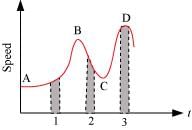 (Fig: 2.15)
Ans: Average acceleration is greatest in interval 2
Average speed is greatest in interval 3
v is positive in intervals 1, 2, and 3
a is positive in intervals 1 and 3 and negative in interval 2
a = 0 at A, B, C, D
Acceleration is given by the slope of the speed-time graph. In the given case, it is given by the slope of the speed-time graph within the given interval of time.
Since the slope of the given speed-time graph is maximum in interval 2, average acceleration will be the greatest in this interval.
Height of the curve from the time-axis gives the average speed of the particle. It is clear that the height is the greatest in interval 3. Hence, average speed of the particle is the greatest in interval 3.
In interval 1:
The slope of the speed-time graph is positive. Hence, acceleration is positive. Similarly, the speed of the particle is positive in this interval.
In interval 2:
The slope of the speed-time graph is negative. Hence, acceleration is negative in this interval. However, speed is positive because it is a scalar quantity.
In interval 3:
The slope of the speed-time graph is zero. Hence, acceleration is zero in this interval. However, here the particle acquires some uniform speed. It is positive in this interval.
Points A, B, C, and D are all parallel to the time-axis. Hence, the slope is zero at these points. Therefore, at points A, B, C, and D, acceleration of the particle is zero.
Old NCERT Solutions
Q1: A jet airplane travelling at the speed of 500 km h–1 ejects its products of combustion at the speed of 1500 km h–1 relative to the jet plane. What is the speed of the latter with respect to an observer on ground?Ans: Speed of the jet airplane, vjet = 500 km/h
Relative speed of its products of combustion with respect to the plane,
vsmoke = – 1500 km/h
Speed of its products of combustion with respect to the ground = v′smoke
Relative speed of its products of combustion with respect to the airplane,
vsmoke = v′smoke – vjet
– 1500 = v′smoke – 500
v′smoke = – 1000 km/h
The negative sign indicates that the direction of its products of combustion is opposite to the direction of motion of the jet airplane.
Q2: Two trains A and B of length 400 m each are moving on two parallel tracks with a uniform speed of 72 km h–1 in the same direction, with A ahead of B. The driver of B decides to overtake A and accelerates by 1 m/s2. If after 50 s, the guard of B just brushes past the driver of A, what was the original distance between them
Ans: For train A:
Initial velocity, u = 72 km/h = 20 m/s
Time, t = 50 s
Acceleration, aI = 0 (Since it is moving with a uniform velocity)
From second equation of motion, distance (sI)covered by train A can be obtained as:
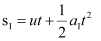
= 20 × 50 + 0 = 1000 m
For train B:
Initial velocity, u = 72 km/h = 20 m/s
Acceleration, a = 1 m/s2
Time, t = 50 s
From second equation of motion, distance (sII)covered by train A can be obtained as:


Length of both trains = 2 × 400m = 800m
Hence, the original distance between the driver of train A and the guard of train B is 2250 – 1000 - 800 = 450m.
Q3: On a two-lane road, car A is travelling with a speed of 36 km h–1. Two cars B and C approach car A in opposite directions with a speed of 54 km h–1 each. At a certain instant, when the distance AB is equal to AC, both being 1 km, B decides to overtake A before C does. What minimum acceleration of car B is required to avoid an accident?
Ans: Velocity of car A, vA = 36 km/h = 10 m/s
Velocity of car B, vB = 54 km/h = 15 m/s
Velocity of car C, vC = 54 km/h = 15 m/s
Relative velocity of car B with respect to car A,
vBA = vB – vA
= 15 – 10 = 5 m/s
Relative velocity of car C with respect to car A,
vCA = vC – (– vA)
= 15 + 10 = 25 m/s
At a certain instance, both cars B and C are at the same distance from car A i.e.,
s = 1 km = 1000 m
Time taken (t) by car C to cover 1000 m =

Hence, to avoid an accident, car B must cover the same distance in a maximum of 40 s.
From second equation of motion, minimum acceleration (a) produced by car B can be obtained as:
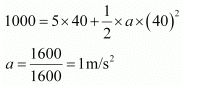
Q4: Two towns A and B are connected by a regular bus service with a bus leaving in either direction every T minutes. A man cycling with a speed of 20 km h–1 in the direction A to B notices that a bus goes past him every 18 min in the direction of his motion, and every 6 min in the opposite direction. What is the period T of the bus service and with what speed (assumed constant) do the buses ply on the road?
Ans: Let V be the speed of the bus running between towns A and B.
Speed of the cyclist, v = 20 km/h
Relative speed of the bus moving in the direction of the cyclist
= V – v = (V – 20) km/h
The bus went past the cyclist every 18 min i.e.,
 (when he moves in the direction of the bus).
Distance covered by the bus =
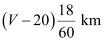 … (i)
… (i)Since one bus leaves after every T minutes, the distance travelled by the bus will be equal to
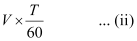
Both equations (i) and (ii) are equal.

Relative speed of the bus moving in the opposite direction of the cyclist= (V + 20) km/h
Time taken by the bus to go past the cyclist


From equations (iii) and (iv), we get
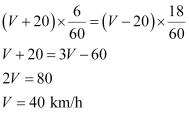
Substituting the value of V in equation (iv), we get
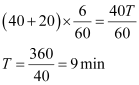
Q5: A three-wheeler starts from rest, accelerates uniformly with 1 ms–2 on a straight road for 10 s, and then moves with uniform velocity. Plot the distance covered by the vehicle during the nth second (n = 1,2,3….) versus n. What do you expect this plot to be during accelerated motion: a straight line or a parabola?
Ans: Straight line
Distance covered by a body in nth second is given by the relation

Where,
u = Initial velocity
a = Acceleration
n = Time = 1, 2, 3, ..... ,n
In the given case,
u = 0 and a = 1 m/s2

This relation shows that:
Dn ∝ n … (iii)
Now, substituting different values of n in equation (iii), we get the following table:
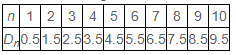
The plot between n and Dn will be a straight line as shown:
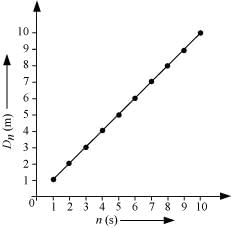
Since the given three-wheeler acquires uniform velocity after 10 s, the line will be parallel to the time-axis after n = 10 s.
Q6: A boy standing on a stationary lift (open from above) throws a ball upwards with the maximum initial speed he can, equal to 49 m/s. How much time does the ball take to return to his hands? If the lift starts moving up with a uniform speed of 5 m/s and the boy again throws the ball up with the maximum speed he can, how long does the ball take to return to his hands?
Ans: Initial velocity of the ball, u = 49 m/s
Acceleration, a = – g = – 9.8 m/s2
Case I:
When the lift was stationary, the boy throws the ball.
Taking upward motion of the ball,
Final velocity, v of the ball becomes zero at the highest point.
From first equation of motion, time of ascent (t) is given as: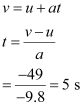
But, the time of ascent is equal to the time of descent.
Hence, the total time taken by the ball to return to the boy’s hand = 5 + 5 = 10 s.
Case II:
The lift was moving up with a uniform velocity of 5 m/s. In this case, the relative velocity of the ball with respect to the boy remains the same i.e., 49 m/s. Therefore, in this case also, the ball will return back to the boy’s hand after 10 s.
Q7: On a long horizontally moving belt (Fig. 3.26), a child runs to and fro with a speed 9 km h–1 (with respect to the belt) between his father and mother located 50 m apart on the moving belt. The belt moves with a speed of 4 km h–1. For an observer on a stationary platform outside, what is the
(a) speed of the child running in the direction of motion of the belt ?.
(b) speed of the child running opposite to the direction of motion of the belt ?
(c) time taken by the child in (a) and (b) ?
Which of the answers alter if motion is viewed by one of the parents?
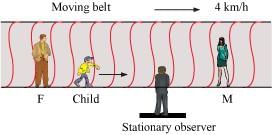 (Fig: 3.26)
Ans: (a) Speed of the belt, vB = 4 km/h
Speed of the boy, vb = 9 km/h
Since the boy is running in the same direction of the motion of the belt, his speed (as observed by the stationary observer) can be obtained as:
vbB = vb +vB = 9 + 4 = 13 km/h
(b) Since the boy is running in the direction opposite to the direction of the motion of the belt, his speed (as observed by the stationary observer) can be obtained as:
vbB = vb +(– vB) = 9 – 4 = 5 km/h
(c) Distance between the child’s parents = 50 m
As both parents are standing on the moving belt, the speed of the child in either direction as observed by the parents will remain the same i.e., 9 km/h = 2.5 m/s.
Hence, the time taken by the child to move towards one of his parents is  .
.
(d) If the motion is viewed by any one of the parents, answers obtained in (a) and (b) get altered. This is because the child and his parents are standing on the same belt and hence, are equally affected by the motion of the belt. Therefore, for both parents (irrespective of the direction of motion) the speed of the child remains the same i.e., 9 km/h.
For this reason, it can be concluded that the time taken by the child to reach any one of his parents remains unaltered.
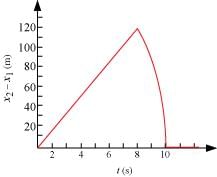
Q8: Two stones are thrown up simultaneously from the edge of a cliff 200 m high with initial speeds of 15 m/s and 30 m/s. Verify that the graph shown in Fig. 3.27 correctly represents the time variation of the relative position of the second stone with respect to the first. Neglect air resistance and assume that the stones do not rebound after hitting the ground. Take g = 10 m/s2. Give the equations for the linear and curved parts of the plot.
Ans: For first stone:
Initial velocity, uI = 15 m/s
Acceleration, a = –g = – 10 m/s2
Using the relation,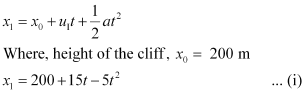
When this stone hits the ground, x1 = 0
∴– 5t2 15t 200 = 0
t2 – 3t – 40 = 0
t2 – 8t+ 5t – 40 = 0
t (t – 8)+ 5 (t – 8) = 0
t = 8 s or t = – 5 s
Since the stone was projected at time t = 0, the negative sign before time is meaningless.
∴t = 8 s
For second stone:
Initial velocity, uII = 30 m/s
Acceleration, a = –g = – 10 m/s2
Using the relation,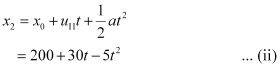
At the moment when this stone hits the ground; x2 = 0
– 5t2 30 t 200 = 0
t2 – 6t – 40 = 0
t2 – 10t+ 4t 40 = 0
t (t – 10) +4 (t – 10) = 0
(t – 10) (t+ 4) = 0
t = 10 s or t = – 4 s
Here again, the negative sign is meaningless.
∴t = 10 s
Subtracting equations (i) and (ii), we get
Equation (iii) represents the linear path of both stones. Due to this linear relation between (x2 – x1) and t, the path remains a straight line till 8 s.
Maximum separation between the two stones is at t = 8 s.
(x2 – x1)max = 15× 8 = 120 m
This is in accordance with the given graph.
After 8 s, only second stone is in motion whose variation with time is given by the quadratic equation:
x2 – x1 = 200 +30t – 5t2
Hence, the equation of linear and curved path is given by
x2 – x1 = 15t (Linear path)
x2 – x1 = 200 +30t – 5t2 (Curved path)
Q9: The speed-time graph of a particle moving along a fixed direction is shown in Fig. 3.28. Obtain the distance traversed by the particle between (a) t = 0 s to 10 s, (b) t = 2 s to 6 s.
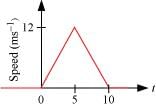 (Fig. 3.28)What is the average speed of the particle over the intervals in (a) and (b)?
Ans: (a) Distance travelled by the particle = Area under the given graph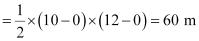
Average speed = 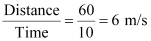
(b) Let s1 and s2 be the distances covered by the particle between time
t = 2 s to 5 s and t = 5 s to 6 s respectively.
Total distance (s) covered by the particle in time t = 2 s to 6 s
s = s1 + s2 … (i)
For distance s1:
Let u′ be the velocity of the particle after 2 s and a′ be the acceleration of the particle in t = 0 to t = 5 s.
Since the particle undergoes uniform acceleration in the interval t = 0 to t = 5 s, from first equation of motion, acceleration can be obtained as:
v = u + at
Where,
v = Final velocity of the particle
12 = 0 a′ × 5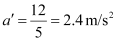
Again, from first equation of motion, we have
v = u + at
= 0 2.4 × 2 = 4.8 m/s
Distance travelled by the particle between time 2 s and 5 s i.e., in 3 s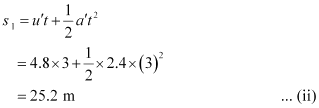
For distance s2:
Let a″ be the acceleration of the particle between time t = 5 s and t = 10 s.
From first equation of motion,
v = u at (where v = 0 as the particle finally comes to rest)
0 = 12 a″ × 5
Distance travelled by the particle in s1 (i.e., between t = 5 s and t = 6 s)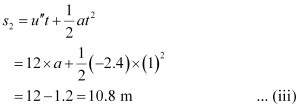
From equations (i), (ii), and (iii), we get
s = 25.2 + 10.8 = 36 m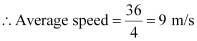
Ques 10: The velocity-time graph of a particle in one-dimensional motion is shown in Fig. 3.29:
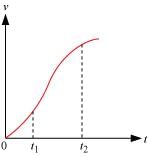
Which of the following formulae are correct for describing the motion of the particle over the time-interval t2 to t1?
(a) x(t2) = x(t1) v(t1)(t2–t1) ( )a(t2–t1)2
(b) v(t2)= v(t1) a(t2–t1)
(c) vAverage = (x(t2) – x(t1)) / (t2 – t1)
(d) aAverage = (v(t2) – v(t1)) / (t2 – t1)
(e) x(t2) = x(t1) vAverage(t2 – t1) ()aAverage(t2 – t1)2
(f) x(t2) – x(t1) = area under the v–t curve bounded by the t-axis and the dotted line shown.
Ans: The correct formulae describing the motion of the particle are (c), (d) and, (f)
The given graph has a non-uniform slope. Hence, the formulae given in (a), (b), and (e) cannot describe the motion of the particle. Only relations given in (c), (d), and (f) are correct equations of motion.
|
96 videos|367 docs|98 tests
|
FAQs on NCERT Solutions Class 11 Physics Chapter 2 - Motion in a Straight Line
| 1. What is motion in a straight line? |  |
| 2. What are the different types of motion in a straight line? | |
| 3. How is speed different from velocity in motion in a straight line? | |
| 4. What is the equation of motion in a straight line? | |
| 5. How can we calculate the distance covered by an object in motion in a straight line? | |





video lectures
,Sample Paper
,NCERT Solutions Class 11 Physics Chapter 2 - Motion in a Straight Line
,study material
,Viva Questions
,Exam
,mock tests for examination
,MCQs
,Extra Questions
,NCERT Solutions Class 11 Physics Chapter 2 - Motion in a Straight Line
,Semester Notes
,NCERT Solutions Class 11 Physics Chapter 2 - Motion in a Straight Line
,Objective type Questions
,shortcuts and tricks
,past year papers
,Important questions
,ppt
,practice quizzes
,Summary
,Free
,Previous Year Questions with Solutions
;




NCERT Solutions: Motion in a Straight Line Free PDF Download
Importance of NCERT Solutions: Motion in a Straight Line
NCERT Solutions: Motion in a Straight Line Notes
NCERT Solutions: Motion in a Straight Line NEET Questions
Study NCERT Solutions: Motion in a Straight Line on the App
|
© EduRev
|
Education Revolution
|


|




