NCERT Solutions Class 12 Chemistry Chapter 9 - Amines

Page No.262 - Intext Questions
Q9.1: Classify the following amines as primary, secondary or tertiary:
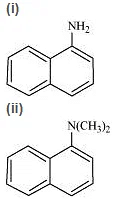
(iii) (C2H5)2CHNH2
(iv) (C2H5)2NH
Ans: Primary: (i) and (iii)
Secondary: (iv)
Tertiary: (ii)
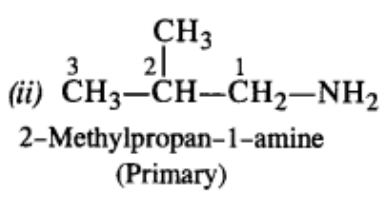
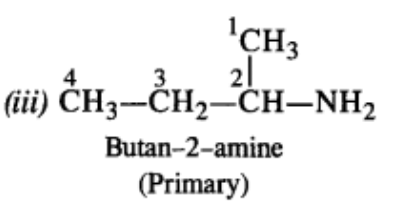
Q9.2: (i) Write structures of different isomeric amines corresponding to the molecular formula, C4H11N.
(ii) Write IUPAC names of all the isomers.
(iii) What type of isomerism is exhibited by different pairs of amines?
Ans: (i), (ii) The structures and their IUPAC names of different isomeric amines corresponding to the molecular formula, C4H11N are given below: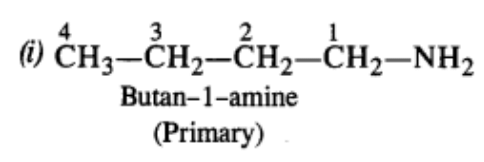
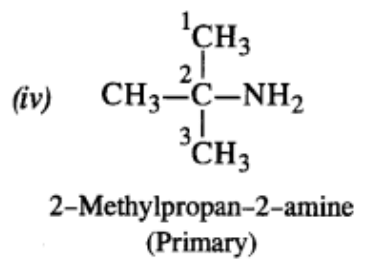
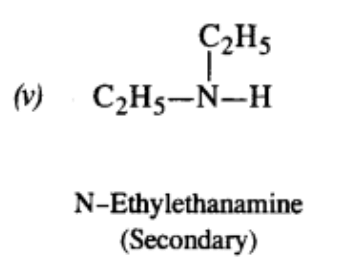
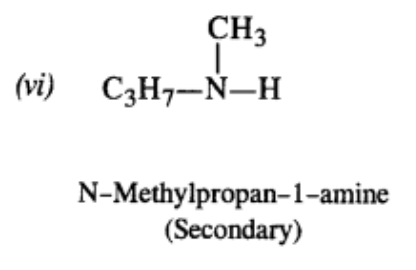
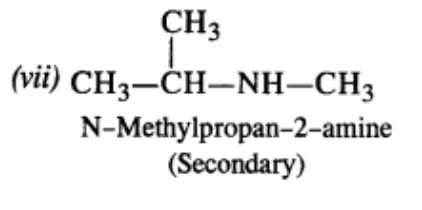
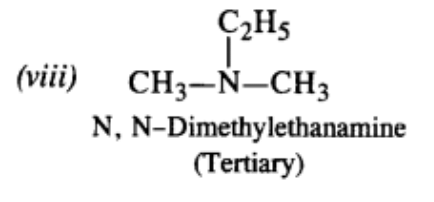
(iii) Isomerism exhibited by different amines
- Chain isomers: (i) and (ii) ; (iii) and (iv) ; (i) and (iv)
- Position isomers: (ii) and (iii) ; (ii) and (iv)
- Metamers: (v) and (vi) ; (vii) and (viii)
- Functional isomers: All three types of amines are the functional isomers of each other.
All primary amines exhibit functional isomerism with secondary and tertiary amines and vice-versa.
Page No.265 - Intext Questions
Q9.3: How will you convert?
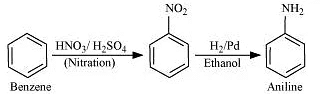
(i) Benzene into aniline
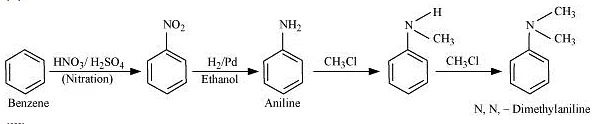
(ii) Benzene into N, N-dimethylaniline
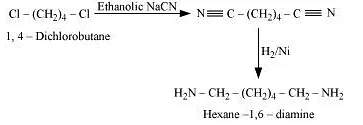
(iii) Cl−(CH2)4−Cl into hexan-1, 6-diamine?
Ans: (i)
(ii)
(iii)
Page No.274 - Intext Questions
Q9.4: Arrange the following in increasing order of their basic strength:
(i) C2H5NH2, C6H5NH2, NH3, C6H5CH2NH2 and (C2H5)2NH
(ii) C2H5NH2, (C2H5)2NH, (C2H5)3N, C6H5NH2
(iii) CH3NH2, (CH3)2NH, (CH3)3N, C6H5NH2, C6H5CH2NH2.
Ans: (i) Considering the inductive effect of alkyl groups, NH3, C2H5NH2, and (C2H5)2NH can be arranged in the increasing order of their basic strengths as:
NH3 < C2H5NH2 < (C2H5)2NH
Again, C6H5NH2 has proton acceptability less than NH3. Thus, we have:

Due to the −I effect of C6H5 group, the electron density on the N-atom in C6H5CH2NH2 is lower than that on the N-atom in C2H5NH2, but more than that in NH3. Therefore, the given compounds can be arranged in the order of their basic strengths as:

(ii) Considering the inductive effect and the steric hindrance of the alkyl groups, C2H5NH2, (C2 H5)2NH2, and their basic strengths as follows:

Again, due to the −R effect of C6H5 group, the electron density on the N atom in C6H5 NH2 is lower than that on the N atom in C2H5NH2. Therefore, the basicity of C6H5NH2is lower than that of C2H5NH2. Hence, the given compounds can be arranged in the increasing order of their basic strengths as follows:

(iii) Considering the inductive effect and the steric hindrance of alkyl groups, CH3NH2, (CH3)2NH, and (CH3)3N can be arranged in the increasing order of their basic strengths as:

In C6H5NH2, N is directly attached to the benzene ring. Thus, the lone pair of electrons on the N−atom is delocalized over the benzene ring. In C6H5CH2NH2, N is not directly attached to the benzene ring. Thus, its lone pair is not delocalized over the benzene ring. Therefore, the electrons on the N atom are more easily available for protonation in C6H5CH2NH2 than in C6H5NH2 i.e., C6H5CH2NH2 is more basic than C6H5NH2.
Again, due to the −I effect of C6H5 group, the electron density on the N−atom in C6H5CH2NH2 is lower than that on the N−atom in (CH3)3N. Therefore, (CH3)3N is more basic than C6H5CH2NH2. Thus, the given compounds can be arranged in the increasing order of their basic strengths as follows.

Q9.5: Complete the following acid-base reactions and name the products:
(i) CH3CH2CH2NH2 + HCl
(ii) (C2H5)3N HCl
Ans: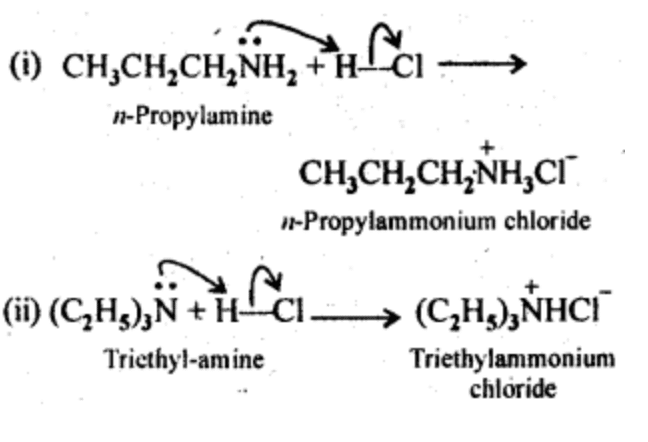
Q9.6: Write reactions of the final alkylation product of aniline with excess of methyl iodide in the presence of sodium carbonate solution.
Ans: Aniline reacts with methyl iodide to produce N, N-dimethylaniline.
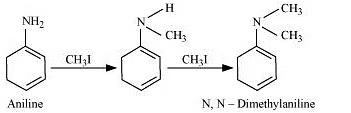
With excess methyl iodide, in the presence of Na2CO3 solution, N, N-dimethylaniline produces N, N, N−trimethylanilinium carbonate. 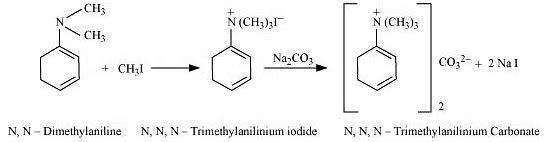
Q9.7: Write chemical reaction of aniline with benzoyl chloride and write the name of the product obtained.
Ans:
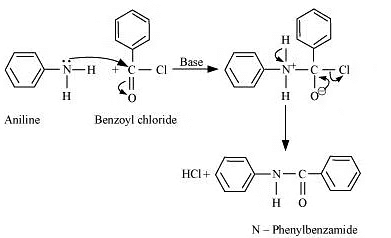
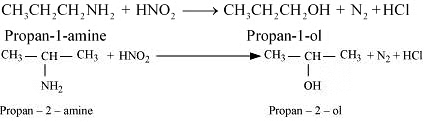
Q9.8: Write structures of different isomers corresponding to the molecular formula, C3H9N. Write IUPAC names of the isomers which will liberate nitrogen gas on treatment with nitrous acid.
Ans: The structures of different isomers corresponding to the molecular formula, C3H9N are given below:
(a) CH3-CH2-CH2-NH2
Propan-1-amine (10)
(b)
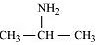
Propan-2-amine (10)
(c)
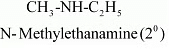
(d)

N,N-Dimethylmethanamine (30)
10amines, (a) propan-1-amine, and (b) Propan-2-amine will liberate nitrogen gas on treatment with nitrous acid.
Page No.277 - Intext Questions
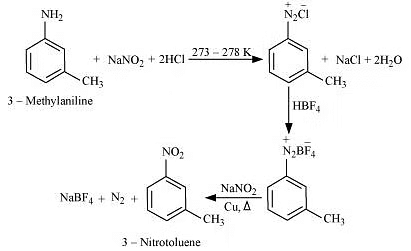
Q9.9: Convert
(i) 3-Methylaniline into 3-nitrotoluene.
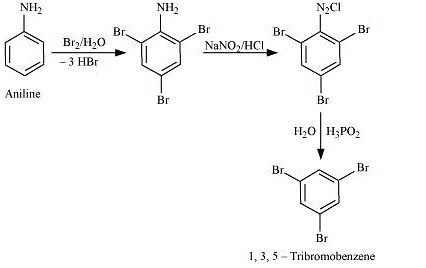
(ii) Aniline into 1,3,5-tribromobenzene.
Ans:- (i)
(ii)
Exercises
Q9.1: Write IUPAC names of the following compounds and classify them into primary, secondary and tertiary amines.
(i) (CH3)2 CHNH2
(ii) CH3(CH2)2NH2
(iii) CH3NHCH(CH3)2
(iv) (CH3)3CNH2
(v) C6H5NHCH3
(vi) (CH3CH2)2NCH3
(vii) m−BrC6H4NH2
Ans:
(i) IUPAC Name: Propan-2-amine
Classification: Primary amine (since it has one alkyl group attached to the nitrogen atom.
(ii) IUPAC Name: Propan-1-amine
Classification: Primary amine (since it has one alkyl group attached to the nitrogen atom)
(iii) IUPAC Name: N-methylpropan-2-amine
Classification: Secondary amine (since it has two alkyl groups attached to the nitrogen atom)
(iv) IUPAC Name: 2-Methylpropan-2-amine
Classification: Primary amine (since it has one alkyl group attached to the nitrogen atom)
(v) IUPAC Name: N-methylbenznamine (or N-methyl aniline)
Classification: Secondary amine (since it has two groups attached to the nitrogen atom — one is a phenyl group, and the other is a methyl group)
(vi) IUPAC Name: N-Ethyl-N-methylethanamine
Classification: Tertiary amine (since it has two alkyl groups attached to the nitrogen atom)
(vii) IUPAC Name: 3-Bromobenzenamine or 3-bromoaniline
Classification: Primary amine (since it has only one group, the phenyl group, attached to the nitrogen atom)
Q9.2: Give one chemical test to distinguish between the following pairs of compounds.
(i) Methylamine and dimethylamine
(ii) Secondary and tertiary amines
(iii) Ethylamine and aniline
(iv) Aniline and benzylamine
(v) Aniline and N-methylaniline.
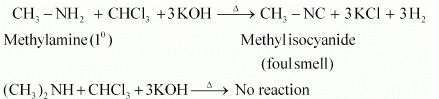
Ans: (i) Methylamine and dimethylamine can be distinguished by the carbylamine test.
Carbylamine test: Aliphatic and aromatic primary amines on heating with chloroform and ethanolic potassium hydroxide form foul-smelling isocyanides or carbylamines. Methylamine (being an aliphatic primary amine) gives a positive carbylamine test, but dimethylamine does not.
(ii) Secondary and tertiary amines can be distinguished by reacting with Hinsberg's reagent (benzene sulphonyl chloride, C6H5SO2Cl).
- Secondary amines react with Hinsberg’s reagent to form a soluble sulphonamide.
- Tertiary amines do not react with Hinsberg’s reagent, so no sulphonamide is formed.

(iii) Ethylamine and aniline can be distinguished using the azo-dye test.
- Aniline (C6H5NH2) reacts with sodium nitrite (NaNO2) and an acid (like hydrochloric acid) to form an azo dye, which is a brightly colored compound.
- Ethylamine (C2H5NH2) does not form an azo dye in the same conditions, as it does not react in the same way as aniline does.
Thus, the formation of the azo dye can be used to distinguish between ethylamine and aniline.

(iv) Aniline and benzylamine can be distinguished by their reactions with nitrous acid (HNO2).
Aniline (C6H5NH2) reacts with HNO2 at a low temperature to form stable diazonium salt. Thus, nitrogen gas is not evolved.
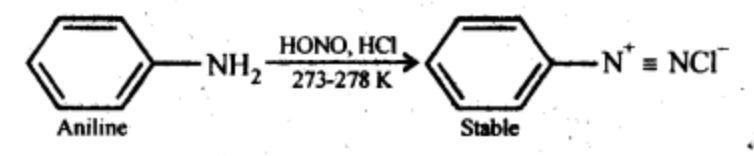
Benzylamine (C6H5CH2NH2), however, reacts with nitrous acid to form a benzenesulfonic acid derivative or a different reaction product rather than a diazonium salt, because the amino group is attached to a -CH2 group, which is not directly part of the aromatic ring. In this evolution of N<2 < gas is noticed.

(v) Aniline and N-methylaniline can be distinguished using the Carbylamine test. Primary amines, on heating with chloroform and ethanolic potassium hydroxide, form foul-smelling isocyanides or carbylamines. Aniline, being an aromatic primary amine, gives positive carbylamine test. However, N-methylaniline, being a secondary amine does not.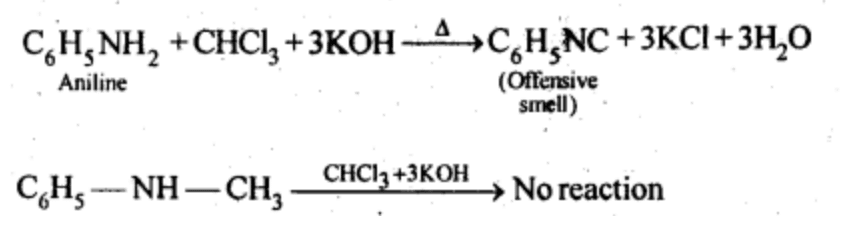
Q9.3: Account for the following:
(i) pKb of aniline is more than that of methylamine.
(ii) Ethylamine is soluble in water whereas aniline is not.
(iii) Methylamine in water reacts with ferric chloride to precipitate hydrated ferric oxide.
(iv) Although amino group is o, p− directing in aromatic electrophilic substitution reactions, aniline on nitration gives a substantial amount of m-nitroaniline.
(v) Aniline does not undergo Friedel-Crafts reaction.
(vi) Diazonium salts of aromatic amines are more stable than those of aliphatic amines.
(vii) Gabriel phthalimide synthesis is preferred for synthesising primary amines.
Ans:
(i) pKb of aniline is more than that of methylamine:
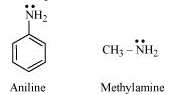
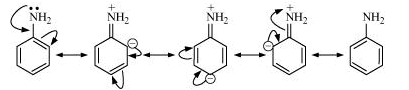
Aniline undergoes resonance and as a result, the electrons on the N-atom are delocalized over the benzene ring. Therefore, the electrons on the N-atom are less available to donate.
On the other hand, in case of methylamine (due to the I effect of methyl group), the electron density on the N-atom is increased. As a result, aniline is less basic than methylamine. Thus, pKb of aniline is more than that of methylamine.
(ii) Ethylamine is soluble in water whereas aniline is not:
Ethylamine when added to water forms intermolecular H−bonds with water. Hence, it is soluble in water.
 Ethylamine
But aniline does not undergo H−bonding with water to a very large extent due to the presence of a large hydrophobic −C6H5 group. Hence, aniline is insoluble in water.

(iii) Methylamine in water reacts with ferric chloride to precipitate hydrated ferric oxide:
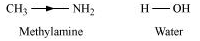
Due to the I effect of −CH3 group, methylamine is more basic than water. Therefore, in water, methylamine produces OH− ions by accepting H ions from water.

Ferric chloride (FeCl3) dissociates in water to form Fe3 and Cl− ions.

Then, OH− ion reacts with Fe3+ ion to form a precipitate of hydrated ferric oxide.
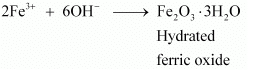
(iv) Although amino group is o,p− directing in aromatic electrophilic substitution reactions, aniline on nitration gives a substantial amount of m-nitroaniline:
Nitration is usually carried out with a mixture of conc. HNO3 and conc. H2SO4. In presence of these acids, most of aniline gets protonated to form anilinium ion. Therefore, in presence of acids, the reaction mixture consist of aniline and anilinium ion. Now, -NH2 group in aniline is activating and o, p-directing while the -+NH3 group in anilinium ion is deactivating : Nitration of aniline (due to steric hindrance at o-position) mainly gives p-nitroaniline, the nitration of anilinium ion gives m-nitroaniline. In actual practice, approx a 1:1 mixture of p-nitroaniline and m-nitroaniline is obtained. Thus, nitration of aniline gives a substantial amount of m-nitroaniline due to protonation of the amino group.
For this reason, aniline on nitration gives a substantial amount of m-nitroaniline.
(v) Aniline does not undergo Friedel-Crafts reaction:
A Friedel-Crafts reaction is carried out in the presence of AlCl3. But AlCl3 is acidic in nature, while aniline is a strong base. Thus, aniline reacts with AlCl3 to form a salt (as shown in the following equation).
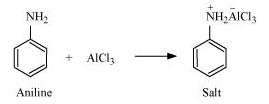
Due to the positive charge on the N-atom, electrophilic substitution in the benzene ring is deactivated. Hence, aniline does not undergo the Friedel-Crafts reaction.
(vi) Diazonium salts of aromatic amines are more stable than those of aliphatic amines:
The diazonium ion undergoes resonance as shown below:
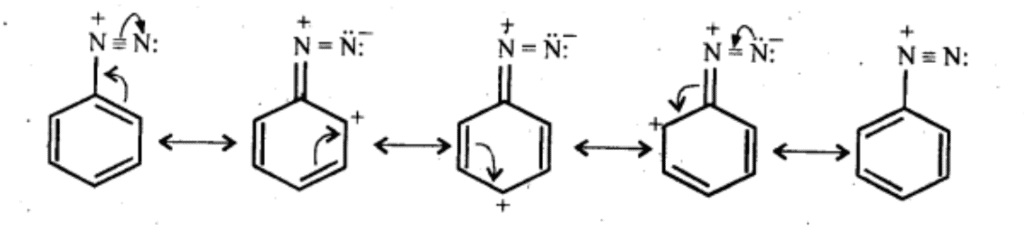
This resonance accounts for the stability of the diazonium ion. Hence, diazonium salts of aromatic amines are more stable than those of aliphatic amines.
(vii) Gabriel phthalimide synthesis is preferred for synthesizing primary amines:
Gabriel phthalimide synthesis results in the formation of 1° amine only. 2° or 3° amines are not formed in this synthesis. Thus, a pure 1° amine can be obtained. Therefore, Gabriel phthalimide synthesis is preferred for synthesizing primary amines.
Q9.4: Arrange the following:
(i) In decreasing order of the pKbvalues: C2H5NH2, C6H5NHCH3, (C2H5)2NH and C6H5NH2
(ii) In increasing order of basic strength: C6H5NH2, C6H5N(CH3)2, (C2H5)2NH and CH3NH2
(iii) In increasing order of basic strength:
(a) Aniline, p-nitroaniline and p-toluidine
(b) C6H5NH2, C6H5NHCH3, C6H5CH2NH2.
(iv) In decreasing order of basic strength in gas phase: C2H5NH2, (C2H5)2NH, (C2H5)3N and NH3
(v) In increasing order of boiling point: C2H5OH, (CH3)2NH, C2H5NH2
(vi) In increasing order of solubility in water: C6H5NH2, (C2H5)2NH, C2H5NH2.
Ans: (i) IDue to delocalisation of lone pair of electrons of the N-atom over the benzene ring,C6H5NH2 and C6H5NHCH3 are far less basic than C2H5NH2 and (C2H,)2NH. Due to +I-effect of the -CH3 group, C6H5NHCH3 is little more basic that C6H5NH2. Among C2H5NH2 and (C2H5)2NH, (C2H5)2NH is more basic than C2H5NH2 due to greater+I-effect of two -C2H5 groups. Therefore correct order of decreasing pKb values is:

(ii) C6H5N(CH3)2 is more basic than C6H5NH2 due to the presence of the +I effect of two −CH3 groups in C6H5N(CH3)2. Further, CH3NH2 contains one −CH3 group while (C2H5)2NH contains two −C2H5 groups. Thus, (C2H5)2 NH is more basic than C2H5NH2.
Now, C6H5N(CH3)2 is less basic than CH3NH2 because of the−R effect of −C6H5 group.
Hence, the increasing order of the basic strengths of the given compounds is as follows:
C6H5NH2 < C6H5N(CH3)2 < CH3NH2 < (C2H5)2NH
(iii) (a)
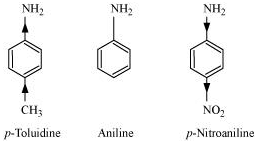
In p-toluidine, the presence of electron-donating −CH3 group increases the electron density on the N-atom.
Thus, p-toluidine is more basic than aniline.
On the other hand, the presence of electron-withdrawing
−NO2 group decreases the electron density over the N−atom in p-nitroaniline. Thus, p-nitroaniline is less basic than aniline.
Hence, the increasing order of the basic strengths of the given compounds is as follows:
p-Nitroaniline < Aniline < p-Toluidine
(b) C6H5NHCH3 is more basic than C6H5NH2 due to the presence of electron-donating −CH3 group in C6H5NHCH3.
Again, in C6H5NHCH3, −C6H5 group is directly attached to the N-atom. However, it is not so in C6H5CH2NH2. Thus, in C6H5NHCH3, the −R effect of −C6H5 group decreases the electron density over the N-atom. Therefore, C6H5CH2NH2 is more basic than C6H5NHCH3.
Hence, the increasing order of the basic strengths of the given compounds is as follows:
C6H5NH2 < C6H5NHCH3 < C6H5CH2NH2.
(iv) In the gas phase, there is no solvation effect. As a result, the basic strength mainly depends upon the I effect. The higher the I effect, the stronger is the base. Also, the greater the number of alkyl groups, the higher is the I effect. Therefore, the given compounds can be arranged in the decreasing order of their basic strengths in the gas phase as follows:
(C2H5)3N > (C2H5)2NH > C2H5NH2 > NH3
(v) The boiling points of compounds depend on the extent of H-bonding present in that compound. The more extensive the H-bonding in the compound, the higher is the boiling point. (CH3)2NH contains only one H−atom whereas C2H5NH2 contains two H-atoms. Then, C2H5NH2 undergoes more extensive H-bonding than (CH3)2NH. Hence, the boiling point of C2H5NH2 is higher than that of (CH3)2NH.
Further, O is more electronegative than N. Thus, C2H5OH forms stronger H−bonds than C2H5NH2. As a result, the boiling point of C2H5OH is higher than that of C2H5NH2and (CH3)2NH.
Now, the given compounds can be arranged in the increasing order of their boiling points as follows:
(CH3)2NH < C2H5NH2 < C2H5OH
(vi) The more extensive the H−bonding, the higher is the solubility. C2H5NH2 contains two H-atoms whereas (C2H5)2NH contains only one H-atom. Thus, C2H5NH2undergoes more extensive H−bonding than (C2H5)2NH. Hence, the solubility in water of C2H5NH2 is more than that of (C2H5)2NH.
Further, the solubility of amines decreases with increase in the molecular mass. This is because the molecular mass of amines increases with an increase in the size of the hydrophobic part. The molecular mass of C6H5NH2 is greater than that of C2H5NH2 and (C2H5)2NH.
Hence, the increasing order of their solubility in water is as follows:
C6H5NH2 < (C2H5)2NH < C2H5NH2
Q9.5: How will you convert:
(i) Ethanoic acid into methanamine
(ii) Hexanenitrile into 1-aminopentane
(iii) Methanol to ethanoic acid
(iv) Ethanamine into methanamine
(v) Ethanoic acid into propanoic acid
(vi) Methanamine into ethanamine
(vii) Nitromethane into dimethylamine
(viii) Propanoic acid into ethanoic acid
Ans: (i)
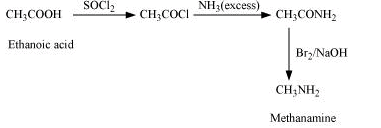
(ii)
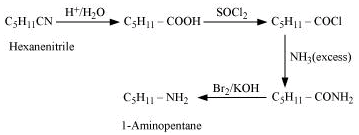
(iii)
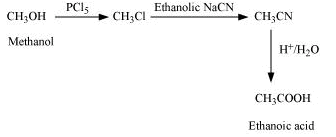
(iv)
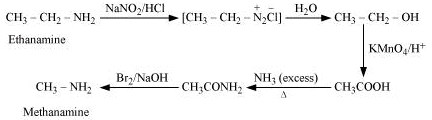
(v)
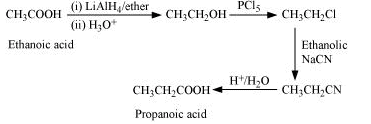
(vi)
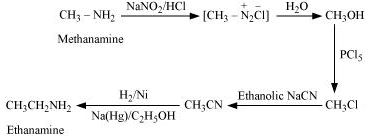
(vii)
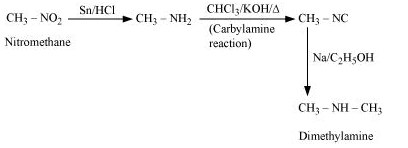
(viii)
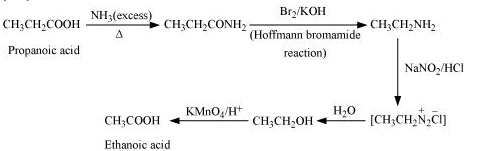
Q9.6: Describe a method for the identification of primary, secondary and tertiary amines. Also write chemical equations of the reactions involved.
Ans: Primary, secondary and tertiary amines can be identified and distinguished by Hinsberg’s test. In this test, the amines are allowed to react with Hinsberg’s reagent, benzenesulphonyl chloride (C6H5SO2Cl). The three types of amines react differently with Hinsberg’s reagent. Therefore, they can be easily identified using Hinsberg’s reagent.
Primary amines react with benzenesulphonyl chloride to form N-alkylbenzenesulphonyl amide which is soluble in alkali.
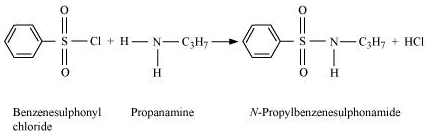
Due to the presence of a strong electron-withdrawing sulphonyl group in the sulphonamide, the H−atom attached to nitrogen can be easily released as proton. So, it is acidic and dissolves in alkali.
Secondary amines react with Hinsberg’s reagent to give a sulphonamide which is insoluble in alkali.
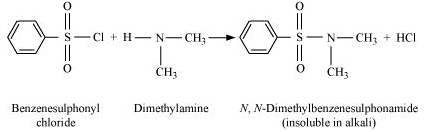
There is no H−atom attached to the N-atom in the sulphonamide.Therefore, it is not acidic and insoluble in alkali
On the other hand, tertiary amines do not react with Hinsberg’s reagent at all.
Q9.7: Write short notes on the following:
(i) Carbylamine reaction
(ii) Diazotisation
(iii) Hofmann’s bromamide reaction
(iv) Coupling reaction
(v) Ammonolysis
(vi) Acetylation
(vii) Gabriel phthalimide synthesis.
Ans: (i) Carbylamine reaction
Carbylamine reaction is used as a test for the identification of primary amines. When aliphatic and aromatic primary amines are heated with chloroform and ethanolic potassium hydroxide, carbylamines (or isocyanides) are formed. These carbylamines have very unpleasant odours. Secondary and tertiary amines do not respond to this test.

For example,

(ii) Diazotisation
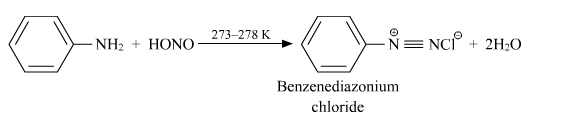
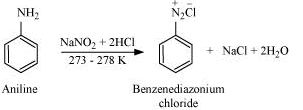
Aromatic primary amines react with nitrous acid (prepared in situ from NaNO2 and a mineral acid such as HCl) at low temperatures (273-278 K) to form diazonium salts. This conversion of aromatic primary amines into diazonium salts is known as diazotization.
For example, on treatment with NaNO2 and HCl at 273−278 K, aniline produces benzenediazonium chloride, with NaCl and H2O as by-products.
(iii) Hoffmann bromamide reaction
When an amide is treated with bromine in an aqueous or ethanolic solution of sodium hydroxide, a primary amine with one carbon atom less than the original amide is produced. This degradation reaction is known as Hoffmann bromamide reaction. This reaction involves the migration of an alkyl or aryl group from the carbonyl carbon atom of the amide to the nitrogen atom.

For example,


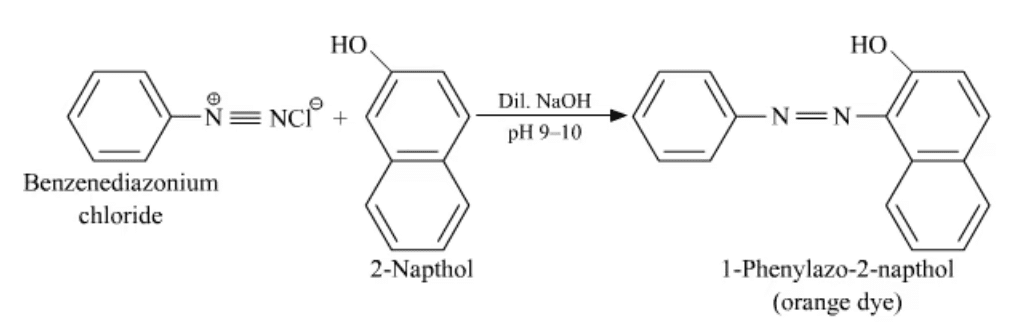
(iv) Coupling reaction
The reaction of joining two aromatic rings through the −N=N−bond is known as coupling reaction. Arenediazonium salts such as benzene diazonium salts react with phenol or aromatic amines to form coloured azo compounds.
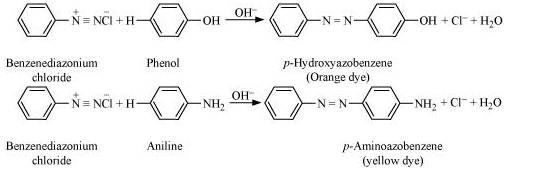
It can be observed that, the para-positions of phenol and aniline are coupled with the diazonium salt. This reaction proceeds through electrophilic substitution.
(v) Ammonolysis
When an alkyl or benzyl halide is allowed to react with an ethanolic solution of ammonia, it undergoes nucleophilic substitution reaction in which the halogen atom is replaced by an amino (−NH2) group. This process of cleavage of the carbon-halogen bond is known as ammonolysis.
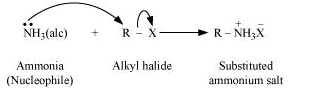
When this substituted ammonium salt is treated with a strong base such as sodium hydroxide, amine is obtained.

Though primary amine is produced as the major product, this process produces a mixture of primary, secondary and tertiary amines, and also a quaternary ammonium salt as shown.

(vi) Acetylation

Acetylation (or ethanoylation) is the process of introducing an acetyl group into a molecule.
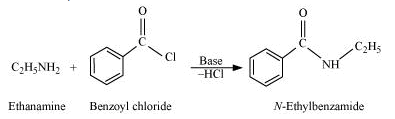
Aliphatic and aromatic primary and secondary amines undergo acetylation reaction by nucleophilic substitution when treated with acid chlorides, anhydrides or esters. This reaction involves the replacement of the hydrogen atom of −NH2 or > NH group by the acetyl group, which in turn leads to the production of amides. To shift the equilibrium to the right hand side, the HCl formed during the reaction is removed as soon as it is formed. This reaction is carried out in the presence of a base (such as pyridine) which is stronger than the amine.
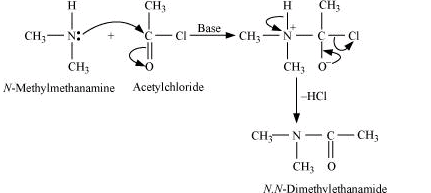
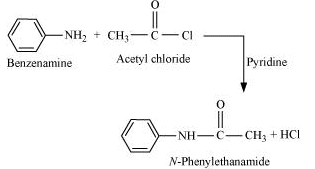
When amines react with benzoyl chloride, the reaction is also known as benzoylation.
For example,
(vii) Gabriel phthalimide synthesis
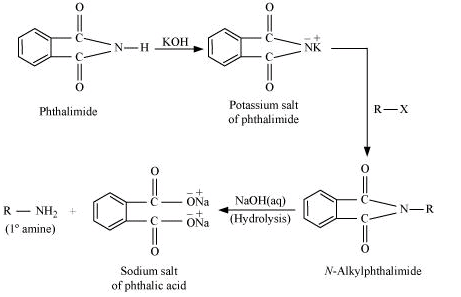
Gabriel phthalimide synthesis is a very useful method for the preparation of aliphatic primary amines. It involves the treatment of phthalimide with ethanolic potassium hydroxide to form potassium salt of phthalimide. This salt is further heated with alkyl halide, followed by alkaline hydrolysis to yield the corresponding primary amine.
Q9.8: Accomplish the following conversions:
(i) Nitrobenzene to benzoic acid
(ii) Benzene to m-bromophenol
(iii) Benzoic acid to aniline
(iv) Aniline to 2,4,6-tribromofluorobenzene
(v) Benzyl chloride to 2-phenylethanamine
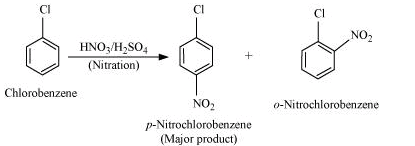
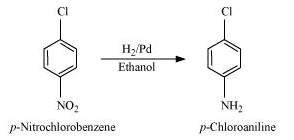
(vi) Chlorobenzene to p-chloroaniline
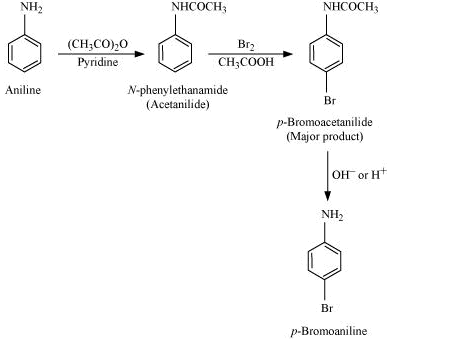
(vii) Aniline to p-bromoaniline
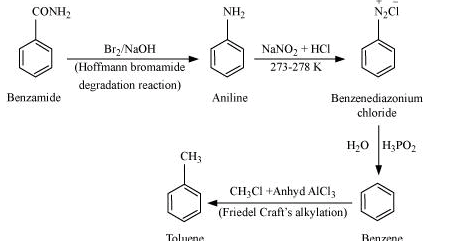
(viii) Benzamide to toluene
(ix) Aniline to benzyl alcohol.
Ans: (i)
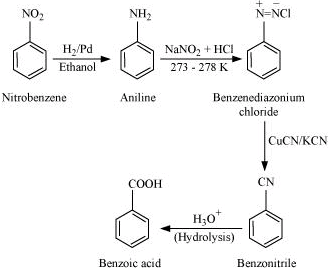
(ii)
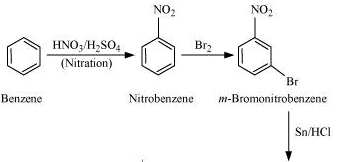
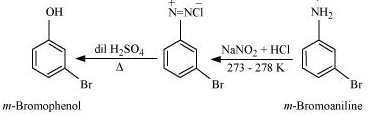
(iii)
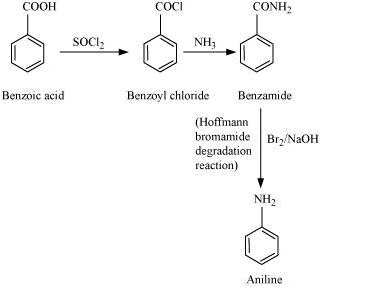
(iv)
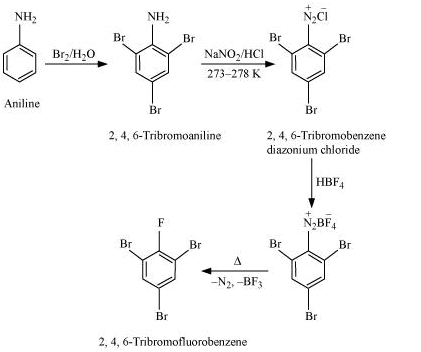
(v)
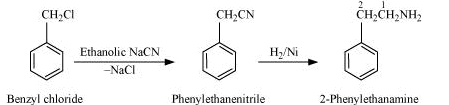
(vi)
(vii)
(viii)
(ix)
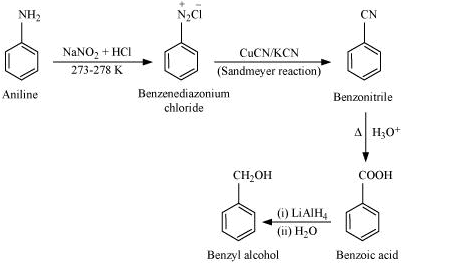
Q9.9: Give the structures of A, B and C in the following reactions:
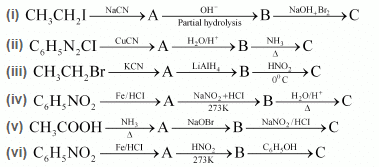
Ans: (i)
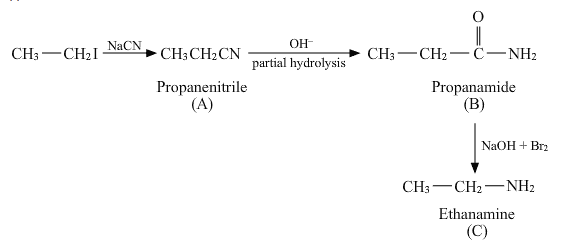
(ii)
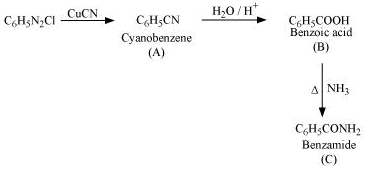
(iii)
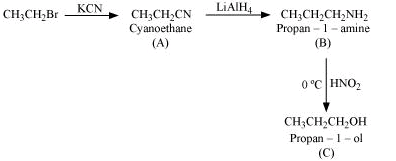
(iv)
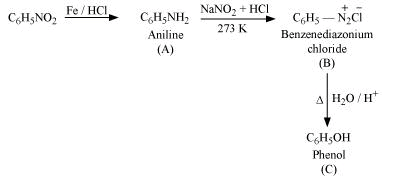
(v)
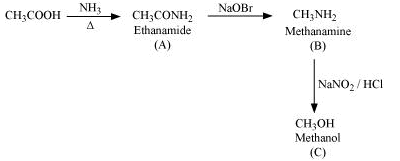
(vi)
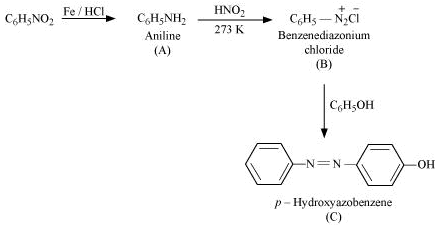
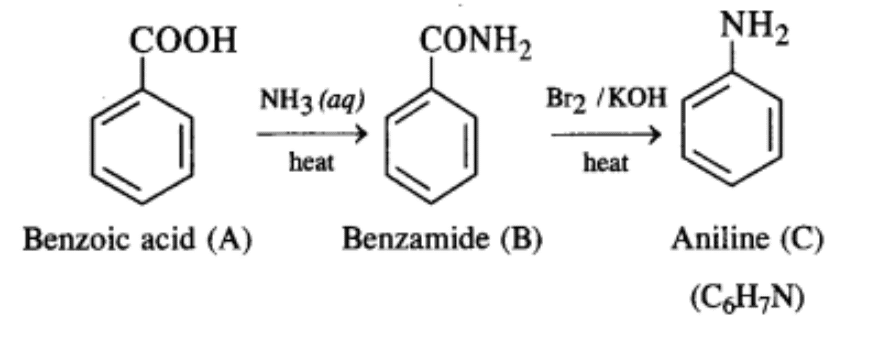
Q9.10: An aromatic compound ‘A’ on treatment with aqueous ammonia and heating forms compound ‘B’ which on heating with Br2 and KOH forms a compound ‘C’ of molecular formula C6H7N. Write the structures and IUPAC names of compounds A, B and C.
Ans: From the available information, we find that ‘B’ upon heating with Br2 and KOH forms a compound ‘C’. The compound ‘B’ is
expected to be an acid amide. Since ‘B’ has been formed upon heating compound ‘A’ with aqueous ammonia, the compound ‘A’ is an aromatic acid.
It is benzoic acid. The reactions involved are given as follows:
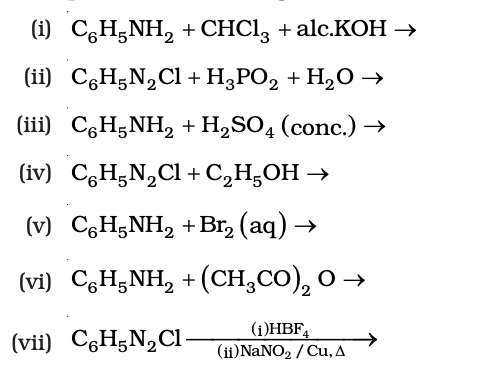
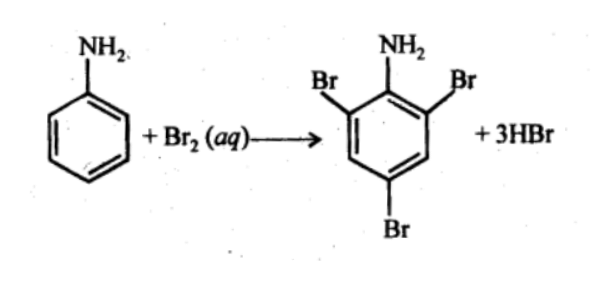
Q9.11: Complete the following reactions:
Ans: (i)

(ii)
(iii)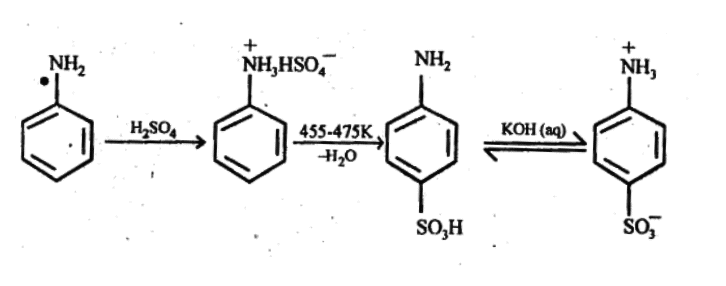
(iv)
(v)
 (vi)
(vi)
 (vii)
(vii)

Q9.12: Why cannot aromatic primary amines be prepared by Gabriel phthalimide synthesis?
Ans: Gabriel phthalimide synthesis is used for the preparation of aliphatic primary amines. It involves nucleophilic substitution (SN2) of alkyl halides by the anion formed by the phthalimide.
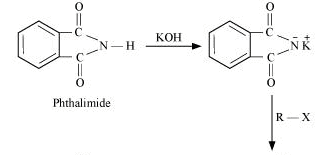
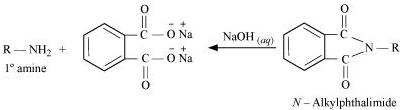
Since aryl halides do not undergo nucleophilic substitution reactions easily, therefore, arylamines, i.e., aromatic, primary amines cannot be prepared by Gabriel phthalimide reaction.
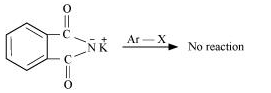
Hence, aromatic primary amines cannot be prepared by this process.
Q9.13: Write the reactions of (i) aromatic and (ii) aliphatic primary amines with nitrous acid.
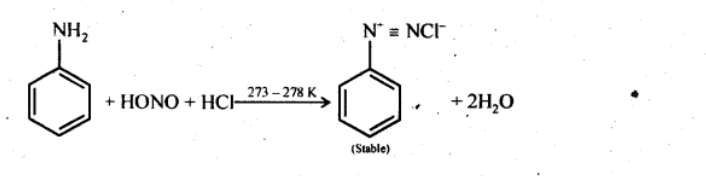
Ans: (i) Both aromatic and aliphatic primary amines react with HNO2 at 273-278 K to form aromatic and aliphatic diazonium salts respectively. But aliphatic diazonium salts are unstable even at this low temperature and thus decompose readily to form a mixture of compounds. Aromatic and aliphatic primary amines reacts with HNO2 as follows :

Q9.14: Give plausible explanation for each of the following:
(i) Why are amines less acidic than alcohols of comparable molecular masses?
(ii) Why do primary amines have higher boiling point than tertiary amines?
(iii) Why are aliphatic amines stronger bases than aromatic amines?
Ans: (i) Amines undergo protonation to give amide ion.

Similarly, alcohol loses a proton to give alkoxide ion.
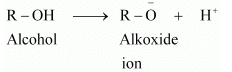
In an amide ion, the negative charge is on the N-atom whereas in alkoxide ion, the negative charge is on the O-atom. Since O is more electronegative than N, O can accommodate the negative charge more easily than N. As a result, the amide ion is less stable than the alkoxide ion. Hence, amines are less acidic than alcohols of comparable molecular masses.
(ii) In a molecule of tertiary amine, there are no H−atoms whereas in primary amines, two hydrogen atoms are present. Due to the presence of H−atoms, primary amines undergo extensive intermolecular H−bonding.
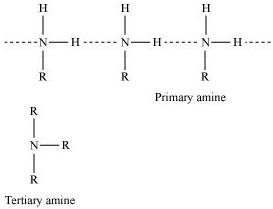
As a result, extra energy is required to separate the molecules of primary amines. Hence, primary amines have higher boiling points than tertiary amines.
(iii) Aromatic amines are far less basic than ammonia and aliphatic amines because of following reasons:
(a) Due to resonance in aniline and other aromatic amines, the lone pair of electrons on the nitrogen atom gets delocalised over the benzene ring and thus it is less easily available for protonation. Therefore, aromatic amines are weaker bases than ammonia and aliphatic amines.
(b) Aromatic amines are more stable than corresponding protonated ion; Hence, they have very less tendency to combine with a proton to form corresponding protonated ion, and thus they are less basic.
|
75 videos|278 docs|78 tests
|
FAQs on NCERT Solutions Class 12 Chemistry Chapter 9 - Amines
| 1. What are amines and what are their properties? |  |
| 2. How are amines classified? | |
| 3. What are some common uses of amines? | |
| 4. How are amines prepared? | |
| 5. What are some common reactions of amines? | |





Previous Year Questions with Solutions
,NCERT Solutions Class 12 Chemistry Chapter 9 - Amines
,Free
,practice quizzes
,mock tests for examination
,past year papers
,NCERT Solutions Class 12 Chemistry Chapter 9 - Amines
,shortcuts and tricks
,Objective type Questions
,Semester Notes
,Exam
,Viva Questions
,NCERT Solutions Class 12 Chemistry Chapter 9 - Amines
,ppt
,Sample Paper
,Summary
,Extra Questions
,MCQs
,study material
,video lectures
,Important questions
;



NCERT Solutions: Amines Free PDF Download
Importance of NCERT Solutions: Amines
NCERT Solutions: Amines Notes
NCERT Solutions: Amines NEET Questions
Study NCERT Solutions: Amines on the App
|
© EduRev
|
Education Revolution
|


|




within 7 days!